Allophones: The Hidden Variations in Human Speech
Have you ever noticed that the same letter can sound slightly different depending on the words around it? In the study of phonology—the branch of linguistics concerned with the systematic organization of sounds in languages—this phenomenon is known as an allophone. While we often think of sounds as fixed, the reality of human speech is much more fluid and complex.
An allophone is one of several possible spoken sounds, or phones, used to pronounce a single phoneme (the smallest unit of sound that distinguishes one word from another) in a specific language. While a native speaker might perceive a single sound, they are actually utilizing a variety of subtle acoustic variations.
Key Facts
- Allophones are variations of a single phoneme that do not change the meaning of a word.
- The term was coined by Benjamin Lee Whorf around 1929.
- Allophones can be predictable based on their phonetic context or occur through free variation.
- Replacing one allophone with another usually results in a non-native accent rather than a change in meaning.
- Native speakers are often unaware of these variations, sometimes even finding them surprising when pointed out.
Types of Allophonic Variation
Not all sound variations behave the same way. Linguists generally categorize allophones into two distinct types based on how they appear in speech.
Complementary Allophones
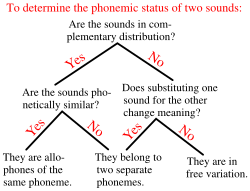
Complementary allophones are not interchangeable. They are predictable because each version appears only in specific phonetic environments. If a speaker were to use the "wrong" allophone in a specific context, it might sound unnatural or confuse the listener. This predictable pattern is known as complementary distribution.
Free-Variant Allophones
In contrast, free-variant allophones occur when a speaker chooses one sound over another by habit or personal preference, without the surrounding sounds dictating the choice. In these cases, the variation does not follow a strict rule of context.
Allophones in English: Real-World Examples
English provides a wealth of examples where allophones play a crucial role in natural pronunciation. One of the most common processes is aspiration. In English, the voiceless plosives /p/, /t/, and /k/ are aspirated—meaning they are accompanied by a strong burst of breath—when they appear at the beginning of a stressed syllable (as in "pin" [pʰɪn]). However, they are unaspirated when they follow an /s/ (as in "spin" [spɪn]).
Other common English allophonic processes include:
- Nasal plosion: A plosive becomes nasalized when followed by a nasal consonant.
- Retraction: The sounds /t/, /d/, /n/, and /l/ are retracted when they appear before an /r/.
- Flapping: In many American English dialects, the alveolar stop /t/ becomes a voiced tap [ɾ] between vowels, as in the word "water."
- Glottalization: Some speakers substitute a glottal stop [ʔ] for /t/ in words like "button."
| Language | Phoneme | Allophone Examples | Note |
|---|---|---|---|
| English | /t/ | [tʰ] (top), [t] (stop), [ɾ] (water) | Allophones in English |
| Central Thai | /t/ and /tʰ/ | Distinct sounds | Different phonemes |
| Spanish | /d/ | [d] (dolor), [ð] (nada) | Allophones in Spanish |
| English | /d/ and [ð] | Distinct sounds | Different phonemes |
Global Linguistic Perspectives
Allophonic variation is a universal feature of language, but the specific rules vary wildly across the globe. Languages with smaller phoneme inventories, such as Hawaiian or Pirahã, often exhibit significant allophonic variation to compensate.
For instance, in some Arabic dialects, [ɡ] and [q] serve as allophones. In certain dialects of Mandarin, [l] and [n] can be allophones. These variations demonstrate that what one culture perceives as a single, stable sound is actually a spectrum of phonetic possibilities.
How Linguists Represent Allophones
Because phonemes are abstract concepts rather than physical sounds, they do not have a single direct transcription. When linguists transcribe speech, they use broad transcription for general purposes. However, when precision is required, they use narrow transcription, employing diacritics to indicate specific allophonic details.
To decide which allophone best represents a phoneme in writing, linguists often use the "elsewhere condition." This convention selects the allophone that occurs in all contexts not covered by specific phonological rules. For example, in English, vowels are typically oral, and only become nasalized when preceding a nasal consonant; therefore, the oral version is treated as the primary representation.
Frequently Asked Questions
What is the difference between a phoneme and an allophone?
A phoneme is an abstract mental category of a sound that can change the meaning of a word (like /p/ vs /b/). An allophone is a physical variation of that sound that does not change the word's meaning.
Does using the wrong allophone make you unintelligible?
Usually, no. Using an incorrect allophone typically makes a speaker sound non-native or accented, but it rarely prevents a listener from understanding the intended word.
Why don't native speakers notice allophones?
Native speakers process language at a level of abstraction. Their brains are trained to categorize various physical sounds into single mental phonemes, making the subtle acoustic differences invisible to their conscious perception.
What is an allotone?
An allotone is a specific type of tonic allophone, such as the neutral tone used in Standard Mandarin.
Can allophones be predictable?
Yes. When an allophone's appearance is determined by the surrounding sounds, it is called a positional variant or is said to be in complementary distribution.