Alberto Fernández: A Political Journey Through Argentina's Presidency
Alberto Ángel Fernández is a prominent Argentine lawyer, academic, and politician who served as the President of Argentina from December 10, 2019, to December 10, 2023. His political trajectory is marked by a long association with the Justicialist Party and a series of high-ranking executive roles that paved the way for his leadership of the nation.
Before ascending to the presidency, Fernández established himself as a key political strategist and administrator, serving under multiple administrations and navigating the complex landscape of Argentine party politics.
Key Facts
- Presidential Term: Served as President of Argentina from 2019 to 2023.
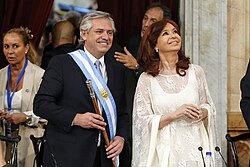
- Key Alliance: Ran as part of the Frente de Todos coalition with Cristina Fernández de Kirchner as Vice President.
- Early Executive Role: Served as Chief of the Cabinet of Ministers from 2003 to 2008.
- Party Leadership: Chaired the Justicialist Party from March 2021 to August 2024.
- Pandemic Response: Implemented one of the world's strictest lockdowns and was the first Latin American president to receive a COVID-19 vaccine.
Early Career and Rise to Power
Fernández's professional background is rooted in law and academia, having studied at the University of Buenos Aires. His early entry into high-level governance began in 1989 when he served as the Superintendent of Insurance under President Carlos Menem until 1995.
In 2000, he transitioned into legislative work as a Legislator for the City of Buenos Aires. However, he is perhaps best known for his tenure as the Chief of the Cabinet of Ministers, a role he held from May 25, 2003, to July 23, 2008, serving under Presidents Néstor Kirchner and Cristina Fernández de Kirchner.
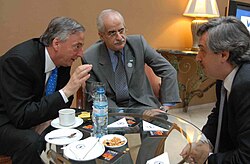
During his time as Chief of Cabinet, Fernández was a central figure in the administration's executive operations, eventually resigning in 2008 to allow Cristina Fernández de Kirchner more direct control over the government.

The Path to the Presidency
Following years of political maneuvering and affiliations with various groups—including the Renewal Front and the Front for Victory—Fernández emerged as the presidential candidate for the Frente de Todos in 2019. His campaign focused on a broad coalition to return the Peronist movement to power.
In the general elections, Fernández secured victory with 12,946,037 votes, representing 48.24% of the electorate. This victory ended the presidency of Mauricio Macri.
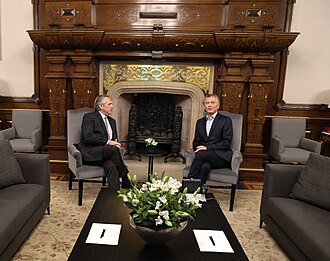
He was sworn in on December 10, 2019, with Cristina Fernández de Kirchner serving as his Vice President.
Presidential Term (2019–2023)
The presidency of Alberto Fernández was characterized by severe economic challenges and a global health crisis. His administration focused on debt restructuring and economic emergency laws to stabilize the nation's finances.
COVID-19 Pandemic Response
Shortly after taking office, Fernández faced the COVID-19 pandemic. He implemented a strict national lockdown to curb the spread of the virus. While the initial announcement was generally well-received, the prolonged measures sparked concerns regarding their economic impact.
![The announcement of the lockdown by Fernández was generally well received, although there were concerns with its economic impact.[98]](/images/6b/00/6b00c3b66f70d3309ca53ff0f2e9069bf6a669e6f3517cf1ec270b4c439ed4fa.jpg)
Fernández gained international attention on January 21, 2021, when he became the first president in Latin America to be vaccinated against COVID-19, receiving the Russian-made Sputnik V vaccine.

Foreign Relations and Diplomacy
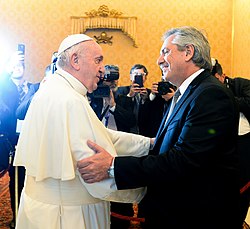
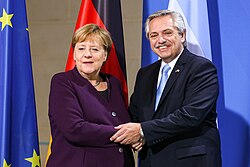
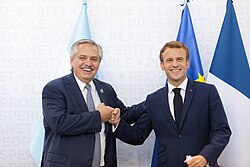
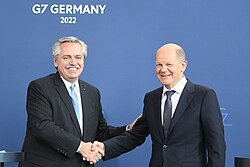
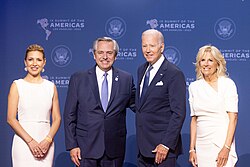
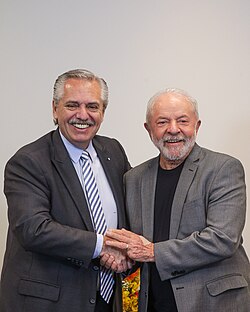
On the global stage, Fernández sought to maintain diverse diplomatic ties. He held meetings with various world leaders, including Pope Francis, German Chancellor Angela Merkel, and French President Emmanuel Macron. He also served as the president of CELAC (Community of Latin American and Caribbean States), advocating for a consensus-based approach to regional integration.
Challenges and Controversies
Fernández's term was not without friction. He faced significant criticism over economic instability, with inflation forecasts exceeding 100% by 2022. Public approval ratings declined over time, with some polls indicating high levels of disapproval toward his government.
Additionally, he faced controversies regarding his adherence to his own COVID-19 restrictions and sparked diplomatic tension with Brazil after comments regarding the origins of the Brazilian people. He also faced backlash for rejecting a Supreme Court ruling in late 2022.
Post-Presidency and Personal Life
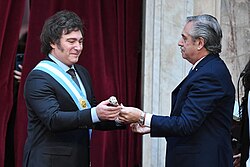
Alberto Fernández completed his term on December 10, 2023, handing over the government to his successor, Javier Milei.
In his personal life, Fernández has been married to Marcela Luchetti (divorced 2005) and had long-term partnerships with Vilma Ibarra and Fabiola Yáñez. He is a father of two children.
| Role | Period | President/Affiliation |
|---|---|---|
| Superintendent of Insurance | 1989–1995 | Carlos Menem |
| City Legislator (Buenos Aires) | 2000–2003 | Encounter for the City |
| Chief of the Cabinet of Ministers | 2003–2008 | Néstor & Cristina Kirchner |
| President of Argentina | 2019–2023 | Frente de Todos |
| President of Justicialist Party | 2021–2024 | Justicialist Party |
Frequently Asked Questions
Who succeeded Alberto Fernández as President of Argentina?
Alberto Fernández was succeeded by Javier Milei, to whom he handed over the government on December 10, 2023.
What was Fernández's role before becoming President?
He held several high-profile roles, most notably serving as the Chief of the Cabinet of Ministers from 2003 to 2008 and as a legislator for the City of Buenos Aires.
How did Alberto Fernández handle the COVID-19 pandemic?
He implemented a strict national lockdown and was the first Latin American president to receive a COVID-19 vaccine, specifically the Sputnik V dose.
Which political party is Alberto Fernández affiliated with?
He is primarily affiliated with the Justicialist Party, though he has been part of various coalitions including the Renewal Front and the Frente de Todos.
What were the main economic challenges during his presidency?
His administration struggled with high inflation, which was forecast to top 100% in 2022, and the economic fallout resulting from pandemic-era lockdowns.