Albatross as a Metaphor: From Coleridge to Modern Pop Culture
In common English parlance, an albatross is far more than a large seabird; it is a powerful metaphor for a psychological or social burden. Typically associated with feelings of guilt, shame, or a perceived curse, having an "albatross around one's neck" describes a heavy weight that a person cannot escape.
This enduring idiom is an allusion to Samuel Taylor Coleridge's 1798 poem, The Rime of the Ancient Mariner. In the narrative, a sailor brings misfortune upon his crew by killing an albatross. As a mark of his transgression and a symbol of his burden, a dead albatross is tied around his neck.
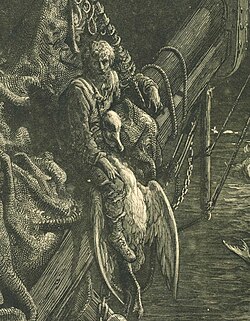
Key Facts
- Origin: Derived from Samuel Taylor Coleridge's 1798 poem The Rime of the Ancient Mariner.
- Meaning: A psychological or social burden, often linked to guilt or shame.
- Literary Reach: Referenced in works by Mary Shelley, Herman Melville, and Jules Verne.
- Cultural Presence: Widely used across modern film, television, music, and video games to signify a curse or inescapable responsibility.
Literary Evolution
Following Coleridge's poem, the albatross became a recurring motif in classic literature. In Mary Shelley's Frankenstein (1818), Robert Walton explicitly mentions the poem, stating he shall "kill no albatross" during his journey. Herman Melville also alluded to the symbol in his 1851 masterpiece, Moby-Dick.
Other authors used the bird to explore different themes. Charles Baudelaire's 1857 poem "L'Albatros" compares poets to the birds—majestic in the sky but clumsy and weighed down by their own "giant wings" when exiled to earth. In Jules Verne's Twenty Thousand Leagues Under the Seas (1870), the shooting of an albatross by a crewman precedes a series of misadventures for the characters.
The symbol's academic recognition grew over time, with the Oxford English Dictionary cataloging Coleridge's specific use of the term in 1883. Even in technical fields, the metaphor appears; for instance, Michael Spivak's A Comprehensive Introduction to Differential Geometry, Vol.2 features cover art depicting a jester with three albatrosses labeled "Cartan," "Riemann," and "Gauss," representing the weight of mathematical legacy.
The Albatross in Film and Television
Cinema and TV have frequently employed the albatross to signal a character's internal struggle or a looming curse. In The Adventures of Sherlock Holmes (1939), Professor Moriarty uses a drawing of a man with an albatross around his neck to bait Holmes. Similarly, in John Carpenter's The Fog (1979), the word is used to describe a curse haunting Antonio Bay.
Modern storytelling continues this trend. In the series The Handmaid's Tale, Serena Joy describes her former husband as "more of an Albatross," while in Boardwalk Empire, Nucky Thompson stays at a motel named "The Albatross," mirroring his mental burdens. Even in sci-fi, Joss Whedon's Serenity (2005) features Captain Malcolm Reynolds referring to River Tam as an albatross, explicitly referencing the Coleridge poem.
Summary of Notable Media References
| Medium | Work | Context of Use |
|---|---|---|
| Literature | Frankenstein | Robert Walton's vow to avoid the Mariner's mistake. |
| Film | Serenity | River Tam as a burden/luck symbol for the crew. |
| Television | The X-Files | Albatross St. as a symbol of Mulder's lifelong quest. |
| Video Games | BioShock Infinite | A vigor advertisement referencing the "hated albatross." |
| Music | Taylor Swift | Song titled "The Albatross" (2024). |
Influence on Music and Gaming
The albatross has inspired countless musical works, ranging from the atmospheric "Albatross" by Fleetwood Mac to Taylor Swift's 2024 track "The Albatross." Many artists use the bird as a lyrical shorthand for personal struggle; for example, Aaron Lewis sings about being an "albatross hanging around my own neck," and Gorillaz uses the term in "Hip Albatross" to describe the burden of the undead.
In the realm of interactive media, the metaphor appears in BioShock Infinite via a vigor dispenser and in Vampire: The Masquerade - Bloodlines, where Prince Sebastian Lacroix describes the burden of leadership as "wearing the albatross and the bullseye."
Frequently Asked Questions
What does it mean to have an albatross around your neck?
It means to carry a heavy psychological burden, such as guilt, shame, or a mistake from the past, that feels like a constant curse or obstacle.
Where did the phrase "albatross around my neck" originate?
The phrase originates from Samuel Taylor Coleridge's 1798 poem The Rime of the Ancient Mariner, where a sailor is forced to wear a dead albatross as punishment for killing the bird.
Is an albatross always a bad omen?
While the metaphor focuses on the burden, some interpretations vary. In the film White Squall, the captain notes that the bird is generally a good omen embodying the spirits of lost sailors, and only becomes bad luck if it is killed.
How is the albatross used in modern pop culture?
It is used across movies, TV shows, and songs to symbolize inescapable responsibility, emotional baggage, or a specific event that haunts a character's life.