Alan Freed: The Disc Jockey Who Popularized Rock and Roll
Before it became a global phenomenon, rock and roll was a niche sound emerging from the fringes of American music. While he did not coin the phrase, Alan Freed was the visionary disc jockey and promoter who brought the genre into the mainstream. Through his high-energy radio broadcasts and massive traveling concerts, Freed bridged cultural divides and helped define the sound of a generation.
Key Facts
- Role: Pioneer disc jockey, concert producer, and promoter.
- Major Contribution: Popularized the term "rock and roll" on mainstream radio in the early 1950s.
- Career Highlights: Hosted the TV series The Big Beat and worked at influential stations including WAKR, WJW, WINS, and WABC.
- Legacy: Inducted into the Rock and Roll Hall of Fame (1986) and the National Radio Hall of Fame (1988).
- Death: Passed away on January 20, 1965, at age 43.
Early Life and Musical Ambitions
Born Albert James Freed in Windber, Pennsylvania, to a Russian Jewish immigrant father and a Welsh-American mother, Freed grew up in Salem, Ohio. A talented musician in his youth, he played the trombone in a high school band called the Sultans of Swing. While he initially aspired to be a bandleader, a severe ear infection forced him to abandon those dreams, leading him toward the world of broadcasting.
The Rise of a Radio Star
The Akron Years at WAKR
Freed began his professional journey in June 1945 at WAKR in Akron, Ohio. Known as "The Old Knucklehead," he quickly became a local celebrity, hosting multiple daily programs including the Jukebox Serenade and Wax Works. However, his tenure was marked by friction with management. In 1948, he signed a contract with a strict non-compete clause that barred him from working within 75 miles of Akron for a year after leaving. When Freed attempted to join a competing station in 1950, he was sued by WAKR owner S. Bernard Berk. The resulting legal battle reached the Supreme Court of Ohio and established a lasting industry model for on-air talent contracts.
Breaking Through in Cleveland
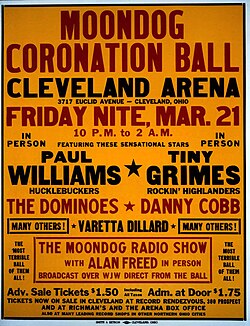
Freed's career shifted gears when he met Leo Mintz, owner of Record Rendezvous in Cleveland. Mintz noted a growing demand for rhythm and blues (R&B) records and encouraged Freed to play them on the air. After being released from his non-compete clause in 1951, Freed joined WJW radio. Using a theme song called "Moondog" and adopting "hipster" slang, he broadcast R&B hits to a wide audience, effectively introducing the sound of rock and roll to the mainstream.
Expanding the Influence: New York and Television
By July 1954, Freed's success led him to WINS in New York City. His influence expanded beyond radio into film and television. In 1957, he hosted The Big Beat on ABC. Despite strong ratings, the show was abruptly canceled after an episode featured African-American artist Frankie Lymon dancing with a white audience member, sparking an uproar among Southern affiliates.
Freed's time in New York was also marked by legal disputes. He was sued for $6,000 by a composer named Hardin, who claimed prior rights to the name "Moondog." Later, while working at WABC, Freed was fired in 1959 after refusing to sign a statement for the FCC denying that he had accepted payola—the illegal practice of taking bribes from record companies to play specific songs.
Downfall and Final Years
The payola scandal devastated Freed's reputation, making him unemployable at major stations. He moved to the West Coast in 1960 to work at KDAY in Santa Monica, and later to WQAM in Miami in 1962. Struggling with the decline of his career, Freed turned to heavy drinking.
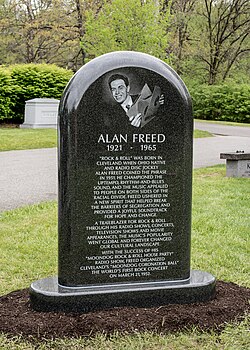
Alan Freed died on January 20, 1965, at the age of 43 in Palm Springs, California. The cause of death was uremia and cirrhosis resulting from alcoholism. At the time of his passing, he was also facing a $38,000 tax evasion audit from the IRS which he could not afford to pay.
Summary of Alan Freed's Career
| Period/Year | Station/Entity | Key Event/Role |
|---|---|---|
| 1945–1950 | WAKR (Akron) | Rose to fame as "The Old Knucklehead" |
| 1951 | WJW (Cleveland) | Popularized R&B and the term "rock and roll" |
| 1954–1958 | WINS (New York) | Expanded influence to the NYC market |
| 1957 | ABC Television | Hosted The Big Beat |
| 1958–1959 | WABC (New York) | Fired following the payola scandal |
| 1960–1965 | KDAY / WQAM | Final radio roles in California and Florida |
Frequently Asked Questions
Did Alan Freed invent the term "rock and roll"?
No, the term existed as early as the 1940s and was used by music critics like Maurie Orodenker in 1942. However, Alan Freed is credited with popularizing the phrase on mainstream radio and redefining it as a musical genre.
What was the payola scandal?
Payola refers to the practice of record labels paying disc jockeys to play certain records to increase their popularity. Freed was fired from WABC after refusing to sign a denial of these practices for the FCC.
Why was The Big Beat canceled?
Although the show had strong ratings, it was canceled following a controversy where African-American singer Frankie Lymon was seen dancing with a white audience member, which caused an uproar among ABC's Southern affiliates.
How is Alan Freed remembered today?
He is recognized as a pivotal figure in music history. He has been inducted into the Rock and Roll Hall of Fame, the National Radio Hall of Fame, and the National Rhythm & Blues Hall of Fame, and he has a star on the Hollywood Walk of Fame.