Al-Shuaibiyah Mosque: A Historic Monument of Aleppo
Located in the heart of the al-Aqabah district in Aleppo, Syria, the al-Shuaibiyah Mosque stands as a testament to the complex religious and political history of the Levant. Also known as the Qastal al-Shu'aybiyya, the al-Shu'aybiyya Madrasa, or popularly as the al-Tuteh Mosque (meaning "Mosque of the Mulberry tree"), this site is situated near the Antioch Gate within the Ancient City of Aleppo, a recognized UNESCO World Heritage Site.
The mosque is more than just a place of worship; it is a layered historical site that reflects the transition of power and faith in one of the world's oldest continuously inhabited cities.
Key Facts
- Location: Al-Aqabah district, Aleppo, Syria.
- Construction Date: Completed between 1150–1 CE.
- Founder: Built by the Zengid ruler Nur al-Din.
- Architectural Style: Islamic architecture with Classical influences.
- UNESCO Status: Part of the Ancient City of Aleppo World Heritage Site.
- Primary Material: Stone.
Historical Evolution
The current structure of the al-Shuaibiyah Mosque replaced an earlier building that held immense symbolic value. The original mosque on this site was the first in Aleppo, marking the exact spot where Muslims first prayed inside the city after capturing it from the Byzantines in 637.
Evidence suggests that the earliest construction may have incorporated a tetrapylon (a four-way arch structure) from the Roman or Byzantine era, which likely influenced the layout of subsequent buildings. In the 10th century, the site was renovated by Abu'l Hasan al-Ghadairi, a local Shi'a patron who died in 925.
A significant shift occurred between 1150 and 1151 when the Zengid ruler Nur al-Din transformed the site into a Sunni and Shafi'i madrasa (an Islamic educational institution). This madrasa was led by Shaykh Shu'ayb, an Andalusi jurist. This transformation was part of a broader political and religious campaign by Nur al-Din to promote Sunnism in Aleppo during a period of high tension between Shi'a and Sunni communities.
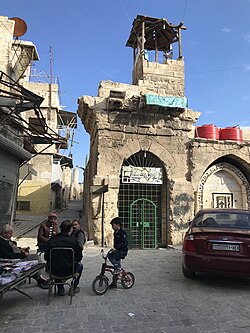
Architectural Significance
The al-Shuaibiyah Mosque is considered unusual within the realm of Islamic architecture. Today, the remaining structure is relatively small, consisting of a partially preserved façade, an entrance gate that once led to the now-lost madrasa, and a sabil (a public water fountain).
Classical Influences and the "Classical Revival"
The most striking feature of the building is its richly decorated entablature—the upper portion of the wall—which is executed in a Classical style. The stone-carved motifs closely imitate ancient Roman or Byzantine decorations, blending these ancient forms with an Arabic inscription from the Qur'an (Surah 9:18).
Because this decoration dates back to Nur al-Din's construction around 1150, it has sparked a scholarly debate regarding a possible "classical revival" in 12th-century Syrian architecture. While some historians see this as a deliberate revival, others, such as art historian Julian Raby, suggest that while classical motifs were common across the region, the motivations for using them varied by local context.
Site Summary
| Feature | Details |
|---|---|
| Alternative Names | Qastal al-Shu'aybiyya, al-Tuteh Mosque |
| Founder | Nur al-Din (Zengid Ruler) |
| Date of Completion | 1150–1 CE |
| World Heritage Site | Ancient City of Aleppo (Inscribed 1986) |
| Key Architectural Element | Classical-style entablature and sabil |
| Coordinates | 36°11′58″N 37°09′10″E |
Frequently Asked Questions
Why is the mosque also called the al-Tuteh Mosque?
It is popularly known as al-Tuteh, which translates literally to the "Mosque of the Mulberry tree."
Who was Nur al-Din and why did he rebuild the mosque?
Nur al-Din was a Zengid ruler (r. 1146–1174) who converted the site from a Shi'a mosque into a Sunni madrasa as part of a wider campaign to establish Sunni orthodoxy in Aleppo.
What makes the architecture of this mosque unusual?
The mosque is notable for its façade, which features stone-carved motifs imitating Roman and Byzantine Classical styles, blending ancient aesthetics with Islamic inscriptions.
Is the al-Shuaibiyah Mosque part of a protected area?
Yes, it is located within the Ancient City of Aleppo, which has been a UNESCO World Heritage Site since 1986, although it was listed as endangered from 2013 to 2020.
What remains of the original madrasa today?
Much of the original madrasa structure has disappeared; the primary remains are the partially preserved façade, the entrance gate, and the wall fountain (sabil).