Agustín Pedro Justo: The Presidency and Legacy of the Infamous Decade
Agustín Pedro Justo Rolón was a pivotal and controversial figure in 20th-century Argentine history. Serving as the 23rd President of Argentina from 1932 to 1938, his tenure defined a period known as the Infamous Decade (1930–1943). This era was characterized by a tension between modernization and systemic political corruption, as Justo navigated the economic wreckage of the Great Depression while maintaining power through questionable means.
Justo's rise to power was not a simple democratic transition. Having participated in the military coup of 1930, he ascended to the presidency two years later. His administration is remembered for a paradoxical blend of progressive social legislation and the implementation of patriotic fraud—a system of electoral manipulation designed to keep the Radical Civic Union (UCR) out of power.
Key Facts
- Presidency: Served as the 23rd President of Argentina from February 20, 1932, to February 20, 1938.
- Political Alliance: Led the Concordancia, a coalition of conservatives, independent socialists, and anti-personalist radicals.
- Economic Reforms: Established the Central Bank of the Argentine Republic and introduced a nationwide income tax.
- Social Contributions: Implemented paid vacations and a maternity leave insurance system.
- Military Rank: Attained the rank of Major General in the Argentine Army.
- Controversy: His administration was marked by the Roca-Runciman Treaty and widespread electoral fraud.
Early Life and Military Ascent
Born on February 26, 1876, in Concepción del Uruguay, Entre Ríos, Justo was the son of Agustín Justo, a former governor of Corrientes, and Otilia Rolón. His life was marked by a dual commitment to military discipline and academic achievement. At age 11, he entered the Colegio Militar de la Nación (National Military College), where he showed early political inclinations by participating in the Revolución del Parque as a cadet.
Justo did not limit himself to military training; he pursued a degree in civil engineering at the University of Buenos Aires. This technical expertise allowed him to specialize as a military engineer by 1904. Over the next two decades, he climbed the ranks from ensign to Major General, serving in various capacities including a diplomatic role as a military attaché in Chile during the 1910 centennial festivities.
The Path to the Presidency
Justo's political trajectory was accelerated by his appointment as Director of the Military College in 1915 and later as Minister of War in 1922 under President Marcelo Torcuato de Alvear. During his time as War Minister, he focused on reorganizing the armed forces and upgrading military infrastructure.
By 1930, Justo had aligned himself with the anti-personalist wing of the Radical party, opposing the leadership of Hipólito Yrigoyen. While he initially expressed reservations about military intervention in government, he eventually supported the coup of September 6, 1930, led by General José Félix Uriburu. However, Justo distanced himself from Uriburu's desire to replace the republican system with a corporative model similar to European fascism, preferring a more liberal, albeit controlled, republicanism.
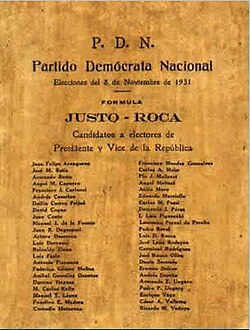
In the elections of November 8, 1931, Justo ran as the candidate for the Concordancia—an alliance comprising the National Democratic Party, the Independent Socialist Party, and the Anti-personalist Radical Civic Union. He won the presidency, though the victory was clouded by accusations of fraud, as Yrigoyen's supporters were largely banned or abstained from the vote.
Presidency and Economic Modernization
Justo assumed office during the height of the Great Depression. To stabilize the economy, his administration initially adopted restrictive fiscal measures under Treasury Minister Alberto Hueyo, including the creation of a patriotic loan (empréstito patriótico) and a new tax on gasoline to fund the National Office of Public Highways.
As his presidency progressed, the government shifted toward greater interventionism. Under the guidance of economist Otto Niemeyer, Justo established the Banco Central de la República Argentina (Central Bank) and created national committees to regulate grain and meat. He also oversaw significant urban development in Buenos Aires, including the construction of the Obelisco and the widening of major avenues like Corrientes and 9 de Julio.
The Roca-Runciman Treaty
The most contentious event of his term was the 1933 Roca-Runciman Treaty. Facing British protectionism, Justo's Vice President, Julio A. Roca Jr., negotiated a deal to ensure Argentine beef continued to enter the UK market. The treaty was widely criticized as a surrender of national sovereignty, as it granted extensive concessions to British companies and railways in exchange for a limited meat quota.
Political Conflict and Repression
Justo's term was plagued by instability and opposition from the Yrigoyenist faction of the UCR. This led to several attempted coups and uprisings in provinces such as Corrientes and Santa Fe. In response, Justo frequently declared states of siege and imprisoned political rivals, including former President Alvear and other party leaders.
Summary of Administration
| Category | Details |
|---|---|
| Term | 1932–1938 |
| Political Coalition | Concordancia |
| Key Economic Institutions | Central Bank of Argentina, National Grain/Meat Committees |
| Social Reforms | Paid vacations, Maternity leave insurance |
| Major Controversy | Roca-Runciman Treaty & Patriotic Fraud |
| Infrastructure | Obelisco de Buenos Aires, National Highway network |
Death and Final Years
After leaving office in 1938, Justo remained a figure of influence. He was considered a potential candidate for a return to power during the government of Ramón Castillo, but these plans were cut short by his death on January 11, 1943, at the age of 66. He was buried in the La Recoleta Cemetery in Buenos Aires.
Frequently Asked Questions
What was the "Infamous Decade"?
The Infamous Decade refers to the period in Argentina from 1930 to 1943, characterized by military coups, electoral fraud, and a conservative government that sought to maintain power by excluding the popular Radical Civic Union.
What was "patriotic fraud"?
Patriotic fraud was a system of electoral manipulation used between 1931 and 1943. Conservative groups justified this fraud as a necessary measure to prevent the "radicals" from returning to power and destabilizing the country.
Why was the Roca-Runciman Treaty so controversial?
The treaty was seen as an act of submission to the United Kingdom. Critics argued that Argentina gave away too many economic concessions to British companies and railways in exchange for a meat quota that was smaller than those given to other British dominions.
What were Justo's most positive contributions?
Despite the political turmoil, Justo modernized Argentina's financial infrastructure by creating the Central Bank and introduced important social protections, such as paid vacations and maternity leave insurance.
How did Justo's military background influence his presidency?
His military training and rank as Major General provided him with the discipline and connections necessary to navigate the 1930 coup and maintain a relationship with the armed forces, which was essential for his survival in power during a volatile era.