Agave americana: Everything You Need to Know About the Century Plant
Commonly known as the century plant, maguey, or American aloe, Agave americana is a striking flowering plant that commands attention in any landscape. Despite its common name, it is not closely related to the Aloe genus. Belonging to the family Asparagaceae, this species is native to Mexico and the state of Texas in the United States, though it has become naturalized in diverse environments across the globe, from the Mediterranean Basin to Australia and New Zealand.
Understanding Agave americana
The scientific classification of Agave americana places it within the order Asparagales and the subfamily Agavoideae. First named by Carl Linnaeus in 1753, the species has maintained its original binomial name for centuries. Today, it is classified as Least Concern by the IUCN, meaning it is not currently considered at high risk of extinction.
Because of its dramatic size and architectural form, the plant is a staple in xeriscaping—a style of landscaping designed to reduce or eliminate the need for supplemental water through the use of drought-tolerant plants. It is frequently used to evoke the atmosphere of 18th- and 19th-century Spanish colonial or Mexican provincial regions in the Southwestern United States and California.
Physical Characteristics and Life Cycle
The name "century plant" refers to the plant's monocarpic nature, a biological term meaning the plant flowers only once at the end of its life. While the name suggests a hundred-year lifespan, Agave americana typically lives between 10 and 30 years. Once the plant completes its flowering cycle, it dies, though it often leaves behind new growth in the form of adventitious shoots from its base.
Physically, the plant is quite imposing. It can spread between 1.8 and 3.0 meters (6–10 ft) in diameter. Its gray-green leaves are massive, measuring 0.9 to 1.5 meters (3–5 ft) in length, and are characterized by prickly margins and a sharp, heavy spike at the tip. At the end of its life cycle, the plant produces a massive, branched stalk adorned with yellow blossoms that can reach heights of 8 to 9 meters (25–30 ft).
Cultivation and Varieties
Agave americana is highly valued by gardeners for its dramatic presence. In hot, dry climates, it is a preferred choice for desert-style gardens. It can also be grown as a houseplant, provided it is given the right conditions. It thrives in highly porous, sandy soil and requires minimal watering, as it should be allowed to dry out completely between waterings. During the winter, the plant undergoes a resting period at temperatures between 10 and 12 °C (50 to 54 °F).
The species includes several recognized subspecies and varieties, such as A. americana subsp. protamericana and A. americana var. oaxacensis. Additionally, many popular cultivars have been developed, some of which have received the Royal Horticultural Society's Award of Garden Merit. Notable cultivars include:
- 'Marginata': Features yellow stripes along the leaf margins.
- 'Mediopicta': Characterized by a broad cream-colored central stripe.
- 'Mediopicta Alba': Features a central white band.
- 'Mediopicta Aurea': Features a central yellow band.
- 'Striata': Displays multiple yellow to white stripes along the leaves.
- 'Variegata': Distinguished by white edges on the leaves.
Historical and Modern Uses
Culinary Traditions
The uses of Agave americana date back to pre-Columbian Mexico. By cutting the flower stem before it blooms, producers can collect a sweet liquid called aguamiel (literally "honey water") from the plant's hollowed heart. This liquid can be fermented to create pulque, a traditional alcoholic beverage.
In the production of distilled spirits, the "hearts" of the agave—known as piñas—are heated in ovens to extract sugars. While Agave americana is used to produce mezcal, it is important to note that the famous spirit tequila is produced specifically from a different species, Agave tequilana (blue agave). Additionally, agave nectar is widely used today as a natural sweetener due to its high fructose content and low glycemic index.
Fibers and Textiles
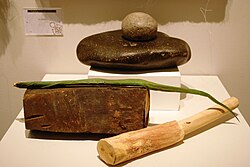
The leaves of the plant yield strong fibers known as pita. These fibers are traditionally used to manufacture ropes, nets, bags, sacks, matting, and coarse cloth. In Mexico, these fibers are also used in a specialized leather embroidery technique called piteado.
Medicinal and Artistic Significance
The plant contains chemical compounds known as agavasaponins and agavosides (fructans). In traditional medicine, it has been used as a laxative, diuretic, and diaphoretic (a substance that induces sweating). However, modern scientific reviews have not yet found sufficient data to confirm its safety or effectiveness for these uses. Notably, contact with the plant can cause allergic dermatitis, a painful skin inflammation.
Beyond utility, the plant has historical artistic value. The Aztecs used the pulped leaves of the agave to create paper, a technique evidenced by the historical Humboldt fragments. The plant also holds heraldic importance, appearing on the coat of arms of Don Diego de Mendoza, a Native American governor in Hidalgo.
Key Facts
- Common Names: Century plant, maguey, or American aloe.
- Lifespan: Typically 10 to 30 years.
- Flowering: Monocarpic (flowers once and then dies).
- Native Habitat: Mexico and Texas, USA.
- Primary Uses: Ornamental landscaping, fiber production, and fermented/distilled beverages.
- Safety Note: Can cause severe allergic skin reactions (dermatitis).
Summary of Agave americana
| Feature | Details |
|---|---|
| Scientific Name | Agave americana |
| Family | Asparagaceae |
| Max Flower Height | 8–9 meters (25–30 ft) |
| Leaf Length | 0.9–1.5 meters (3–5 ft) |
| Conservation Status | Least Concern (IUCN 3.1) |
Frequently Asked Questions
Why is it called the century plant?
The name comes from its monocarpic nature, meaning it spends many years growing before flowering only once at the end of its life cycle. Although called the "century plant," it usually lives between 10 and 30 years.
Is Agave americana the same as Aloe?
No. While it is often called "American aloe" in common conversation, it is not closely related to the Aloe species.
How can I grow Agave americana as a houseplant?
It requires highly porous, sandy soil and minimal watering. It should be allowed to dry out between waterings and benefits from a winter resting period at temperatures around 10 to 12 °C (50 to 54 °F).
What is the difference between tequila and mezcal?
Tequila is produced specifically from Agave tequilana (blue agave). Mezcal is a broader category of distilled agave spirits that can be made from several different agave species, including Agave americana.
Is it safe to handle the plant?
You should exercise caution, as Agave americana can cause severe allergic dermatitis (skin irritation) upon contact.