Afşin-Elbistan A Power Station
The Afşin-Elbistan A is a major lignite-fired power station located in Turkey. Owned by Çelikler Holding, this facility represents a significant part of the country's industrial energy infrastructure, utilizing local coal resources to generate electricity for the national grid.
The plant operates by burning lignite—a soft, brown coal—which is transported directly from the nearby Kışlaköy coal mine via conveyor belts. This strategic proximity to fuel sources was a primary driver for the plant's development, reducing the need for expensive fuel imports.
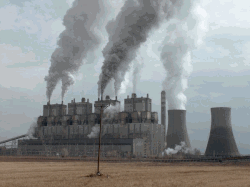
Key Facts
- Owner: Çelikler Holding
- Nameplate Capacity: 1,355 MW
- Primary Fuel: Lignite from Kışlaköy coal mine
- Operational Units: 3 units currently active
- Commission Date: 1984
- Environmental Impact: Estimated annual CO2 emissions exceeding 8 million tonnes
Operational History and Evolution
Brought online between 1984 and 1987, Afşin-Elbistan A was established during an era when solar and wind energy were prohibitively expensive and Turkey had not yet discovered significant natural gas reserves. By utilizing local lignite, the plant helped limit the country's current account deficit by reducing reliance on imported energy.
The facility's importance was historically recognized to the extent that it was featured on the reverse of the 5000 lira banknotes issued between 1990 and 1994.
Environmental Challenges and Refurbishment
Over the decades, the plant has faced intense scrutiny regarding its emissions. In 2005, an assessment was conducted for refurbishing the plant and installing flue-gas desulfurization (FGD)—a technology used to remove sulfur dioxide from exhaust gases—but the installation did not occur at that time.
In January 2020, the plant was shut down after failing to meet new, stricter flue gas pollution limits. While the company planned to install filters by June 2020, the COVID-19 pandemic delayed the delivery of FGD parts. Eventually, gas and dry flue gas filters were completed in 2020, followed by wet flue gas filters in 2021.
Despite these upgrades, the plant has remained a point of contention. In 2019, Greenpeace highlighted the facility as a source of "poison," and a 2022 study found levels of nickel and chromium in the surrounding soil that exceeded regulatory limits.
Proposed Expansion and Legal Battles
In recent years, Çelikler Holding explored expanding the facility by adding a 4th and 5th unit, which would have added approximately 700 MW to the total capacity. To achieve this, the company considered purchasing second-hand steam turbines from decommissioned American nuclear plants.
This expansion faced significant opposition and legal hurdles:
- Environmental Impact Assessment (EIA): An EIA initiated in 2022 was approved in December 2024, but it was subsequently annulled by a court in 2026.
- Health Concerns: Opponents used CALPUFF modeling to estimate that increased dispersion of NO2, SO2, and PM2.5 could lead to 1,900 premature deaths.
- Climate Goals: The expansion was planned for a 35-year lifespan, extending beyond Turkey's 2053 net-zero target.
- Emissions Forecast: The EIA suggested the expansion could emit 28 million tonnes of CO2 annually, significantly higher than the 15 million tonnes emitted by the ZETES power stations in 2022.
Technical Specifications and Waste Management
The combustion of lignite at Afşin-Elbistan A results in specific waste byproducts: 2% of the fuel remains as slag (glassy residue) and 18% as fly ash (fine particles that escape the combustion chamber). To manage these, a new landfill site was planned in 2019, and experts have suggested incorporating modified fly ash into concrete production.
| Metric | Value / Detail |
|---|---|
| Total Nameplate Capacity | 1,355 MW |
| Annual Net Output (2022) | 3,686 GWh |
| Annual Net Output (2023) | 210 GWh (Reduced due to earthquake damage) |
| Annual Net Output (2024) | 1,640 GWh |
| Planned Expansion | 2 units (approx. 688-700 MW) |
Frequently Asked Questions
Why was the power plant shut down in January 2020?
The plant was shut down because it did not meet the new flue gas emission limits that came into force that month.
What is the primary fuel used at Afşin-Elbistan A?
The plant burns lignite, which is sourced from the nearby Kışlaköy coal mine and transported via conveyor belts.
What happened to the proposed expansion of the plant?
Although an Environmental Impact Assessment (EIA) was approved in December 2024, a court annulled the EIA in 2026.
How did the 2023 earthquakes affect the facility?
The plant suffered damage due to the earthquakes, which resulted in a significant drop in power generation for the year 2023, falling to 210 GWh.
What are the environmental concerns regarding the plant's waste?
Beyond air pollution, a 2022 study found that levels of chromium and nickel in the soil surrounding the plant exceeded legal regulations.