African Scops Owl
The African scops owl (Otus senegalensis) is a small, elusive bird of prey widespread across sub-Saharan Africa. Known for its exceptional camouflage and distinctive vocalizations, this nocturnal hunter plays a vital role in its ecosystem by controlling insect populations across a variety of wooded landscapes.
Key Facts
- Scientific Name: Otus senegalensis
- Conservation Status: Least Concern (IUCN 3.1)
- Size: Approximately 15–17 cm in length
- Wingspan: 45 cm (18 in)
- Diet: Primarily insects, spiders, and small vertebrates
- Distribution: Endemic to sub-Saharan Africa
Taxonomy and Classification
First described by William Swainson in 1837 from a specimen found in Senegal, the African scops owl was originally placed in the now-defunct genus Scops. It is currently classified under the genus Otus within the family Strigidae (true owls).
Historically, this bird was considered a subspecies of the European scops owl. While it was once grouped with the Arabian, Socotra, and Annobón scops owls, these are now recognized as distinct species. There are currently three recognized subspecies of Otus senegalensis:
- Otus senegalensis senegalensis: Found widely throughout sub-Saharan Africa.
- Otus senegalensis nivosus: Located in south-eastern Kenya, ranging from the Lali Hills to the lower Tana River.
- Otus senegalensis feae: Endemic to Annobón island in the Gulf of Guinea (though Birdlife International considers this a separate species).
Physical Description
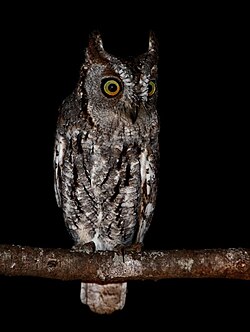
The African scops owl is a compact bird, measuring roughly 17 cm (6.7 in) in length. Its plumage is designed for cryptic coloration—camouflage that allows it to blend into its surroundings—typically appearing greyish-brown, though some individuals exhibit warmer brown or pale rufous tones with streaks and mottling.
Key identifying features include a grey facial disk bordered by a narrow black edge and striking yellow eyes. The owl possesses ear tufts, which it generally keeps lowered unless it feels disturbed.
Range and Habitat
This species is endemic to sub-Saharan Africa, inhabiting regions from sea level up to elevations of 2,000 m (6,600 ft). It is highly adaptable, residing in wooded habitats and forest edges, as well as mangroves and residential gardens.
| Feature | Details |
|---|---|
| Length | 15–17 cm (5.9–6.7 in) |
| Wingspan | 45 cm (18 in) |
| Primary Diet | Insects (grasshoppers, beetles, crickets, moths) |
| Breeding Season | April to June |
| CITES Status | Appendix II |
Behavior and Ecology
Nocturnal Habits and Camouflage
Strictly nocturnal, the African scops owl spends its days perching close to tree trunks. To avoid detection, it closes its eyes and extends its ear-tufts, mimicking the appearance of a broken tree branch. Unlike the Eurasian scops owl, this species is less territorial and may nest in loose aggregations where sites are relatively close to one another.
Vocalizations
The bird is recognized by its distinctive voice: a monotonous, quivering "prrrp" call delivered at five-second intervals. Pairs may engage in duets, calling throughout the night both before and after they leave their roost.
Diet and Hunting
The African scops owl primarily feeds on insects such as beetles, crickets, moths, and grasshoppers, though it also consumes spiders, scorpions, and small vertebrates. It typically hunts by listening or scanning from a perch before swooping down to the ground, though it is also capable of hawking (catching insects in mid-air).
Breeding and Life Cycle
Between April and June, the female lays four to six eggs directly on the floor of a tree hollow. The incubation period lasts approximately 27 days, during which the male provides food for the female. After hatching, the female feeds the young using prey brought by the male. The young typically fledge (leave the nest) within 30 days.
Frequently Asked Questions
How can you tell an African scops owl apart from a Eurasian scops owl?
While the Eurasian scops owl is typically slightly larger, the two species are very similar and can be difficult to distinguish in the field.
What do African scops owls eat?
Their diet consists mainly of insects like grasshoppers, beetles, crickets, and moths, as well as spiders, scorpions, and small vertebrates.
Where does the African scops owl live?
It is endemic to sub-Saharan Africa, living in wooded areas, forest edges, mangroves, and gardens at elevations from sea level up to 2,000 meters.
How does the African scops owl hide from predators during the day?
It uses cryptic plumage to blend in with tree bark, closes its eyes, and extends its ear-tufts to look like a tree branch.
What is the breeding cycle of the African scops owl?
They lay four to six eggs in tree hollows between April and June. Eggs incubate for about 27 days, and the young fledge approximately 30 days after hatching.