24th Punjabis: History of a Distinguished Infantry Regiment
The 24th Punjabis were a storied infantry regiment of the British Indian Army, characterized by a long legacy of service across Asia and the Middle East. From their origins during the mid-19th century upheavals to their eventual integration into the modern Pakistan Army, the regiment played a pivotal role in numerous colonial and global conflicts.
Originally raised in 1857, the unit underwent several redesignations as the British Indian Army evolved. Today, the lineage of the 24th Punjabis continues through the 8th Battalion (CRACKS) of the Punjab Regiment in the Pakistan Army.
Key Facts
- Founded: June 5, 1857, at Peshawar.
- Original Name: 11th Regiment of Punjab Infantry (also known as 24th Punjab Native Infantry).
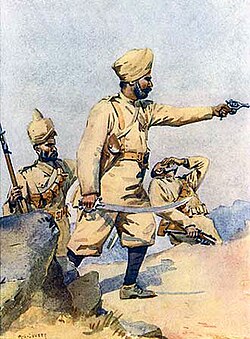
- Uniform: Red with white facings.
- Major Transitions: Became the 4th Battalion 14th Punjab Regiment in 1922 and later the 8th Battalion The Punjab Regiment in 1956.
- Current Status: Active within the Pakistan Army as 8th Battalion (CRACKS) The Punjab Regiment.
Early History and Colonial Engagements
The regiment was established on June 5, 1857, by Captain G N Kave in Peshawar during the Indian Mutiny (a major uprising against British rule). In its early years, the unit was known as the 24th Punjab Native Infantry, though it was briefly designated as the 16th PNI.
The regiment saw significant action during the Second Afghan War (1878–80), notably participating in Lord Roberts' famous march from Kabul to Kandahar and fighting in the Battle of Kandahar on September 1, 1880. In 1897, the unit was stationed at Malakand during a Pashtun tribal uprising. During a fierce engagement in July of that year, Lieutenant Edmund Costello was awarded the Victoria Cross for his conspicuous gallantry.
By 1900, the regiment's reach extended to East Asia, where they were deployed to China to help suppress the Boxer Rebellion (an anti-foreign, anti-Christian uprising).
World War I and the Kitchener Reforms
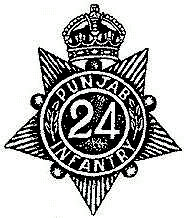
Following the 1903 reforms led by Lord Kitchener, the unit was officially renamed the 24th Punjabis. The First World War brought the regiment to the forefront of global conflict, with deployments in Egypt and Mesopotamia (modern-day Iraq).
In Mesopotamia, the regiment fought in the Battles of Shaiba and Ctesiphon. However, they suffered a major setback during the Siege of Kut al Amara in 1915, where the unit was captured by Turkish forces. After reforming, the 24th Punjabis returned to Mesopotamia in April 1917 to fight in the Battle of Khan Baghdadi. Their service during the Great War concluded with deployments in Salonika and Russian Transcaucasia.
Reorganization and Transition to the Pakistan Army
Between 1921 and 1922, the British Indian Army underwent a massive reorganization. The 24th Punjabis were grouped with the 19th, 20th, 21st, and 22nd Punjabis, as well as the 40th Pathans, to form the 14th Punjab Regiment. The 24th Punjabis became the 4th Battalion of this new regiment.
During the Second World War, the battalion served in the Burma Campaign. Following the partition of India in 1947, the 14th Punjab Regiment was allocated to the Pakistan Army. In 1956, it merged with the 1st, 15th, and 16th Punjab Regiments to form a single, large Punjab Regiment, and the unit was redesignated as 8 Punjab.
In the post-independence era, the battalion remained active in several conflicts, including the 1948 war in Kashmir, the 1965 Indo-Pakistan War (serving in the Lahore and Chhamb Sectors), and the 1971 conflict in East Pakistan.
Regimental Summary
| Period/Year | Designation | Key Engagement/Event |
|---|---|---|
| 1857 | 24th Punjab Native Infantry | Indian Mutiny |
| 1878–1880 | 24th Punjab Native Infantry | Second Afghan War |
| 1900 | 24th Punjab Native Infantry | Boxer Rebellion |
| 1903–1922 | 24th Punjabis | World War I (Mesopotamia) |
| 1922–1947 | 4th Battalion 14th Punjab Regiment | World War II (Burma) |
| 1956–Present | 8th Battalion The Punjab Regiment | Indo-Pakistani Wars |
Prominent General Officers
The regiment has produced several high-ranking military leaders, including:
- Gen Muhammad Sharif: Joint Chief of Staff Committee.
- Lt Gen Syed Ather Ali: Commander 5 Corps and Defence Secretary.
- Lt Gen Khalid Rabbani: Commander 11 Corps and Chairman AWT.
- Lt Gen Khalid Zia: Commander 31 Corps.
- Maj Gen Muhammad Mushtaq: DG Military Intelligence and GOC 11th Division.
- Maj Gen Mumtaz Hussain: GOC 7 Div.
- Maj Gen Muhammad Arshad Ch (late).
Frequently Asked Questions
When was the 24th Punjabis first raised?
The regiment was raised on June 5, 1857, at Peshawar by Captain G N Kave during the Indian Mutiny.
What happened to the regiment during the Siege of Kut al Amara?
During the 1915 Siege of Kut al Amara in Mesopotamia, the 24th Punjabis were captured by Turkish forces.
Which prestigious award was won by a member of the regiment at Malakand?
Lieutenant Edmund Costello was awarded the Victoria Cross for his conspicuous gallantry during the action at Malakand in July 1897.
How is the regiment designated in the modern Pakistan Army?
The unit currently exists as the 8th Battalion (CRACKS) of The Punjab Regiment.
In which major campaigns did the regiment fight during the 20th century?
The regiment fought in the Boxer Rebellion, World War I (Egypt, Mesopotamia, Salonika, and Russian Transcaucasia), World War II (Burma Campaign), and the Indo-Pakistani wars of 1948, 1965, and 1971.