2020 United States Census: Results, Challenges, and Impact
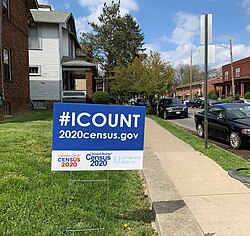
The 2020 United States Census marked the twenty-fourth official count of the nation's population. Conducted by the U.S. Census Bureau, this massive undertaking is more than just a head count; it is a constitutional requirement that determines how political power and federal resources are distributed across the country for a decade.
From navigating a global pandemic to enduring high-profile legal battles over citizenship questions, the 2020 cycle was one of the most complex in American history. Despite these hurdles, the census provided a critical snapshot of the nation's demographic shifts, race and ethnicity, and living arrangements.
Key Facts
- Total Population: 331,449,281 (a 7.4% increase from 2010).
- Most Populous State: California (39,538,223).
- Least Populous State: Wyoming (576,851).
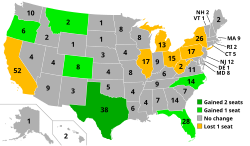
- Congressional Impact: 13 states experienced changes in their number of congressional seats.
- Response Rate: The Census Bureau reported the count as 99.98% complete nationwide.
The Purpose and Impact of the Census
The census serves several vital functions that affect nearly every community in the United States. The data collected informs three primary areas of governance:
Apportionment and Redistricting
Apportionment is the process of dividing the 435 seats in the U.S. House of Representatives among the 50 states based on their population. On April 26, 2021, the Census Bureau announced the apportionment figures, which resulted in seat changes for 13 states. Following this, states engage in redistricting, where they redraw the boundaries of congressional and legislative districts to ensure equal representation.
Federal Funding Distribution
Census data is used to determine how hundreds of billions of dollars in federal funds are allocated annually. This funding supports critical infrastructure and social services, including healthcare, housing, and education.
Demographic Analysis
Beyond politics and money, the census tracks essential trends in race, ethnicity, income, poverty, and employment. This allows the government and businesses to understand where the population is growing and what services are most needed.

Implementation and Operational Challenges
The 2020 Census faced unprecedented obstacles that threatened the accuracy and timeline of the count.
The COVID-19 Pandemic
The emergence of COVID-19 forced the Census Bureau to make drastic operational adjustments. In-person interviews were suspended, and field operations were delayed, with some not resuming until mid-May 2020. The Bureau had to increase call center capacity and adapt its data collection methods to maintain safety while striving for a complete count.
The Citizenship Question Debate
A significant legal controversy arose over the proposed addition of a citizenship question to the census. This led to multiple lawsuits in New York, California, and Maryland. After a series of rulings and a Supreme Court case, the Department of Justice eventually confirmed that the citizenship question would not be included in the 2020 Census.

Data Privacy and Accuracy
To protect respondent anonymity, the Bureau implemented differential privacy, a mathematical technique that adds "noise" to the data to prevent individuals from being identified. However, this approach faced criticism from some researchers who argued it could impact the accuracy of detailed data for small populations.
Population Trends and Results
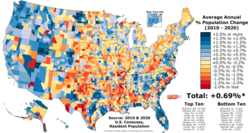
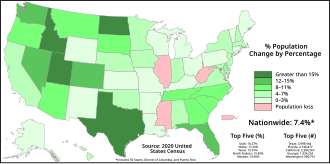
The final results highlighted significant shifts in where Americans live. While the overall population grew by 7.4%, this growth was not uniform across the country.
| Metric | Value/Detail |
|---|---|
| Total U.S. Population | 331,449,281 |
| Population Growth (since 2010) | 7.4% |
| Largest State | California |
| Smallest State | Wyoming |
| States with Seat Changes | 13 |
| Completion Rate | 99.98% |
Frequently Asked Questions
What is the difference between apportionment and redistricting?
Apportionment determines how many congressional seats each state receives based on its total population. Redistricting is the subsequent process where each state redraws the actual boundaries of those districts.
Was a citizenship question included in the 2020 Census?
No. After extensive legal battles and a Supreme Court review, the citizenship question was not included in the final questionnaire.
How did COVID-19 affect the census count?
The pandemic caused delays in field operations, the suspension of in-person interviews, and required the Bureau to shift more resources toward call centers and digital responses.
What is differential privacy?
Differential privacy is a data-protection method used by the Census Bureau to ensure that individual respondents cannot be identified from the published statistics by adding controlled mathematical noise to the data.
Why is the census important for federal funding?
The federal government uses census data to distribute funds for essential services like hospitals, fire departments, schools, and roads, ensuring money goes where the people actually live.