1910 United States Census: A Snapshot of a Growing Nation
Conducted on April 15, 1910, the thirteenth census of the United States provided a critical demographic window into a country undergoing rapid expansion and urbanization. Managed by the Census Bureau, this massive undertaking recorded a total resident population of 92,228,496, marking a significant 21 percent increase from the 76,212,168 people counted in 1900.
Beyond simple headcounts, the 1910 census introduced structural changes to how data was collected and organized. Notably, the Bureau shifted the page orientation of its forms from portrait to landscape to accommodate more detailed information.
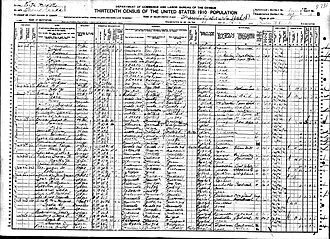
Key Facts
- Total Population: 92,228,496 (a 21% increase since 1900).
- Most Populous State: New York, with 9,113,614 residents.
- Least Populous State: Nevada, with 81,875 residents.
- Budget: $14 million was allocated for the operation.
- Urban Milestone: For the first time, all of the top 50 largest cities had populations exceeding 100,000.
- Innovation: Introduced metropolitan districts for cities with at least 200,000 people.
Organization and Administration
The 1910 census was overseen by Dr. Edward Dana Durand, who had been appointed in 1909. At the time, Dr. Durand served as the head of the Bureau of Corporations. To execute the nationwide count, the government allocated a budget of $14 million.
Census Questions and Data Collection
The 1910 census was comprehensive, seeking to capture a detailed social and economic profile of the American people. Enumerators collected data on personal identity, family structure, and socioeconomic status.
Personal and Family Details
The forms recorded basic identifiers such as name, address, sex, race, and age. Family dynamics were captured through the relationship to the head of the household and marital status. For women, the census specifically tracked the number of children born and the number of children still living.
Nativity and Citizenship
To track immigration patterns, the Bureau asked for the place of birth and mother tongue of the individual and their parents. Foreign-born residents were asked for their year of immigration, their naturalization status, and their ability to speak English.
Economic and Social Status
The census gathered extensive data on labor and living conditions, including:
- Occupation: Trade, profession, industry, and class of worker.
- Employment: Whether employees were out of work during the year.
- Education: Literacy levels and school attendance since September 1, 1909.
- Housing: Whether the home was owned (and if mortgaged) or rented, and if the property was a farm or a house.
- Health and History: Whether the person was blind, deaf, or dumb, and if they were a survivor of the Union or Confederate Army or Navy.
Population Trends and State Rankings
The 1910 data revealed dramatic shifts in where Americans lived. While New York remained the most populous state, some of the most explosive growth occurred in the West. Washington and Oklahoma, for example, saw population increases exceeding 100%.
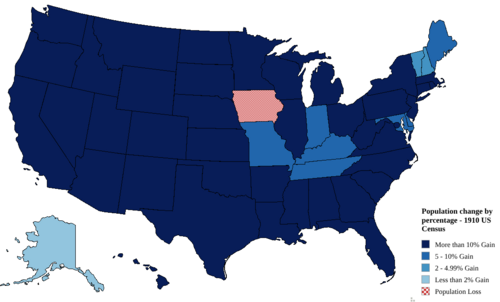
| Rank | State | 1910 Population | 1900 Population | Percent Change |
|---|---|---|---|---|
| 1 | New York | 9,113,614 | 7,268,894 | 25.4% |
| 2 | Pennsylvania | 7,665,111 | 6,302,115 | 21.6% |
| 3 | Illinois | 5,638,591 | 4,821,550 | 16.9% |
| 4 | Ohio | 4,767,121 | 4,157,545 | 14.7% |
| 5 | Texas | 3,896,542 | 3,048,710 | 27.8% |
| 6 | Massachusetts | 3,366,416 | 2,805,346 | 20.0% |
| 7 | Missouri | 3,293,335 | 3,106,665 | 6.0% |
| 8 | Michigan | 2,810,173 | 2,420,982 | 16.1% |
| 9 | Indiana | 2,700,876 | 2,516,462 | 7.3% |
| 10 | Georgia | 2,609,121 | 2,216,331 | 17.7% |
Urbanization and Language
The 1910 census highlighted the rise of the American city. New York City led the nation with over 4.7 million residents, followed by Chicago and Philadelphia. Interestingly, despite Texas being the 5th most populous state, it was the last census in which Texas failed to have a single city in the top 50 largest cities.
The data also reflected the diverse origins of the foreign-born population. While English and Celtic languages were most common, German (2,759,032 speakers), Italian (1,365,110), and Yiddish/Hebrew (1,051,767) were the most prominent non-English mother tongues.
Data Availability
The original 1910 census sheets were microfilmed in the 1940s and subsequently destroyed. However, these records remain accessible today. Microfilmed rolls are held by the National Archives and Records Administration, and digital microdata is available through the Integrated Public Use Microdata Series (IPUMS). Additionally, the National Historical Geographic Information System provides aggregate data and electronic boundary files.
Frequently Asked Questions
Who was in charge of the 1910 US Census?
Dr. Edward Dana Durand, the head of the Bureau of Corporations, was appointed in 1909 to oversee the census.
What was the total population of the US in 1910?
The resident population was determined to be 92,228,496, which was a 21% increase over the 1900 census.
What new geographical concept was introduced in 1910?
The 1910 census introduced metropolitan districts for cities with at least 200,000 people, serving as the predecessor to modern metropolitan statistical areas.
Which state saw the most significant population growth?
Among the states listed, Washington saw a massive increase of 120.4%, and Oklahoma grew by 109.7%.
How can researchers access the 1910 census records today?
Records are available via the National Archives (microfilm), the Integrated Public Use Microdata Series (microdata), and the National Historical Geographic Information System (aggregate data).