1945 Manchester Congress: The Turning Point of Pan-Africanism
In October 1945, a pivotal gathering took place in the United Kingdom that would reshape the political landscape of the African continent and its diaspora. The Fifth Pan-African Congress, held at the Chorlton-on-Medlock Town Hall in Manchester, marked a fundamental shift in the movement for global black liberation. While previous congresses had been led primarily by intellectuals from the United States and the Caribbean, the Manchester meeting signaled the rise of African-born leaders who would soon lead their nations to independence.
The event occurred at a critical historical juncture. Following the end of World War II, approximately 700 million people remained under imperial rule—subject people denied basic freedoms, democratic representation, and the right to form trade unions. Having fought for European colonial powers during the war under promises of self-government that were never fulfilled, a new wave of militancy emerged, demanding immediate decolonization and the end of racial discrimination and capitalism.
Key Facts
- Date: October 15 to 21, 1945.
- Location: Chorlton-on-Medlock Town Hall, Manchester, UK.
- Attendance: Approximately 87–90 delegates from 50 organizations and 200 audience members.
- Key Figures: W.E.B. Du Bois, George Padmore, Kwame Nkrumah, Jomo Kenyatta, and Hastings Banda.
- Core Goal: To advocate for the total decolonization of Africa and the end of imperial rule.
- Symbolism: The hall was decorated with the flags of Ethiopia, Liberia, and Haiti—the only black nations under self-governance at the time.
Planning and Organization
The road to Manchester began in 1944 through correspondence between W.E.B. Du Bois, Amy Jacques Garvey, and Harold Moody regarding an "African Freedom Charter." Although Du Bois initially proposed a meeting in London, he later collaborated with George Padmore, who had also called for a post-war congress. After tentative plans to host the event in Paris to coincide with the World Trade Union Conference, the venue was shifted to Manchester in August 1945.
The West African Students' Union had expressed a preference for the event to be hosted in Liberia rather than Europe, but the logistical arrangements ultimately solidified in England.
A New Era of Representation
The Fifth Congress was distinguished by its diverse and radical composition. Unlike its predecessors, which were dominated by the black middle class, the Manchester meeting was driven by delegates from the African continent and Africans studying or working in Britain. This shift attracted a broader coalition of trade unionists, workers, and radical students.
Among the attendees were future presidents of independent nations, including Kwame Nkrumah (Ghana), Jomo Kenyatta (Kenya), and Hastings Banda (Malawi). The delegation was truly global, featuring representatives from the Caribbean (including Jamaica, Barbados, and Trinidad and Tobago), South Africa, Nigeria, and various "fraternal delegates" from India, Sri Lanka, and Cyprus.
| Category | Details |
|---|---|
| Total Delegates | 87–90 representing ~50 organizations |
| Total Audience | Approximately 200 people |
| Key Regions | Continental Africa, Caribbean, UK, USA, India, Sri Lanka |
| Notable Future Leaders | Nkrumah, Kenyatta, Banda |
Critical Issues Addressed
The Congress was structured into several sessions, each tackling a specific facet of oppression and liberation:
- The Colour Problem in Britain: Chaired by Amy Ashwood Garvey, this session addressed racial discrimination, the "colour bar" (racial segregation in employment), and the plight of abandoned mixed-race children of black ex-servicemen.
- Imperialism in North and West Africa: Led by W.E.B. Du Bois, this session saw a demand for total independence. Kwame Nkrumah specifically advocated for revolutionary methods to seize power.
- Oppression in South Africa: Delegates condemned the systemic social, economic, and health inequalities faced by Black South Africans.
- The East African Picture: Opened by Jomo Kenyatta, this discussion focused on the seizure of the best lands by white settlers and the resulting wage inequalities.
- Ethiopia and the Black Republics: The Congress criticized the UN for providing aid to Italy (the former occupier) while Britain continued to exercise control over Ethiopia despite the restoration of Emperor Haile Selassie.
- Caribbean Problems: Trade union delegates debated the merits of complete independence versus self-government or dominion status.
The Role of Women
Women were central to the success of the Fifth Congress. Amy Ashwood Garvey provided critical leadership by chairing the opening session, while Alma La Badie of the Universal Negro Improvement Association spoke on child welfare. Beyond the formal sessions, women managed the essential social and organizational logistics that sustained the event.
Outcomes and Legacy
The 1945 Congress fundamentally shifted the Pan-African movement, positioning African leaders as the primary agents of change in the struggle against colonialism. While the British press largely ignored the event—with the exception of Picture Post, which published "Africa Speaks in Manchester"—its impact was profound.
In the aftermath, W.E.B. Du Bois sought to increase NAACP support for the movement, but the onset of the Red Scare (a period of intense anti-communist suspicion in the US) caused the NAACP to distance itself from Pan-Africanism.
Commemoration
The legacy of the Congress is preserved in Manchester through several initiatives:
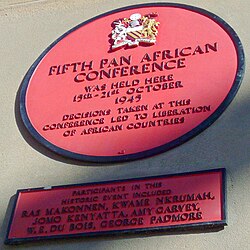
- Red Plaque: A commemorative plaque on the wall of Chorlton Town Hall, attributed to the efforts of activist Kath Locke.
- Exhibitions: The 70th anniversary in 2015 featured the "Black Chronicles III" exhibition, showcasing photographs by John Deakin.
- Academic Celebrations: In 2020, Manchester Metropolitan University held "PAC@75," a series of creative and academic events curated by Professor Ola Uduku.
- Archives: Records are held at the Ahmed Iqbal Ullah Race Relations Resource Centre and the Working Class Movement Library.
Frequently Asked Questions
How did the Fifth Pan-African Congress differ from previous ones?
Unlike the first four congresses, which were predominantly led by the African diaspora in the US and UK, the Fifth Congress was dominated by delegates from the African continent and Africans living in Britain, shifting the focus toward direct decolonization.
Who were some of the most notable attendees?
The congress included future heads of state such as Kwame Nkrumah, Jomo Kenyatta, and Hastings Banda, as well as influential intellectuals like W.E.B. Du Bois and George Padmore.
What was the "colour bar" discussed during the sessions?
The "colour bar" referred to discriminatory employment practices and racial segregation in the United Kingdom that limited the opportunities available to black people.
Why was the location changed from Paris to Manchester?
The event was originally scheduled for Paris to coincide with the 1945 World Trade Union Conference, but plans were altered in August 1945 to move the congress to England.
What was the impact of the Red Scare on the movement?
The Red Scare led the NAACP to step back from its support of Pan-Africanism due to the political climate of anti-communism in the United States during the late 1940s.