14th Ferozepore Sikhs: History of a Distinguished Indian Army Regiment
The 14th (King George's Own) Ferozepore Sikhs was a storied infantry regiment of the British Indian Army. From its inception in the mid-19th century to its eventual integration into the modern Indian Army, the regiment served as a vital component of the Indian Empire's military strength, participating in critical campaigns across Asia and Europe.
Key Facts
- Active Period: 1846–1922.
- Origins: Formed as the Regiment of Ferozepore in 1846.
- Uniform: Red coats with yellow facings.
- Major Conflicts: Siege of Lucknow, Second Anglo-Afghan War, Boxer Rebellion, and World War I.
- Final Designation: 14th (King George's Own) Ferozepore Sikhs.
- Legacy: Became the 1st Battalion 11th Sikh Regiment after post-WWI reforms.
Foundations and Evolution
The regiment's history began in 1846 with the formation of the Regiment of Ferozepore. Over the next several decades, the unit underwent numerous redesignations reflecting the shifting administrative structures of the Bengal Army (the army of the Bengal Presidency) and the broader Bengal Command.
Between 1861 and 1903, the unit transitioned through several titles, including the 14th Bengal Native Infantry and the 14th (Ferozepore) Sikh Infantry. A significant turning point occurred in 1903 during the Kitchener reforms—a series of sweeping organizational changes to the Indian Army initiated by Lord Kitchener to modernize the force—resulting in the name 14th Ferozepore Sikhs.
Royal Patronage and Honors
The regiment maintained close ties with the British monarchy. In 1905, the unit participated in the Rawalpindi Parade to honor the visit of the Prince and Princess of Wales to India. Consequently, the regiment was renamed the 14th Prince of Wales's Own Ferozepore Sikhs in 1906, and later the 14th (King George's Own) Ferozepore Sikhs in 1910, with King George V serving as Colonel-in-Chief from 1906.
Military Campaigns and Global Service
The 14th Sikhs were deployed in a variety of high-stakes engagements across the globe, proving their versatility in different terrains and combat scenarios.
Early Engagements and Asian Campaigns
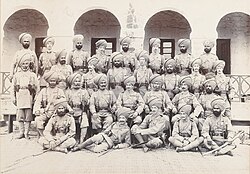
The regiment saw early action at the Siege of Lucknow and during the Second Anglo-Afghan War (1878), specifically at Ali Masjid. They were also involved in the Defence of Chitral in 1895. At the turn of the century, the regiment was deployed to China in 1900 as part of an international force sent to suppress the Boxer Rebellion, a violent anti-foreign and anti-Christian uprising. They remained in China for two years.
World War I
During the Great War, the 14th Ferozepore Sikhs were deployed to two major theaters of operation. They served in the Gallipoli Campaign as part of the 29th Indian Brigade and later fought in the Mesopotamia Campaign (modern-day Iraq) attached to the 51st Indian Brigade of the 17th Indian Division.
Amalgamation and Modern Legacy
Following the conclusion of World War I, the Indian Army underwent significant restructuring. The 14th Ferozepore Sikhs were amalgamated into a larger regimental structure, becoming the 1st Battalion 11th Sikh Regiment. Following India's independence, the regiment's lineage was allocated to the contemporary Indian Army.
| Category | Details |
|---|---|
| Branch | Army (Infantry) |
| Active Years | 1846–1922 |
| Key Battle Honours | Lucknow, Afghanistan, Ali Masjid, Chitral, China, The Great War |
| Uniform Colors | Red with yellow facings |
| Successor Unit | 1st Battalion 11th Sikh Regiment |
Frequently Asked Questions
When was the 14th Ferozepore Sikhs first formed?
The regiment traces its origins back to the formation of the Regiment of Ferozepore in 1846.
What was the regiment's role in the Boxer Rebellion?
The regiment was part of an international force deployed to China in 1900 to fight the Boxer Rebellion, remaining there until 1902.
Which campaigns did the regiment participate in during World War I?
The regiment served in both the Gallipoli Campaign with the 29th Indian Brigade and the Mesopotamia Campaign with the 51st Indian Brigade, 17th Indian Division.
What happened to the regiment after World War I?
As part of post-war reforms, the regiment was amalgamated and became the 1st Battalion 11th Sikh Regiment.
Who was the Colonel-in-Chief of the regiment?
King George V served as the Colonel-in-Chief starting in 1906.