Zodiac Constellations: The Science and History of the Celestial Belt
The zodiac is a belt-shaped region of the night sky that serves as a celestial map for the movement of the Sun, Moon, and planets. Extending approximately 8° north and south of the ecliptic—the apparent path the Sun follows across the celestial sphere over a year—this region has been used for millennia to track time and navigate the heavens.
While often associated with astrology, the zodiac is rooted in astronomical observation. It is divided along the ecliptic into 12 equal segments known as signs, each spanning 30° of celestial longitude. These signs roughly align with the astronomical constellations that the Sun appears to pass through during its annual cycle.
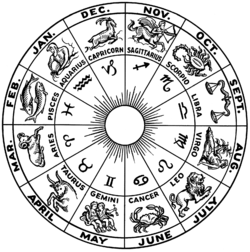
Key Facts
- Definition: A celestial belt extending 8° north and south of the ecliptic.
- Structure: Divided into 12 equal signs of 30° each, totaling a 360° circle.
- Origin: Developed by Babylonian astronomers during the 1st millennium BC.
- Precession: The Earth's axial shift causes the Sun's position in constellations to change over centuries.
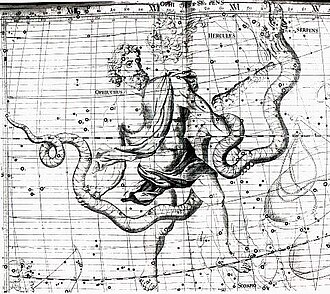
- Constellations: While there are 12 traditional signs, the ecliptic actually intersects 13 constellations, including Ophiuchus.
The History and Evolution of the Zodiac
Babylonian Origins
The zodiacal system originated with Babylonian astronomy, likely during the Achaemenid Empire. Around the end of the fifth century BC, astronomers divided the ecliptic into 12 equal signs, mirroring 12 schematic months of 30 days each. Modern astrophysics suggests this system was introduced between 409 and 398 BC. Unlike modern systems, Babylonian astronomers fixed the zodiac in relation to specific stars, such as the "Rear Twin Star" (β Geminorum) for Cancer.
Global Transmission
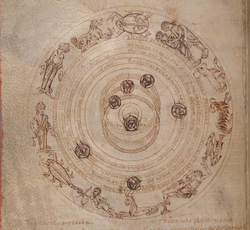
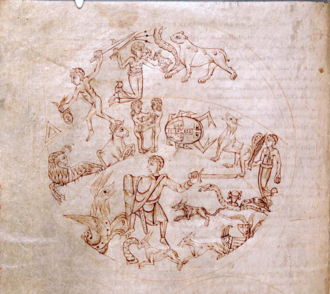
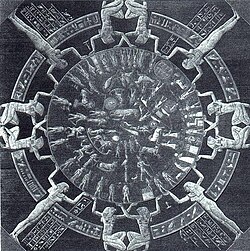
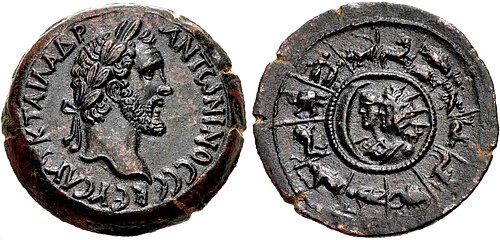
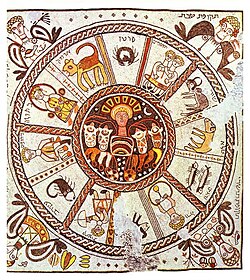
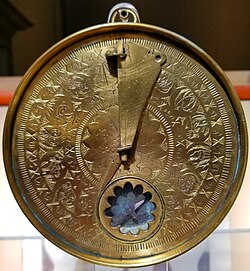
By the 2nd century BC, this system was communicated into Greek astronomy and influenced the development of the Hindu zodiac. Over the centuries, the zodiac appeared in various cultural artifacts, from Roman Egyptian coins to medieval stained glass and Ottoman sundials.

The Twelve Signs vs. Astronomical Constellations
It is important to distinguish between zodiac signs (mathematical divisions of 30°) and astronomical constellations (irregular areas of the sky defined by stars). While the signs are equal in size, the actual constellations vary significantly in the amount of time the Sun spends within their boundaries.
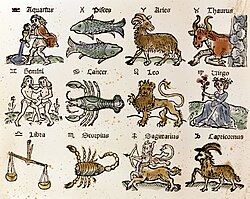
| Sign/Constellation | Approx. Solar Stay (IAU) | Brightest Star | Traditional Tropical Dates |
|---|---|---|---|
| Aries | 25 days | Hamal | Mar 21 – Apr 19 |
| Taurus | 37 days | Aldebaran | Apr 20 – May 20 |
| Gemini | 31 days | Pollux | May 21 – Jun 20 |
| Cancer | 20 days | Tarf | Jun 21 – Jul 22 |
| Leo | 37 days | Regulus | Jul 23 – Aug 22 |
| Virgo | 45 days | Spica | Aug 23 – Sep 22 |
| Libra | 23 days | Zubeneschamali | Sep 23 – Oct 22 |
| Scorpius | 7 days | Antares | Oct 23 – Nov 21 |
| Ophiuchus | 18 days | Rasalhague | N/A |
| Sagittarius | 32 days | Kaus Australis | Nov 22 – Dec 21 |
| Capricornus | 28 days | Deneb Algedi | Dec 22 – Jan 19 |
| Aquarius | 24 days | Sadalsuud | Jan 20 – Feb 18 |
| Pisces | 38 days | Alpherg | Feb 19 – Mar 20 |
The ecliptic actually intersects 13 constellations. Ophiuchus sits between Scorpius and Sagittarius. This astronomical fact is often misreported as a "change" to the zodiac by organizations like NASA or the IAU, but the 13th constellation has always been there; it simply isn't part of the traditional 12-sign astrological system.
Precession of the Equinoxes
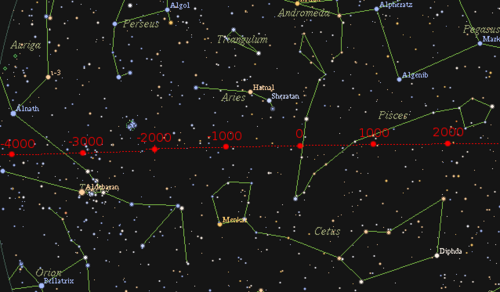
The precession of the equinoxes is a slow change in the orientation of Earth's rotational axis. This causes the point of the March equinox (the vernal equinox) to drift backward through the zodiac over thousands of years.
Historically, the vernal equinox was known as the "first point of Aries." However, due to precession, this point has moved. By the 2nd century AD, it had shifted into the constellation Pisces, where it remains today. This means the Sun is no longer in the constellation Aries when it enters the astrological sign of Aries.
Zodiacal Light
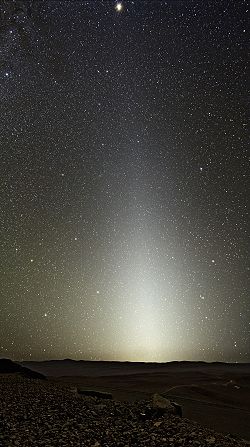
Beyond the constellations, the zodiac is visible through zodiacal light. This is a faint, diffuse glow seen in the night sky, caused by sunlight scattering off interplanetary dust particles within the zodiacal band.
![Two false dawns,[73] gegenschein (middle) and the rest of the zodiacal band of the zodiacal light, with the zodiac marked (visually crossed by the Milky Way), in this composite image of the night sky above the northern and southern hemisphere](/images/76/75/76754c2f102df413ddaa3d3329dbc84985479b69f0646730c95bcbc04c7286d1.jpg)
Frequently Asked Questions
What is the difference between a zodiac sign and a constellation?
A zodiac sign is a mathematical division of the ecliptic, always exactly 30° wide. A constellation is a physical group of stars with irregular boundaries. While signs are named after constellations, they do not share the same size or exact boundaries.
Did NASA change the zodiac signs?
No. NASA and other astronomical bodies have not changed the zodiac. The confusion arises because the ecliptic intersects 13 constellations (including Ophiuchus), whereas traditional astrology uses 12 signs. Astronomy has always recognized these 13 intersections.
What is the precession of the equinoxes?
Precession is the gradual shift in the direction of Earth's axis. This causes the position of the Sun at the vernal equinox to move slowly through the constellations over a cycle of approximately 26,000 years.
Why is the vernal equinox called the "First Point of Aries"?
It is a historical designation from when the vernal equinox actually occurred while the Sun was in the constellation Aries. Due to precession, the point has since moved into Pisces, but the name "First Point of Aries" is still used as a reference point in astronomy.
How long does the Sun stay in each zodiac sign?
On average, the Sun stays in each 30° sign for about 30.43 days. However, because Earth's orbit is slightly elliptical (eccentricity), the actual duration varies, ranging from approximately 29.4 days in Capricorn to 31.4 days in Cancer.