Zhong Shan: Tenure as China's Minister of Commerce
In February 2017, the Standing Committee of the National People's Congress appointed Zhong Shan as the Minister of Commerce. His tenure was defined by a period of significant global economic volatility, most notably the escalating trade tensions between the world's two largest economies.
Key Facts
- Appointment: Named Minister of Commerce in February 2017.
- Core Stance: Asserted that there are "no winners" in a trade war.
- Diplomatic Role: Accompanied President Xi Jinping to high-level summits in Buenos Aires (2018) and Osaka (2019).
- Key Milestone: Witnessed the signing of the first US-China trade deal in January 2020.
- Succession: Replaced by Wang Wentao in December 2020.
Navigating the China–United States Trade War
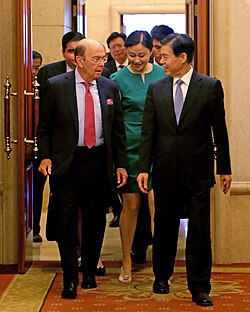
Beginning in 2018, Zhong became a central figure in managing the trade conflict with the United States. While he explicitly stated that China did not wish to engage in a trade war, he maintained that the nation would protect its interests against protectionism—the economic policy of restricting imports from other countries through methods such as tariffs on imported goods.
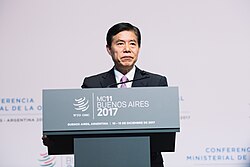
From 2019 onward, Zhong was deeply involved in formal trade negotiations. Despite his public calls for stability, US officials viewed him as a "hardliner" due to his uncompromising stance. In July 2019, writing for the People's Daily, Zhong accused the United States of provoking economic frictions and violating the principles of the World Trade Organization (WTO), the global international organization dealing with the rules of trade between nations.
Economic Resilience and Foreign Investment
During a period marked by the COVID-19 pandemic and concerns over decoupling—the process of breaking off mutual dependencies between two economies—Zhong remained optimistic about China's economic appeal. He argued that the country continued to attract foreign investors thanks to its complete industrial support systems and a high-quality, abundant labor force.
Diplomatic Engagements and Transition
Zhong's role extended beyond policy statements to high-level diplomacy. He was part of the delegation accompanying Chinese leader Xi Jinping during critical meetings with US President Donald Trump in Buenos Aires in 2018 and Osaka in 2019. His tenure culminated in January 2020, when he joined Vice Premier Liu He to witness the signing of the first trade agreement between the two nations.
| Year | Event/Milestone | Context |
|---|---|---|
| 2017 | Appointment | Named Minister of Commerce in February |
| 2018 | Buenos Aires Summit | Accompanied Xi Jinping to meet Donald Trump |
| 2019 | Osaka Summit | Accompanied Xi Jinping to meet Donald Trump |
| 2020 | Trade Deal | Witnessed signing of first US-China trade deal (January) |
| 2020 | Departure | Replaced by Wang Wentao in December |
Frequently Asked Questions
When was Zhong appointed as Minister of Commerce?
Zhong was appointed to the position in February 2017 by the Standing Committee of the National People's Congress.
What was Zhong's perspective on the US-China trade war?
Zhong stated that China did not wish to fight a trade war and emphasized that such conflicts result in "no winners," though he insisted on protecting national interests against US protectionism.
How did US officials perceive Zhong during negotiations?
According to the Washington Post, US officials viewed Zhong as a "hardliner" because of his strong stance during the trade war.
What factors did Zhong cite as strengths for foreign investment in China?
He believed China remained attractive to foreign investors due to its complete industrial support and its abundant, high-quality labor force.
Who succeeded Zhong as Minister of Commerce?
Zhong was replaced by Wang Wentao in December 2020.