Yunnanozoon: The Enigmatic Early Cambrian Bilaterian
Deep within the Lower Cambrian deposits of the Chengjiang biota in Yunnan province, China, lies the fossil record of Yunnanozoon lividum. This extinct species of bilaterian animal—organisms with bilateral symmetry—has sparked decades of scientific debate. Its unique anatomy places it at a critical, yet controversial, junction in the evolutionary history of complex life.
The name Yunnanozoon is derived from the region of its discovery, Yunnan, and the Ancient Greek word zôion, meaning "animal." Its specific name, lividum, is Latin for "lead-coloured," referring to the distinct preservation of the specimens.
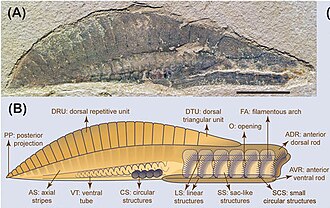
Key Facts
- Temporal Range: Lower Cambrian period.
- Location: Chengjiang biota, Yunnan province, China.
- Size: Ranged from 2 to 6 centimetres in length.
- Body Shape: Fusiform (spindle-shaped) and strongly laterally compressed.
- Key Features: Seven pairs of filamentous arches and potential blood vessels (aortae).
- Taxonomic Status: Highly debated; variously classified as a stem-chordate, stem-vertebrate, or bilaterian of uncertain placement.
Anatomy and Physical Description
Yunnanozoon possessed a fusiform body that was taller than it was wide. A segmented dorsal unit sat atop the body, featuring a triangular first segment followed by several rectangular segments. Below this unit, axial stripes ran along the body length.
Respiratory and Feeding Structures
The front of the animal featured seven pairs of filamentous arches. These arches were covered by sac-like structures with openings between them. Scientists suggest that Yunnanozoon used these arches for feeding, while the openings on the side of the body served to expel water.
Internal Systems and the Glomeruli Debate
Toward the rear of the body, a tube-like structure is visible, likely the gut. At the mid-point of the body, four pairs of circular structures have been identified. While some researchers initially believed these were gonads, a 2026 study suggests they are more likely glomeruli—networks of blood vessels used for renal filtration in kidneys.
The glomeruli theory presents a biological puzzle: such structures typically require a systemic heart to create blood pressure. While no systemic heart is preserved in Yunnanozoon, it does possess branchial hearts (swollen structures assisting blood flow), similar to those found in modern lancelets. It is hypothesized that Yunnanozoon may have had a more powerful version of this system to support vertebrate-like filtration.
Circulatory Evidence
The front half of the body contained rod-like, likely sclerotized (hardened) structures. Furthermore, fossils show evidence of dorsal and ventral aortae (main arteries). This is supported by their three-dimensional tube shape, the presence of material resembling coagulated blood, and chemical signatures of protein and iron.
Taxonomic Controversy and Classification
Since its description in 1991, the placement of Yunnanozoon in the tree of life has been a subject of intense scrutiny. Because it shares traits with several different groups, it has been variously classified as a cephalochordate, hemichordate, stem-deuterostome, or even a relative of Ecdysozoa.
| Study/Year | Proposed Classification | Primary Evidence/Reasoning |
|---|---|---|
| Hou et al. (1991) | Incertae sedis (Metazoa) | Initial discovery; uncertain placement. |
| Cong et al. (2015) | Bilateria (Uncertain) | Comprehensive review of yunnanozoan morphology. |
| Tian et al. (2022) | Stem-vertebrate | Cartilage within an extracellular matrix in arches. |
| Mussini et al. (2024) | Stem-chordate | Transitional form between Vetulicolia and Chordata. |
The Haikouella Connection
For a time, another genus called Haikouella was described from the same deposits. However, a 2015 study determined that the differences used to separate the two—such as the number of arches and the presence of "pharyngeal teeth"—were either nonexistent or misinterpretations. Consequently, Haikouella is now widely considered a junior synonym of Yunnanozoon lividum.
Frequently Asked Questions
What was Yunnanozoon?
Yunnanozoon was an extinct bilaterian animal from the Lower Cambrian period, found in the Chengjiang biota of China. It is characterized by a spindle-shaped body and filamentous arches.
How did Yunnanozoon feed?
It is suggested that Yunnanozoon used its seven pairs of filamentous arches to capture food, while expelling water through openings on the sides of its body.
Why is its classification so controversial?
Its anatomy displays a mix of primitive and advanced traits, leading scientists to debate whether it is a stem-chordate, a stem-vertebrate, or a more distant relative of the deuterostomes.
What are the circular structures in its body?
While once thought to be gonads, more recent research suggests they are glomeruli, which are blood vessel networks used for filtering waste from the blood.
Is Haikouella a different animal from Yunnanozoon?
Current scientific consensus, following a 2015 study, suggests that Haikouella is not a separate genus but is actually the same species as Yunnanozoon lividum.