Yale Law School: A Legacy of Scholarly Excellence and Public Service
Yale Law School stands as one of the most prestigious legal institutions in the world, distinguished by a profound commitment to scholarly research and public service. Unlike many of its peers, the school fosters a culture that prioritizes academic contribution and government service over immediate entry into corporate law firms. This orientation is reflected in its graduates, with 9% pursuing careers in academia and only 46% entering law firms within five years of graduation.
The institution is renowned for its intimate learning environment, boasting a 4.5:1 student-to-faculty ratio—the lowest among all U.S. law schools. This close mentorship is complemented by a unique approach to pedagogy and student evaluation.
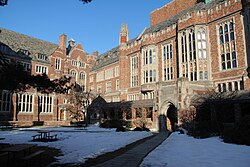
Key Facts
- Admissions: Extremely competitive with an acceptance rate of less than 5% and a yield rate of approximately 80%.
- Academic Structure: Only one semester of required classes, featuring a non-traditional Honors/Pass/Low Pass/Fail grading system.
- Clinical Experience: Over 80% of students participate in clinics; first-year students can represent clients due to unique Connecticut State court rules.
- Rankings: Consistently ranked #1 by the Fortuna Ranking; historically held the top spot in U.S. News & World Report from 1990 until 2026.
- Faculty Impact: Recognized in a 2010 survey as having the most cited law faculty in the United States.

Academic Culture and Innovation
Yale Law School broke away from traditional legal education norms following student unrest in the late 1960s. The school abandoned traditional grading and ranking. Currently, first-semester first-year students are evaluated on a Credit/No Credit basis, while the remainder of their studies are graded as Honors, Pass, Low Pass, or Fail.
Student Publications
The school hosts nine law journals. Most accept editors without a competition, with the exception of the flagship Yale Law Journal. The Journal employs a rigorous two-part admissions process consisting of a "bluebooking exam" (a test of legal citation skills) and a writing competition. Other prominent publications include the Yale Journal on Regulation, the Yale Law & Policy Review, and the Yale Journal of International Law.
Clinical Training and Global Reach
With over two dozen clinics, Yale Law provides students with real-world experience representing clients before federal and state courts, international tribunals, and private arbitration. This practical training is a cornerstone of the curriculum, with the vast majority of students engaging in clinical work before graduation.
Beyond the U.S., the school maintains a global perspective through a partnership with Paris-Panthéon-Assas University and the ESSEC Business School, which together organize a summer school focused on law and economics.
Admissions and Selectivity
Admission to Yale Law is among the most competitive in the United States, with an annual intake of approximately 200 students. For the 2023 entering class, the median GPA was 3.96 and the median LSAT score was 175.
The Selection Process
The admissions process involves a rigorous screening phase. Approximately 25% of applications are independently reviewed by three faculty members. Applicants who receive a perfect score of 12 (a 4 from each reviewer) are admitted immediately. Additionally, 50 to 80 outstanding students are admitted outside of this specific review process.
Advanced Degrees
- LL.M. Program: A highly selective program admitting around 25 students annually, primarily those intending to enter legal academia.
- Visiting Researchers: Approximately 10 researchers are admitted each year.
- J.S.D. Program: Admission is exclusive to those who have achieved exceptional standing in their Yale LL.M. degree and show promise for outstanding scholarly contributions.
Financials and Career Outcomes
The cost of attending Yale Law is significant. For the 2021–2022 academic year, the total cost of attendance was approximately $93,923. Data from 2022 indicates that the average borrowing student graduated with $143,437 in debt.
Despite the cost, the professional outcomes remain strong. For the class of 2021, the median salary 10 months after graduation was $94,000, with a mean salary of $136,943.
| Employment Status | Percentage |
|---|---|
| Employed – bar passage required | 73.48% |
| Employed – J.D. advantage | 14.78% |
| Employed – professional position | 3.04% |
| Pursuing graduate degree full-time | 4.35% |
| Unemployed (including deferred start) | 3.81% |
| Other/Unknown | 0.43% |
Specialized Centers and Research
Yale Law supports a vast array of intellectual inquiry through its specialized centers and workshops. Notable examples include:
- The Paul Tsai China Center and the Workshop on Chinese Legal Reform.
- The Orville H. Schell, Jr. Center for International Human Rights and the Gruber Program for Global Justice and Women's Rights.
- The John M. Olin Center for Law, Economics and Public Policy.
- The Information Society Project and the Tech Accountability & Competition Project.
Frequently Asked Questions
Why did Yale Law School withdraw from the U.S. News & World Report rankings?
In November 2022, Yale voluntarily withdrew, citing the rankings' methodology as "profoundly flawed." The school argued that the rankings discourage low-income applicants and devalue programs that prioritize public interest over high-paying corporate roles.
How does the grading system at Yale Law differ from other schools?
Yale does not use a traditional GPA or rank its students. First-semester students receive Credit/No Credit, while subsequent years are graded on an Honors/Pass/Low Pass/Fail scale.
Can first-year students practice law in clinics at Yale?
Yes. Due to unique Connecticut State court rules, Yale Law allows first-year students to represent clients in clinics, a privilege typically reserved for second- and third-year students at other institutions.
What is the typical career path for a Yale Law graduate?
While many enter prestigious law firms, there is a strong cultural emphasis on government service, judicial clerkships, and academia. Approximately 9% of graduates enter academia within five years.
How selective is the Yale Law Journal admissions process?
It is the most competitive publication at the school, requiring a two-part competition: a four- to five-hour "bluebooking" exam followed by a traditional writing competition.