Xenos vesparum: The Specialized Parasite of Paper Wasps
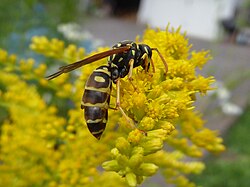
In the complex world of insect interactions, few species exhibit a lifestyle as peculiar as Xenos vesparum. First described in 1793, this parasitic insect belongs to the order Strepsiptera and specializes as an endoparasite—an organism that lives inside its host—specifically targeting paper wasps of the genus Polistes, most notably Polistes dominula.
The biological strategy of X. vesparum is defined by extreme sexual dimorphism, where males and females possess entirely different physical forms and ecological roles to ensure the survival of the species.
Key Facts
- Host: Primarily targets paper wasps in the genus Polistes.
- Sexual Dimorphism: Males are free-flying; females are permanent endoparasites.
- Male Lifespan: Extremely short, typically lasting less than five hours.
- Life Cycle: Begins as mobile larvae called triungulins.
- Host Impact: Causes reproductive castration in female wasps and modifies their behavior.
- Stylopization: The process where the parasite extrudes from the host's abdomen.
Morphology and Sexual Dimorphism
The physical differences between the sexes of X. vesparum are a direct result of their mating system. Both sexes develop within the abdomen of the host wasp, but their paths diverge sharply upon reaching maturity.
The Free-Living Male
Adult males are small, winged insects whose sole purpose is reproduction. Their adult lives are fleeting, lasting less than five hours. They locate mates via scent and land on the abdomen of an infected wasp. To avoid being brushed off by the wasp's hindlegs, they cling tightly with their legs and wings. Insemination occurs either by spreading sperm around the female's genital opening or through hypodermic insemination, where the male penetrates the female's cuticle to inject sperm directly into the haemocoel (the primary body cavity). The male dies shortly after mating.
The male's anatomy is highly specialized. Their eyes contain only about 65 ommatidia (individual visual units), far fewer than the thousands found in most insects. These eyes are irregularly distributed and resemble the eyes of phacopid trilobites. Additionally, their forewings are modified into club-like organs called pseudohalteres, which function similarly to the halteres of flies to maintain equilibrium during flight.
The Neotenic Female
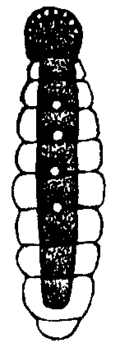
Females exhibit neoteny, a condition where they retain larval characteristics into adulthood. They remain permanent endoparasites, residing entirely within the host's body cavity. They never develop wings, legs, eyes, or mouthparts. Their only external feature is a ventral opening used for mating and the release of larvae.
The Life Cycle of Xenos vesparum
The life cycle of X. vesparum is a sophisticated journey from a mobile larva to a specialized adult.
- Triungulin Stage: The first stage consists of mobile larvae called triungulins. These larvae exit the mother's genital opening, guided by light. They are deposited either in the wasp nest or in foraging areas. If the latter, they use chemical cues to find a foraging wasp, attach to it, and are carried back to the nest.
- Infection: Once in the nest, triungulins seek out immature wasps, showing a preference for females. They enter the host's abdomen via mechanical separation of the cuticle, avoiding the creation of a wound to bypass the host's initial immune response.
- Growth and Evasion: The second and third larval stages grow slowly to ensure the host survives. They avoid the host's immune system through unknown chemical properties and a unique method of moulting without ecdysis (the shedding of the exoskeleton), a trait unique to strepsipterans.
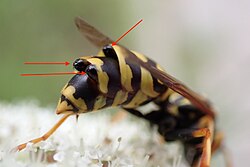
- Stylopization: In the final stage, the parasite develops into its adult form. Males pupate and emerge from the abdomen. Females remain inside but extrude their posterior end just enough for mating and larval release. This extrusion is known as stylopization.
Impact on the Host Wasp
Behavioral Manipulation
Infected female worker wasps undergo significant behavioral changes. They cease their colony duties and act as if they are future queens, abandoning the nest earlier than uninfected wasps. They often congregate on Campsis radicans (trumpet creeper) bushes. This preference is believed to be a coevolved trait; the plant provides excellent nutrition and shelter for the wasp, ensuring the host survives long enough for the parasite to spread. These aggregations also bring infected and uninfected wasps together, facilitating the spread of triungulin larvae.
Reproductive Castration
Female wasps infected with X. vesparum suffer from parasitic castration. Their ovaries remain undeveloped, and their juvenile hormone levels drop, rendering them reproductively dead. Because of this, the parasite is sometimes described as a parasitoid when infecting females. In contrast, male wasps with light to moderate parasite loads appear to remain reproductively healthy, though the effects of heavy infections (more than four parasites) are not yet fully understood.
| Feature | Female Host Wasp | Male Host Wasp |
|---|---|---|
| Reproductive Status | Castrated (Undeveloped ovaries) | Generally unaffected (low/moderate load) |
| Behavioral Change | Abandons nest; forms aggregations | No significant modification |
| Parasite Outcome | High success for larval spread | "Dead end" for females; viable for males |
| Plant Preference | Strong preference for Trumpet Creeper | Not observed |
Frequently Asked Questions
What is stylopization?
Stylopization is the process by which the Xenos vesparum parasite extrudes its body (the male pupa or the adult female's posterior) through the abdomen of the host wasp to allow for emergence or mating.
How do male Xenos vesparum find mates?
Despite having highly modified eyes, adult males are thought to locate females primarily through scent. Their adult life is extremely short, lasting less than five hours, dedicated entirely to this search.
Why do infected wasps prefer trumpet creeper bushes?
This is likely a result of coevolution. The bushes provide the wasp with superior nutrition and shelter, increasing the host's survival rate and creating a concentrated area where the parasite can easily spread to other wasps.
What are triungulins?
Triungulins are the first-stage, free-living larvae of X. vesparum. They are responsible for locating and infecting new host wasps, often by hitching a ride on a foraging adult wasp to reach the nest.
Does the parasite kill the host wasp?
No, the parasite generally avoids killing the host, as the host's survival is paramount to the parasite's own survival. However, it does effectively castrate female hosts, preventing them from reproducing.