Wymondham Village: A Journey Through History and Heritage
Nestled in the English countryside, Wymondham is a village where medieval history and quaint rural charm coexist. From its ancient manor and architectural landmarks to its surprising connection to one of Britain's most famous cheeses, the village offers a rich tapestry of stories that span centuries.
Key Facts
- St Peter's Church: A 13th-century cruciform church featuring Early English and Perpendicular styles.
- The Manor: Historically held by the Hamelin family before passing to the Berkeley family.
- Railway Heritage: Home to the former Edmondthorpe and Wymondham station on the Midland and Great Northern Joint Railway.
- Culinary Legacy: Traditionally linked to Frances Pawlett, a pioneer in the shaping of modern Stilton cheese.
- Local Landmarks: Includes the Berkeley Arms pub and a converted windmill visitor attraction.
The Manor and the Hamelin Legacy
The history of Wymondham is deeply intertwined with the Hamelin family, who held the manor during the 1200s. In 1290, William Hamelin established a chantry chapel—a small chapel where a priest was paid to sing masses for the soul of the founder—in the south transept of the parish church. This arrangement was funded by land grants in Wymondham, Saxby, and Thorp Edmer. However, the chantry likely ceased to exist by 1553 following the Reformation, which abolished masses for the departed.
Records from 1297 show that Sir John Hamelin and Sir William de Hamelin held a knight's fee under Edmund, Earl of Lancaster (the brother of King Edward Longshanks). The Hamelin lineage eventually influenced the Hamlyn baronets through their coat of arms.
A striking monument in the church's south transept depicts Sir John Hamelin as a cross-legged knight; he is believed to have participated in three crusades. The manor eventually passed to the Berkeley family through Sir John's daughter and heiress, Isabel Hamelin, and her husband, Sir Thomas Berkeley. Sir Thomas, a prominent lawyer and politician who died in 1488, served as Sheriff for Rutland, Warwickshire, and Leicestershire.
St Peter's Church and Village Life
St Peter's Church serves as the spiritual heart of the village. Built in the 13th century, the structure follows a cruciform plan (shaped like a cross) in the Early English style, while the spire and the third storey of the tower reflect the later Perpendicular style. The church is well-known for hosting the June 2007 wedding of footballer Michael Carrick and Lisa Roughead.
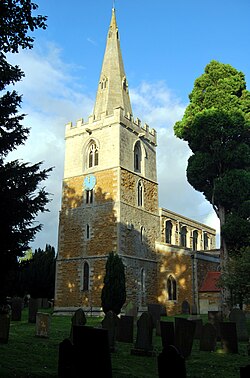
A notable addition to the church is the clock installed on November 23, 1906, by John Smith and Sons of Derby. Costing £121 at the time (approximately £12,720 in 2025), the clock features two external dials, strikes the hours, and chimes the Cambridge Quarters.
Beyond the church, the village maintains a close-knit community atmosphere. Residents enjoy the Berkeley Arms pub, a primary school, a pre-school group, and a large playing field named after Sir John Sedley. For visitors, a converted windmill provides a tea room and craft shops, while a mobile Post Office visits twice weekly.
The Disused Railway and Industrial Past
To the north of the village lies the remnant of the Midland and Great Northern Joint Railway branch line, which once connected Saxby and Bourne. The Edmondthorpe and Wymondham railway station was a key stop, though it closed to passengers in 1959. Despite the passenger closure, the line remained active for ironstone freight and was even used by Queen Elizabeth during a journey in 1967.
The line also facilitated holiday travel from Leicester to Skegness. Today, those traveling along Butt Lane toward the windmill can still see the former goods shed, the station, the Station House, and the Grade II Listed Navvies' Cottage.
The Origins of Stilton Cheese
Wymondham claims a fascinating place in culinary history. Frances Pawlett (or Paulet), a skilled cheesemaker from the village, is traditionally credited with establishing the specific shape and style characteristics of modern Stilton cheese during the 1720s, although other figures have also been mentioned in historical accounts.
Village Summary
| Category | Detail |
|---|---|
| Primary Church | St Peter's (13th Century) |
| Historic Families | Hamelin and Berkeley |
| Railway Line | Midland and Great Northern Joint Railway |
| Notable Product | Stilton Cheese (attributed to Frances Pawlett) |
| Local Pub | The Berkeley Arms |
Frequently Asked Questions
Who was Sir John Hamelin?
Sir John Hamelin was a 13th-century landowner in Wymondham and a knight who is believed to have been a crusader on three separate occasions. His effigy remains in the south transept of St Peter's Church.
What is the architectural style of St Peter's Church?
The church was primarily built in the Early English style on a cruciform plan, with the spire and the tower's third storey constructed in the Perpendicular style.
When did the local railway station close?
The Edmondthorpe and Wymondham railway station closed to passengers in 1959, although it continued to be used for ironstone freight and royal visits.
What is Wymondham's connection to Stilton cheese?
Frances Pawlett, a cheesemaker from Wymondham, is traditionally credited with defining the modern shape and style of Stilton cheese in the 1720s.
How much did the church clock cost originally?
The clock, installed in 1906 by John Smith and Sons, cost £121, which is equivalent to approximately £12,720 in 2025.