WUOT Radio: A History of Public Broadcasting at the University of Tennessee
The story of WUOT is one of academic ambition and community service. What began as a campaign promise for a student body presidency evolved into a cornerstone of public broadcasting in East Tennessee, bridging the gap between the University of Tennessee (UT) and the wider Appalachian region.
The Foundations of WUOT
The vision for a university-led radio station was championed by Howard Baker, who included the idea as a plank in his campaign for student body president at UTK. On June 2, 1949, the University of Tennessee officially applied to the Federal Communications Commission (FCC) for a construction permit to establish a noncommercial FM station in Knoxville.
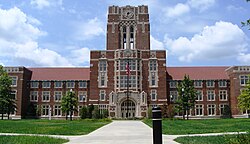
The FCC approved the application within a month. To get the station off the ground, the university acquired equipment from WKPB, a defunct commercial station previously owned by The Knoxville Journal. The Journal had shuttered WKPB on April 15, 1949, due to the rising uncertainty brought about by the advent of television. For a total of $16,000, the university secured the necessary hardware and established its first studios on the ground floor of Ayres Hall.
Early Growth and Technical Expansion
WUOT officially signed on the air on October 27, 1949. In its early days, the station was entirely student-operated, broadcasting for five and a half hours daily. The programming was a mix of informational segments, classical music, and reports on student activities. Beyond its own signal, the university produced 25 radio programs that were distributed to 17 commercial stations across Tennessee by 1950; by 1956, this network grew to 65 stations.
The station's technical capabilities saw a massive leap in 1955. Through a generous contribution from station WROL—which provided a 10 kW transmitter valued at $50,000 and a higher-power antenna—WUOT increased its power from 3,500 watts to 70,500 watts. This upgrade required a large crane to extend the tower by 75 feet (23 m) at a site near the John Tarleton Institute. This expansion allowed the signal to reach as far as Asheville, North Carolina, and Blue Ridge, Georgia.
Further milestones followed: the transmitter moved to Sharp's Ridge in 1961, and by 1968, the station reached its maximum power of 100,000 watts and introduced stereo broadcasting. In 1971, the station expanded its musical offerings to include more jazz, a change prompted by requests from inmates at the Brushy Mountain State Penitentiary.
Modernization and the NPR Era
As the station grew, it outgrew its original home. After discussions in the mid-1960s, WUOT moved into a dedicated communications building in Circle Park in 1969, providing more space and updated equipment.
WUOT holds the distinction of being a charter member of National Public Radio (NPR). In 1971, it carried the first broadcast of All Things Considered. While the introduction of this network program replaced the popular light classical "dinner hour" music—much to the chagrin of some listeners—it marked a shift toward the public affairs and local news programming that would be significantly expanded by the mid-1990s.

Diversification of the Airwaves
While WUOT maintained its focus on fine arts, student demand for rock music eventually led to the launch of WUTK-FM in the early 1980s. The station's influence also extended to other campuses; when the University of Tennessee at Chattanooga launched WUTC in 1980, it initially simulcast WUOT's programming to get on the air quickly before developing its own independent schedule.
Community Impact and Innovation
In recent years, WUOT has leveraged its resources for deep-dive community reporting. In 2017, the station launched "TruckBeat," a project partnering with an independent producer to report on the opioid epidemic in rural East Tennessee. The project utilized a former WBIR-TV live truck, which the station had originally purchased to cover the 1982 World's Fair. This initiative was recognized by the Online News Association for its excellence in topical reporting among small newsrooms.
Key Facts
- Founded: Signed on October 27, 1949.
- Original Location: Ground floor of Ayres Hall.
- Peak Power: 100,000 watts (achieved in 1968).
- NPR Status: Charter member of National Public Radio.
- Notable Project: "TruckBeat," focusing on the rural opioid epidemic.
- Initial Cost: $16,000 for equipment from defunct station WKPB.
| Year | Milestone | Detail |
|---|---|---|
| 1949 | Launch | Signed on Oct 27; student-operated. |
| 1955 | Power Boost | Increased to 70,500 watts via WROL equipment. |
| 1961 | Relocation | Transmitter moved to Sharp's Ridge. |
| 1968 | Max Power | Reached 100,000 watts and began stereo broadcasts. |
| 1969 | New Facility | Moved from Ayres Hall to Circle Park. |
| 1971 | NPR Integration | Carried first broadcast of All Things Considered. |
Frequently Asked Questions
Who was responsible for the initial idea of a UT radio station?
The idea was a campaign plank for Howard Baker when he ran for student body president at the University of Tennessee.
How did WUOT acquire its first set of equipment?
The university purchased equipment for $16,000 from WKPB, a commercial station owned by The Knoxville Journal that had closed due to the rise of television.
What is the significance of WUOT's relationship with NPR?
WUOT was a charter member of National Public Radio and was among the first to broadcast the program All Things Considered in 1971.
Why was jazz music added to the schedule in 1971?
The addition of jazz hours was a direct response to requests made by inmates at the Brushy Mountain State Penitentiary.
What was "TruckBeat"?
TruckBeat was a reporting project that used a repurposed 1982 World's Fair live truck to travel rural East Tennessee and report on the impacts of the opioid epidemic.