Wright County Demographics: Population Trends and Census Analysis
Wright County has experienced a significant demographic transformation over the last century and a half. From a small settlement in the mid-19th century to a growing modern community, the county's population trajectory reflects broader regional shifts in urbanization and migration. By analyzing decennial census data, we can see a clear pattern of steady growth that accelerated sharply toward the end of the 20th century.
Population Growth History
The population of Wright County began at 3,729 in 1860 and grew rapidly during the late 1800s. After a period of relative stability between 1900 and 1960—where the population hovered around 27,000 to 29,000 residents—the county entered a phase of exponential growth starting in 1970. This surge continued through the early 21st century, with the population reaching 141,337 by the 2020 census.
Current estimates suggest this upward trend continues, with a projected population of 157,557 by 2025.
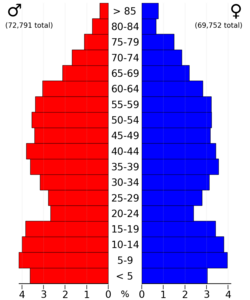
2020 Census Detailed Analysis
The 2020 United States census provides a comprehensive snapshot of the county's current social and physical landscape. The median age—the age that divides the population into two numerically equal groups—was 37.4 years. The age distribution shows that 28.3% of residents are under 18, while 13.3% are 65 years of age or older.
Gender and Urbanization
The gender ratio remains nearly balanced, with 101.4 males for every 100 females. Among adults (18 and over), the ratio shifts slightly to 99.5 males for every 100 females. In terms of residency, 60.8% of the population lives in urban areas, while 39.2% reside in rural settings.
Household and Housing Statistics
There were 50,509 households recorded in 2020. Family structures vary, with 59.7% being married-couple households, 18.5% featuring a female householder with no spouse or partner, and 14.9% featuring a male householder with no spouse or partner. Approximately 21.1% of all households consist of individuals, and 8.9% are individuals aged 65 or older living alone.
The county contains 54,467 housing units, with a total vacancy rate of 7.3%. Homeownership is high, with 83.4% of occupied units being owner-occupied and 16.6% being renter-occupied.
Racial and Ethnic Composition
Wright County has historically been predominantly White, though it has become more diverse over the last four decades. In 2020, the racial makeup was 89.9% White, 5.0% from two or more races, 1.9% Black or African American, 1.3% Asian, 1.6% from other races, and 0.3% American Indian and Alaska Native. Hispanic or Latino residents of any race made up 3.3% of the population.
Looking back to the 2000 census, the county's ancestry was heavily influenced by Northern European roots, with 42.3% of residents claiming German ancestry, followed by Norwegian (11.9%), Swedish (7.4%), and Irish (6.6%).
Key Facts
- Total Population (2020): 141,337 residents.
- Projected Population (2025): 157,557.
- Median Age: 37.4 years (as of 2020).
- Homeownership Rate: 83.4% of occupied housing units.
- Urban vs. Rural: 60.8% urban, 39.2% rural.
- Primary Ancestry: German (42.3% in 2000).
Population Summary Table
| Census Year | Total Population | % Change | Median Age |
|---|---|---|---|
| 1860 | 3,729 | — | N/A |
| 1900 | 29,157 | 20.7% | N/A |
| 1960 | 29,935 | 8.0% | N/A |
| 2000 | 89,986 | 31.0% | 33.0 |
| 2010 | 124,700 | 38.6% | N/A |
| 2020 | 141,337 | 13.3% | 37.4 |
Frequently Asked Questions
How has the population of Wright County changed since 1860?
The population has grown from 3,729 in 1860 to 141,337 in 2020, with the most rapid growth occurring between 1970 and 2020.
What is the racial composition of the county as of 2020?
The county is 89.9% White, 5.0% multiracial, 1.9% Black or African American, 1.3% Asian, 1.6% other races, and 0.3% American Indian and Alaska Native, with 3.3% identifying as Hispanic or Latino.
What are the housing trends in Wright County?
As of 2020, the county has a high owner-occupancy rate of 83.4%, with a relatively low overall vacancy rate of 7.3%.
What was the economic status of the county in 2000?
In 2000, the median household income was $53,945 and the median family income was $60,940, with a per capita income of $21,844. Approximately 4.7% of the population lived below the poverty line.
What is the age distribution of the population?
Based on 2020 data, the median age is 37.4 years, with 28.3% of the population under 18 and 13.3% aged 65 or older.