World Heritage in Danger: Protecting Humanity's Most Threatened Sites
The global community recognizes that some of the world's most precious landmarks and ecosystems are fragile. To address this, the United Nations Educational, Scientific and Cultural Organization (UNESCO) maintains the List of World Heritage in Danger. Established in 1972 under the World Heritage Convention, this list serves as a critical tool for designating and managing sites that face significant threats and require urgent international attention.
The primary goal of the list is to raise global awareness and mobilize counteractive measures. By identifying sites where conservation requires major interventions, UNESCO encourages the involved State Parties to implement corrective actions to ensure these treasures are preserved for future generations.
Key Facts
- Purpose: To alert the international community to imminent or potential threats to World Heritage Sites.
- Current Status: As of May 2026, there are 53 sites on the list (39 cultural and 14 natural).
- Regional Distribution: The Arab States hold the highest number of endangered sites (22), followed by Africa (12).
- Financial Aid: The World Heritage Fund may provide financial support to properties listed as being in danger.
- Outcome: Sites can be removed from the danger list after improvement, or in extreme cases, delisted from the World Heritage List entirely.
Defining the Threats: Natural vs. Cultural
UNESCO distinguishes between ascertained dangers (proven imminent threats) and potential dangers. The nature of these threats varies depending on whether the site is a natural or cultural property.
Natural Sites
For natural properties, ascertained dangers include a serious decline in the population of endangered or valuable species, or the deterioration of scientific value and natural beauty. These are often caused by human activities such as:
- Logging and mining
- Pollution and settlement
- Agriculture and major public works
Cultural Sites
Cultural properties face ascertained dangers when there is a serious deterioration of architectural coherence, ornamentation, structure, or materials. This often results in a loss of historical authenticity or cultural significance.
Both types of sites are susceptible to potential dangers, including armed conflicts, inadequate management systems, development projects, or changes in legal protective status. Cultural sites may also be threatened by gradual environmental, climatic, or geological changes.
The Process of Inscription and Recovery
A site is not added to the danger list arbitrarily. First, its condition is assessed, and a program for corrective measures is developed in cooperation with the State Party. The World Heritage Committee then makes the final decision on inscription.
Once listed, the state of conservation is reviewed annually. Depending on the progress, the committee may request further measures or remove the site from the danger list if the threats have ceased. In severe cases, a site may be delisted from the World Heritage List entirely. For example, the Dresden Elbe Valley and the Liverpool Maritime Mercantile City were delisted after being placed on the danger list, while the Arabian Oryx Sanctuary was delisted directly.
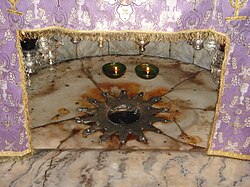
Some sites are so critically threatened that they are designated as both a World Heritage Site and World Heritage in Danger in the same year. A notable example is the Church of the Nativity, traditionally regarded as the birthplace of Jesus, which was later removed from the danger list in 2019.
Global Distribution of Endangered Sites
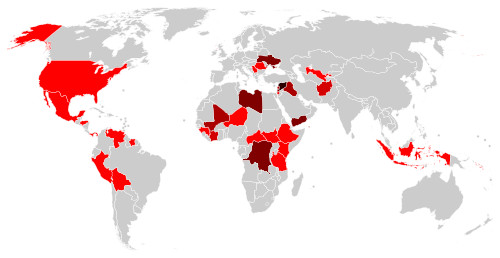
The distribution of endangered sites reflects various global crises, from environmental degradation to geopolitical instability. Armed conflict has had a devastating impact in regions like Syria, endangering the Ancient City of Aleppo and the Ancient Villages of Northern Syria. Similarly, in the Democratic Republic of the Congo, military conflict and environmental decay threaten multiple national parks.
| UNESCO Region | Number of Sites |
|---|---|
| Arab States | 22 |
| Africa | 12 |
| Europe and North America | 7 |
| Latin America and the Caribbean | 6 |
| Asia and the Pacific | 6 |
| Total | 53 |
Frequently Asked Questions
What happens if a site is delisted from the World Heritage List?
Delisting is the most severe action UNESCO can take. It occurs when a site has lost the characteristics that originally gave it its Outstanding Universal Value, often following a period on the List of World Heritage in Danger.
Can a site be listed as endangered and a World Heritage Site simultaneously?
Yes. Some sites are inscribed on both the World Heritage List and the List of World Heritage in Danger in the same year if the threats are immediate upon their recognition.
How does UNESCO help sites on the danger list?
UNESCO provides international visibility to the threats and may allocate financial support from the World Heritage Fund to assist in conservation and corrective measures.
What are the most common threats to natural sites?
Natural sites are primarily threatened by human activities such as pollution, logging, mining, and agriculture, as well as the decline of endangered species populations.
Which region currently has the most endangered sites?
As of May 2026, the Arab States have the highest number of sites on the List of World Heritage in Danger, with 22 listed properties.