Woodville Railway Station: A History of New Zealand's Rail Hub
For over a century, Woodville served as a critical junction in New Zealand's rail network, bridging the gap between the Hawkes Bay region, the Manawatū, and Wellington. From its beginnings as a remote railhead to its era as a bustling transit hub, the station's evolution mirrors the broader development of the nation's transport infrastructure.
Key Facts
- First Train: Arrived on 22 March 1887.
- Strategic Junction: Connected the Palmerston North–Napier line with the Wellington–Woodville railway in 1897.
- Major Infrastructure: Featured a unique balloon loop installed in the 1960s to manage rolling stock coupling.
- Passenger Services: Hosted the Napier Express, Wairarapa Mail, and later the Bay Express.
- Closure: Timetabled passenger services ended on 8 October 2001.
Early Years: 1887–1897
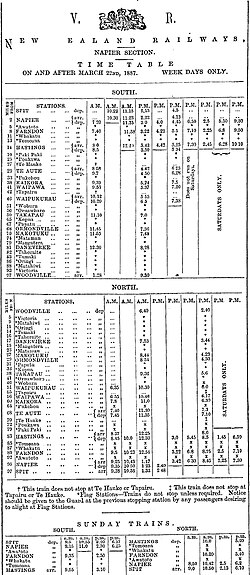
Woodville began as a station on the Palmerston North–Napier line, which was built southwards from Napier during the 1880s. The railhead reached Woodville on 22 March 1887, where it remained the terminus for four years until the line was extended through the Manawatū Gorge to Palmerston North in March 1891.
During this period, passengers traveling south to the Wairarapa or west to Palmerston North relied on private coach operators. Once the line to Palmerston North was completed, the Napier Express was inaugurated, connecting the Hawkes Bay region to Wellington via services operated by the Wellington and Manawatu Railway company at Longburn.
The Golden Era: 1897–1908
A pivotal moment occurred on 11 December 1897, when the Wellington–Woodville railway connected with the Palmerston North–Napier line. This gave the government its own direct rail link from Wellington into the Manawatū and Hawkes Bay regions, sparking a surge in freight traffic.
To avoid losing traffic to private companies, the Railways Department rerouted the Napier Express south through the Wairarapa to Wellington. However, this was unpopular with passengers; the journey time increased by an hour due to the operational challenges of the Rimutaka Incline, a steep section of track requiring specialized operation.
Operational Evolution: 1908–2001
The nationalization of the Wellington–Manawatu line in 1908 led to a shift in traffic. Because this route was superior to the Wairarapa Line, freight and the Napier Express were diverted back through Palmerston North. This trend shifted again in 1955 with the opening of the Rimutaka Tunnel, which allowed Wellington–Napier freight to return to the Wairarapa Line.
Passenger Services and Railcars
Woodville became the terminus for the Wairarapa Mail, a locomotive-hauled service. In 1936, Wairarapa-class RM railcars were introduced, eventually replacing the Mail in 1948 due to coal shortages. Following the Rimutaka Tunnel opening, these were replaced by twinset railcars.
By the mid-1960s, locomotive-hauled trains returned, fully replacing railcars by 1977. The route saw the introduction of the Endeavour in 1972, which later became the Bay Express in 1989. Due to declining patronage, these services were cancelled by October 2001.
Station Staffing (1959)
At its peak, the station required a significant workforce to maintain operations. In 1959, the staff complement totaled 29 members.
| Position | Number of Staff |
|---|---|
| Stationmasters | 1 |
| Section Officers | 1 |
| Shift Clerks | 2 |
| Cadets | 2 |
| Office Assistants | 1 |
| Exchange Attendant | 1 |
| Guards | 4 |
| Signalmen | 7 |
| Shunters and Traffic Assistants | 11 |
| Numbertakers | 3 |
| Traffic Assistants and Junior Porters | 4 |
Station Facilities and Architecture
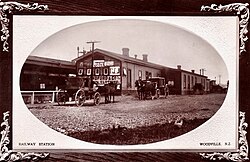
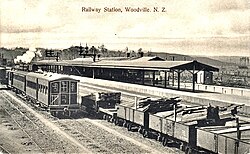
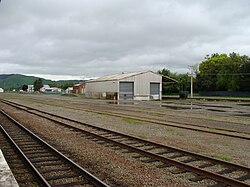
The original 1887 station was a wooden building with a sealed platform, a 6th class station design featuring a verandah, goods shed, and engine shed. Over the years, it was upgraded to 3rd class, adding a crane, fixed signals, and a passing loop for wagons.
A notable feature was the Refreshment Room, leased initially to Thomas Fairhurst in 1887. Once run by the Railways Department, it was described by author Katherine Mansfield as a "great barn of a place." It eventually closed on 9 November 1952, following a Royal Commission recommendation.
The Modern Station and Balloon Loop
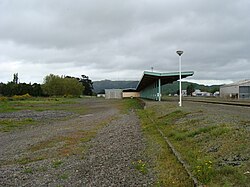
By 1960, the original building had deteriorated. A new station was planned alongside a balloon loop (a circular track allowing trains to turn around without reversing). This loop was necessary because the overall route from Wellington to Woodville and back acted as a giant loop, causing coupling hooks on wagons to face the wrong direction.
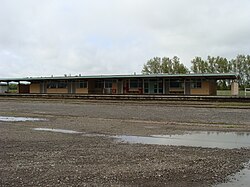
The new station, a composite construction of concrete, timber, and block veneer, was occupied on 11 December 1964. The entire project, including the deviation and a new power signalling system, was officially opened by Minister of Railways J.K. McAlpine on 25 July 1966.
Frequently Asked Questions
Why was a balloon loop installed at Woodville?
The balloon loop was installed to ensure rolling stock coupling hooks faced the correct direction. Because the route between Wellington, Palmerston North, and Woodville formed a massive loop, hooks often ended up reversed, requiring manual correction by teams of men.
What was the Rimutaka Incline?
The Rimutaka Incline was a steep section of the Wairarapa Line. Its operational requirements were so demanding that they increased journey times by an hour, making the route less popular than the alternative via Palmerston North.
When did passenger services officially end at Woodville?
Timetabled passenger services ended on 8 October 2001, following the cancellation of the Bay Express due to declining patronage.
Who was the author that described the Woodville dining room?
New Zealand author Katherine Mansfield described the refreshment room as a "great barn of a place" filled with papered chandeliers and long tables.
What replaced the Wairarapa Mail?
The Wairarapa Mail was replaced by Wairarapa-class RM railcars in 1948, primarily due to coal shortages.