Women's Shinty Competition Structure and Leagues
Women's shinty has evolved from a small gathering of pioneering clubs into a structured national competition. Originally established with teams like Dunadd, Glengarry, and Oban Camancheroes, the league system has expanded significantly to encompass the majority of the sport's primary playing regions across Scotland.
The Evolution of the League System
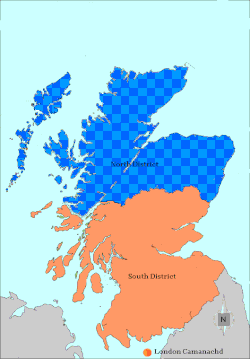
The organizational structure of the Women's Camanachd Association (WCA) has undergone several changes to ensure the growth of the game. Prior to 2013, the system consisted of a National League One featuring 10-a-side teams, supported by two regional divisions based on the traditional North and South Districts where teams played 8-a-side.
However, this regional split often resulted in very small leagues and a shortage of matches, which hindered the overall development of the sport. To combat this, the WCA implemented a major restructuring in 2014.
In 2014, the WCA amalgamated the North and South Divisions Two into a single National Division Two. Combined with the promotion of Skye and Lochaber to National Division One, this change created two substantial leagues, providing players with more regular competitive opportunities.
National Division One (2014)
The top tier of the competition in 2014 featured the following clubs:
- Glasgow Mid-Argyll
- Aberdour
- Skye Camanachd
- Lochaber
- Glengarry
- Badenoch & Strathspey
National Division Two (2014)
The second tier provided a competitive platform for developing clubs and reserve sides:
- Oban Lorn
- Lovat
- Ardnamurchan
- Glasgow Mid-Argyll (Reserve team)
- Strathglass
- Dunadd Camanachd
- Cowal & Bute
Cup Competitions
Beyond the league format, the WCA oversees prestigious knockout competitions that define the women's shinty calendar.
The Valerie Fraser Trophy
The Valerie Fraser Trophy is the women's equivalent of the men's Camanachd Cup, representing the pinnacle of achievement in the sport. To encourage wider participation, Division Two teams were granted entry into the competition starting in 2012. Currently, a club needs to win two games to secure the trophy. The competition has been sponsored by Peter Gow of Inverness for several years.
WCA Challenge Cup
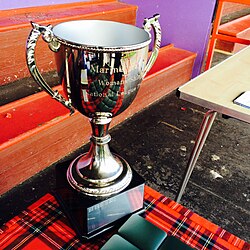
The Women's Camanachd Association Challenge Cup serves as a dedicated competition for reserve sides and teams competing in Division Two. This tournament is sponsored by Mowi.
Representative Matches
At the highest level of the game, representative matches are held for senior and U-18 players. These contests pit the North District against the South District and are traditionally hosted in Oban. Notably, these representative games are among the few instances where the women's game is played as 12-a-side.
Key Facts
- League Expansion: The WCA moved from regional North/South divisions to a National Division Two in 2014 to increase the number of games.
- Premier Trophy: The Valerie Fraser Trophy is the top honor in women's shinty.
- Team Sizes: League play typically varies between 8 and 10-a-side, while representative games use a 12-a-side format.
- Representative Hub: Oban is the traditional venue for North vs. South representative matches.
| Competition | Level/Eligibility | Key Detail |
|---|---|---|
| National Division One | Top Tier | 10-a-side format |
| National Division Two | Second Tier / Reserves | Amalgamated in 2014 |
| Valerie Fraser Trophy | Open (Div 1 & 2) | Equivalent to Camanachd Cup |
| WCA Challenge Cup | Div 2 & Reserves | Sponsored by Mowi |
| Representative Games | North vs. South | 12-a-side format |
Frequently Asked Questions
What is the equivalent of the Camanachd Cup for women?
The Valerie Fraser Trophy is the women's equivalent of the men's Camanachd Cup.
Why did the WCA change the league structure in 2014?
The previous regional North and South divisions often resulted in very small leagues and a lack of games, which stunted the growth of the sport. Amalgamating them into a National Division Two allowed for more regular play.
How many players are on the field during representative games?
Representative games at the senior and U-18 levels are played 12-a-side, which is one of the few times this format is used in the women's game.
Who is eligible to play in the WCA Challenge Cup?
The WCA Challenge Cup is specifically for reserve sides and teams playing in National Division Two.
Where are the North and South representative games usually played?
These matches are traditionally played in Oban.