Wireless USB Protocol Architecture and Implementation
Wireless USB (W-USB) adapts the traditional USB model to a wireless environment, ensuring that the familiar connectivity experience is maintained while addressing the unique challenges of radio frequency communication. By modifying the existing protocol stack, W-USB enables secure, efficient data transfer without the need for physical copper wiring.
The W-USB Protocol Stack
The architecture of W-USB preserves the core USB model but introduces specific adjustments across three primary layers to accommodate wireless needs:
- Function Layer: Undergoes minor changes to improve overall efficiency and provide support for isochronism (the delivery of data at a constant rate).
- Device Layer: Now incorporates specialized device management and security features tailored for wireless connectivity.
- Bus Layer: While its core functionality remains the same, it has been substantially adapted to ensure security and efficiency over wireless networks.
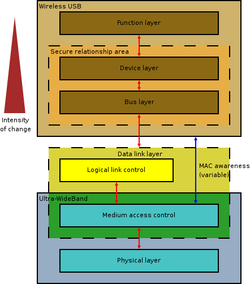
Addressing Wireless Challenges
Moving from copper wires to wireless signals introduces two primary risks: uncertainty regarding the connection state between the host and device, and increased exposure to eavesdropping. To mitigate these, W-USB establishes an explicit secure relationship. The bus layer handles the encryption of every transmission, ensuring that communication remains private without disrupting the interaction between other layers.
Data Transmission and Efficiency
W-USB utilizes a TDMA (Time Division Multiple Access) polling approach supervised by the host. Each transfer consists of three components: a token, the data itself, and a handshake. To maximize efficiency, multiple tokens containing timing information can be grouped into transaction groups. Additionally, packet sizes and flow control have been optimized for power efficiency while maintaining the high-level pipe model used in standard USB.
Because wireless media typically experience higher error rates than wired connections, W-USB modifies its buffering and data handshake mechanisms to maintain stability.
Integration with UWB
W-USB integrates with Ultra-Wideband (UWB) by defining two critical layers: the PHY (Physical) layer and the MAC (Medium Access Control) layer. The MAC layer is combined with the Logical Link Control (LLC) sublayer to create the link layer. This link layer is responsible for synchronization, PHY error management, and encryption/decryption. The PHY layer focuses specifically on the correctness of headers rather than the payloads.
MAC Layer and Superframes
The MAC layer organizes communication into superframes, which are divided into 256 time slots. The initial slots are reserved for beaconing information. Other slots are allocated to clusters of devices, identified by MMCs. While the host is fully aware of the MAC layer and manages one or more communication channels, devices simply use the W-USB interface to communicate.
Device Beaconing Categories
Devices are categorized by their level of "MAC consciousness," which determines how they interact with the network:
- Self-beaconing devices: The most capable devices, able to perform beaconing independently.
- Directed-beaconing devices: These have limited capabilities and rely on the host to detect and beacon for nearby devices.
- Non-beaconing devices: These have very limited transmission and reception abilities and must operate in very close proximity to the host.
To maintain network precision, hosts manage global timers with an accuracy of 20 ppm (parts per million). This precision is vital for slot allocation and accurate beaconing. Devices may also use beacons to declare reservations.
Asynchronous Transfers and Endpoints
The superframe includes specific time slots for device notification. These are used for asynchronous transfers initiated by the devices, which bypass the standard pipes and tap the bus layer directly. The host assigns these slots dynamically. All other W-USB transactions between the host and endpoints function similarly to standard USB.
Key Facts
- Encryption: All W-USB transmissions are encrypted at the bus layer.
- Timing: Superframes consist of 256 time slots.
- Precision: Host global timers must maintain a precision of 20 ppm.
- Structure: Transfers are composed of a token, data, and a handshake.
- UWB Integration: The MAC and LLC sublayers merge to form the link layer.
| Device Type | MAC Consciousness | Beaconing Ability | Operational Range |
|---|---|---|---|
| Self-beaconing | High | Independent | Standard |
| Directed-beaconing | Medium | Host-dependent | Standard |
| Non-beaconing | Low | None/Very Limited | Very Close Proximity |
Frequently Asked Questions
How does W-USB ensure security compared to wired USB?
Unlike wired connections, W-USB is exposed to any device within signal range. It solves this by establishing an explicit secure relationship and encrypting every transmission at the bus layer.
What is the role of the superframe in W-USB?
The superframe organizes wireless communication into 256 time slots, allowing the host to manage beaconing information, allocate slots to device clusters, and handle asynchronous transfers.
What is the difference between the PHY and MAC layers in this context?
The PHY layer ensures the correctness of headers, while the MAC layer (as part of the link layer) handles synchronization, encryption, and the management of time slots within the superframe.
Why is timer precision important for the W-USB host?
Hosts must maintain timers with 20 ppm precision because channel time is sent within MMCs and used for slot allocation; inaccurate timing would disrupt the TDMA-based polling system.
Can non-beaconing devices communicate over long distances?
No, non-beaconing devices have very limited transmission and reception capabilities and can only operate in very close vicinity to the host.