William Walton: The Confidant and Architect of John F. Kennedy's Legacy
While history remembers the inner circle of the Kennedy administration through official titles and political appointments, few figures were as influential yet invisible as William Walton. A man of diverse talents—ranging from journalism and abstract expressionist painting to high-stakes political organizing—Walton served as one of President John F. Kennedy's most trusted friends and confidants.
Walton's relationship with the Kennedys began in the neighborhood of Georgetown, where he lived at 2903 P Street NW. The bond was immediate and affectionate; Kennedy nicknamed him "Billy Boy," while Jacqueline Kennedy referred to him as "Baron" or "Czar." Beyond social ties, Walton acted as a bridge to the Washington elite, introducing the couple to Washington Post publisher Katharine Graham.
Key Facts
- Political Role: Managed JFK's 1960 campaign operations in New York, West Virginia, and Wisconsin.
- Personal Trust: One of the few people aware of JFK's severe health struggles, including Addison's disease.
- Aesthetic Influence: Advised Jacqueline Kennedy on White House redecoration and the design of the Oval Office.
- Funeral Coordination: Designed the catafalque and funerary decorations for JFK's lying-in-repose.
- Burial Site: Helped select the specific plot at Arlington National Cemetery, aligning it with the Lincoln Memorial.
The 1960 Presidential Campaign
Walton's transition from the arts to politics was marked by his organizational brilliance. He joined Kennedy's 1960 campaign in the spring, long before the nomination seemed certain. His ability to stabilize chaotic environments made him indispensable; Robert F. Kennedy specifically dispatched him to New York to manage a fractured state Democratic Party. Walton successfully neutralized internal conflict by hiring critical reporter William Haddad as an aide to Robert Kennedy.
Because of his proximity to the candidate, Walton was privy to secrets kept from the public. He witnessed the reality of Kennedy's failing health, which included chronic back problems, a deteriorating left knee, Addison's disease (a disorder affecting the adrenal glands), and a possible addiction to amphetamines. Walton observed an aide constantly accompanying the candidate with a kit of necessary medications.
By election night, Walton's status was cemented. He was among the few permitted to watch the returns with the family and attended an exclusive post-election dinner. It was during this dinner that Walton unsuccessfully urged Kennedy to remove J. Edgar Hoover as Director of the FBI.
Life in the White House
Despite his influence, Walton held no official government position, leaving him largely unknown to the general public. He often spent his time escorting Jacqueline Kennedy to social events when the president was occupied. His primary contribution to the administration's public face was aesthetic; he advised the First Lady on the redecoration of the White House, specifically integrating sculpture and paintings into the Oval Office.
Though he was an early opponent of the Vietnam War, his intellectual and gregarious nature ensured he remained a favorite of the First Family, even being invited to their first White House Thanksgiving in 1961.
Designing the State Funeral
Following the assassination of John F. Kennedy on November 22, 1963, Walton was thrust into a critical role in managing the nation's grief. When Jacqueline Kennedy expressed a desire for a catafalque (a raised platform for a coffin) similar to the one used for Abraham Lincoln, Walton took charge of the research and design.
Using engravings from Harper's Weekly, Walton sketched the bier and coordinated the decorations. He managed a staff of military officers and aides to drape the East Room in black crepe, carefully refining the design to avoid an "overwrought" appearance. He personally curated the religious artifacts for the room, rejecting several silver items in favor of a realistic wooden Benedictine crucifix and wooden candlesticks from Saint Stephen Martyr Catholic Church.
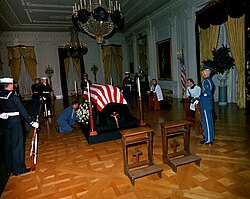
Walton's influence extended to the most intimate decisions of the funeral. He was one of the few who viewed the body before 5:00 A.M. on November 23, and his agreement with Secretary of Defense Robert McNamara convinced Robert Kennedy to proceed with a closed-casket funeral.
The Selection of the Burial Site
Walton played a pivotal role in choosing the final resting place at Arlington National Cemetery. While visiting the grounds with Robert McNamara and Robert Kennedy, Walton instinctively identified a plot on the lawn below Arlington House. His spatial intuition was remarkably precise; the site he chose sat almost exactly on the axis between Arlington House and the Lincoln Memorial, missing the center line by only six inches.
Managing the Funeral Tributes
As emotions ran high among officials, some proposed outlandish tributes, such as flying Air Force One at a low altitude over the Arlington Memorial Bridge. Walton stepped in to lead the planning meetings, successfully steering the group toward a more dignified and consensus-based outline for the state funeral.
| Phase | Key Contribution | Impact |
|---|---|---|
| 1960 Campaign | New York Operation Lead | Stabilized the Democratic Party in the most populous state. |
| Administration | White House Redecoration | Curated art and sculpture for the Oval Office. |
| Funeral Planning | Catafalque Design | Created the visual setting for the lying-in-repose. |
| Burial | Site Selection | Aligned the grave with the Lincoln Memorial axis. |
Frequently Asked Questions
What was William Walton's professional background before politics?
Walton was a journalist who served as a Washington correspondent for Time and an editor for The New Republic. He later became an abstract expressionist painter whose work was collected by the Phillips Collection and the Corcoran Gallery of Art.
How did Walton help the 1960 Kennedy campaign?
He managed campaign operations in West Virginia and Wisconsin and took overall control of the New York operation, where he successfully neutralized political divisions by hiring critical journalists as aides.
What role did Walton play in the design of JFK's funeral?
Walton researched and sketched the catafalque based on Abraham Lincoln's funeral, coordinated the black crepe decorations in the East Room, and selected the religious icons used during the lying-in-repose.
Did William Walton agree with all of JFK's policies?
No. Despite their close friendship, Walton differed with the president on several political issues and was an early opponent of the Vietnam War.
How did Walton contribute to the selection of the burial site?
He helped select the lawn below Arlington House and specifically pointed out the location that aligned the grave with the axis of the Lincoln Memorial.
What was Walton's opinion on the Eternal Flame?
Initially, Walton found the idea of an eternal flame "aesthetically unfortunate" and tried to persuade Jacqueline Kennedy against it. However, he later came to view it as a moving memorial and helped shepherd the design through the Commission of Fine Arts in 1964.