White-throated Treerunner
The white-throated treerunner (Pygarrhichas albogularis) is a distinctive bird native to the southern reaches of the Americas. A member of the Furnariidae family, this species is the sole representative of its genus. While it shares a striking physical and behavioral resemblance to the nuthatch (Sitta spp.), this is a classic example of convergent evolution—where unrelated species evolve similar traits to adapt to similar environments.
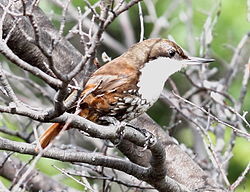
Measuring approximately 15 cm in length, the white-throated treerunner is easily identified by its bright white throat and chest, which contrast sharply with its dark brown upperparts. Its lower back and tail transition into a reddish hue, and its bill is long and slightly curved upward, perfectly adapted for extracting prey from tree bark.
Key Facts
- Scientific Name: Pygarrhichas albogularis
- Conservation Status: Least Concern (IUCN 3.1)
- Habitat: Nothofagus (false beech) forests in Chile and Argentina.
- Diet: Small arthropods, including beetle larvae and diptera.
- Unique Trait: Ability to descend tree trunks head-first, similar to nuthatches.
- Nesting: Uses tree cavities in old or fire-damaged trees.
Taxonomy and Evolutionary History
The species was first described in 1831 by British explorer Phillip Parker King. Over the following century, its classification shifted several times. In 1837, zoologist Hermann Burmeister established the genus Pygarrhichas, deriving the name from Greek words meaning "rump" and "wicker" to describe the bird's stiff tail, which assists its movement on vertical trunks.
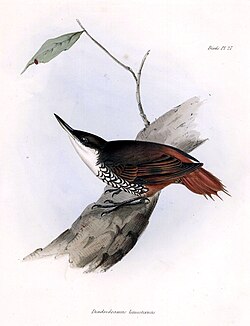
For years, the treerunner's placement within the Furnariidae family was debated. While it looks like other bark-gleaning birds, molecular phylogenies published between 2009 and 2011 clarified that it is more closely linked to the genera Microxenops and Ochetorhynchus. This suggests that its nuthatch-like appearance is an evolutionary adaptation rather than a sign of close kinship.
Physical Description
The white-throated treerunner typically weighs between 20 and 27 grams. Its plumage is characterized by a blackish-brown face and a dull brown crown. The back is a paler chestnut-brown, leading to a red rump and tail. Its tail is particularly specialized, featuring rigid feathers (rectrices) with shortened barbs that end in small spines up to 9 mm long, providing essential support while climbing.
| Feature | Measurement/Description |
|---|---|
| Average Length | 15–16 cm (5.9–6.3 in) |
| Weight | 20–27 g (0.71–0.95 oz) |
| Bill Length | 16–23.8 mm (0.63–0.94 in) |
| Wing Chord | 76–86 mm (3.0–3.4 in) |
| Tail Length | 52–65 mm (2.0–2.6 in) |
Ecology and Behavior
Foraging and Diet
The white-throated treerunner is a restless forager. It moves in a jerky fashion, spiraling up trunks or descending head-first to search for small invertebrates. It often taps the bark—similar to a woodpecker—to locate larvae. Its diet primarily consists of arthropods, specifically beetles and diptera.
Research in the Osorno province indicates a preference for Nothofagus species, such as the Coigüe and Neuquén Roble, as well as the Ulmo tree. These preferences are likely due to the bark structure and the abundance of insects. In predator-free island environments, they have been observed foraging on the ground.
Social Structure and Vocalizations
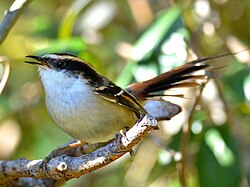
While sedentary, the bird can be erratic outside the breeding season, often joining mixed-species foraging flocks. Common companions include the thorn-tailed rayadito, striped woodpecker, and fire-eyed diucon. Its vocalizations include a piercing cry resembling falling water droplets and a metallic "kik-ik" or "tsik" contact call.
Breeding and Nesting
This species is believed to be monogamous, typically laying two to three eggs between November and December. They nest in tree cavities, often reusing holes created by woodpeckers or utilizing fire-damaged trunks. Nest cavities are generally 25–40 cm deep. Interestingly, they are known to readily accept man-made nest boxes.
Distribution and Habitat
The white-throated treerunner is found from Santiago, Chile, and Mendoza, Argentina, extending south to Tierra del Fuego and as far as Horn Island. They inhabit forests from sea level up to 1,200 meters in altitude.
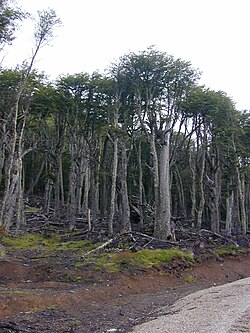
They specifically seek out forests with large, old trees—primarily those of the Nothofagus genus (false beech)—as these provide the necessary cavities for nesting. Because they rely on senescent (aging) trees, the preservation of old-growth forests is critical for their survival.
Cultural Significance
The bird holds a place in the traditional stories of the Yahgan people, where it is known as tatajurj. In these narratives, the bird accompanies women to collect epiphytic fungi (Cyttaria) from the trunks of Magellanic Beech, Lenga, and Ñire trees.
Frequently Asked Questions
Is the white-throated treerunner endangered?
No, the International Union for Conservation of Nature (IUCN) classifies the species as "Least Concern" due to its relatively large range and stable population numbers.
Why does it look like a nuthatch?
This is due to convergent evolution. Both the white-throated treerunner and the nuthatch evolved similar body shapes and behaviors because they occupy similar ecological niches, foraging for insects on tree trunks.
Where can the white-throated treerunner be found?
It is native to the southern tip of South America, specifically in central and southern Chile and western Argentina, ranging from Santiago and Mendoza to Tierra del Fuego.
What do white-throated treerunners eat?
Their diet consists mainly of small arthropods, including adult beetles, beetle larvae, and diptera, which they find by scouring the bark of old trees.
Do they build their own nests?
They nest in cavities. While they can excavate in senescent or fire-damaged trees, they frequently reuse existing cavities, often competing with woodpeckers for these sites.