Whitby Railway Station: A History of North Yorkshire's Coastal Rail Hub
The story of Whitby's railway is a reflection of the broader evolution of British transport, moving from early horse-drawn carriages to the steam age and surviving the drastic cuts of the mid-20th century. Once a bustling hub connecting the coast to the heart of Yorkshire, the station remains a vital link for the town today.
The Early Years and Steam Transition
The origins of the station date back to 1836 with the opening of the Whitby and Pickering Railway. This initial line was a single-track, horse-worked system engineered by the legendary George Stephenson. The original facilities were modest, consisting of a carriage shed, workshop, and offices located near the end of the current platform.
A significant transformation occurred in 1845 when the York and North Midland Railway (Y&NM) took over the line. The Y&NM converted the route into a double-tracked, steam-powered line and commissioned architect George Townsend Andrews to design the current station, along with the goods and locomotive sheds. A standout feature of Andrews' design was the "Euston Truss" overall roof, a grand architectural element that remained until British Railways replaced it with modern awnings in 1953.
Expansion and the Golden Age of Rail
By 1854, the Y&NM helped form the North Eastern Railway (NER). To accommodate growing traffic from various branch lines, the NER added two additional platforms. The network expanded significantly over the following decades: the Esk Valley Line reached a junction at Grosmont in 1865, and coastal lines opened from Loftus in 1883 and Scarborough in 1885.
Technological advancements also reached Whitby in 1876, when the time interval system was replaced by block signalling (a system where only one train is allowed in a specific section of track at a time). This change necessitated the construction of an unusual three-storey signal box, designed specifically to provide a clear line of sight over the adjacent goods shed.
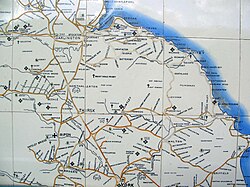
One of the most unique legacies of the NER era is the station's tile map. Installed around 1900 as part of a 25-station initiative, Whitby is one of only nine stations in the UK where these maps remain intact and in situ.
Nationalisation and the Beeching Cuts
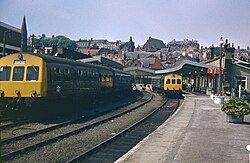
The station transitioned through several ownerships during the 20th century, becoming part of the London and North Eastern Railway (LNER) in 1923 and eventually British Railways following nationalisation in 1948. While rolling stock and signalling evolved, the station's basic structure remained largely unchanged until the 1960s.
The 1963 Beeching Report—a government proposal to reduce the railway network—recommended the closure of all three lines serving Whitby. Consequently, the routes to York (via Pickering and Malton) and the coastal lines were closed by 1965. However, the Esk Valley Line to Middlesbrough was spared due to the poor road access available for replacement bus services.
Decline and Modern Restoration
The loss of the branch lines led to a period of severe decline. Most staff were let go, the goods shed and signal box were demolished, and the double track to Grosmont was reduced to a single line. Platforms 3 and 4 were completely removed to make way for a supermarket, and Platform 2 was truncated.
The only surviving original structures from this era are the two-track engine shed and the remains of one of the 1835 weighbridge houses from the original Whitby and Pickering Railway.
Recent years have seen a resurgence in activity. In 2013, plans were approved for major redevelopment, leading to the restoration and extension of Platform 2 in 2014. This allowed the North Yorkshire Moors Railway (NYMR) to increase services to four or five trains per day during peak periods. Northern has also adjusted its service frequency, increasing to six trains per day in 2019, with further adjustments to morning capacity occurring between 2023 and 2025.
Key Facts
- Engineer: George Stephenson designed the original 1836 horse-worked line.
- Architect: George Townsend Andrews designed the current station and sheds.
- Rare Heritage: One of only nine stations to still possess an original NER tile map.
- Survival: The Esk Valley Line survived the Beeching cuts due to poor local road access.
- Infrastructure: The station once featured a grand "Euston Truss" roof, removed in 1953.
| Year | Event | Significance |
|---|---|---|
| 1836 | Opening of W&P Railway | First horse-worked line opens. |
| 1845 | Y&NM Takeover | Conversion to steam and double track. |
| 1876 | Block Signalling | Installation of the three-storey signal box. |
| 1900 | Tile Map Installation | One of few remaining intact NER maps. |
| 1963-65 | Beeching Cuts | Closure of most lines except Esk Valley. |
| 2014 | Platform 2 Rebuilt | Increased capacity for NYMR services. |
Frequently Asked Questions
Who designed the original Whitby railway?
The original horse-worked line opened in 1836 was engineered by George Stephenson.
Why did the Esk Valley Line survive the Beeching Report?
While other lines were closed, the Esk Valley Line to Middlesbrough remained open because the roads in the area were too poor to support replacement bus services.
What is unique about the maps at Whitby station?
Whitby is one of only nine stations that still have their original North Eastern Railway tile maps installed and intact from the 1900 installation project.
What happened to the original station roof?
The station originally featured a fine "Euston Truss" overall roof, but it was removed by British Railways in 1953 and replaced with the current awnings.
Which platforms are currently in use?
Platforms 3 and 4 were removed for a supermarket development. Currently, Platform 1 is the primary rail served area, and Platform 2 was rebuilt and restored in 2014.