Wheeling and Lake Erie Railroad: A History of Ohio's Iron Cross
The story of the Wheeling & Lake Erie (W&LE) is a complex saga of ambition, financial volatility, and engineering evolution. Spanning over a century, the railroad evolved from fragmented, struggling lines into a vital industrial artery for the state of Ohio, primarily serving the transport of coal and iron ore between the Ohio River valley and the ports of Lake Erie.
The Early Struggle: Two Parallel Visions
The origins of the W&LE are rooted in two distinct systems. The first was incorporated on March 10, 1871, by Joel Wood. Wood envisioned a standard-gauge (4 feet, 8 1/2 inches) line to transport coal from eastern Ohio to Lake Erie ports, specifically linking Wheeling, West Virginia, to Sandusky and Toledo, Ohio. However, funding collapsed due to rescinded municipal ordinances and the Panic of 1873.
Following Wood's failure, associates pivoted to a narrow-gauge system (three-foot width), which was a cheaper alternative popularized by the Denver & Rio Grande. This iteration opened a 12.5-mile segment between Huron and Norwalk in June 1877 but ultimately failed and shut down by late 1879.
Simultaneously, General E.R. Eckley launched the Ohio & Toledo Rail Road (O&T) in 1872. Eckley's path was equally rocky, involving the acquisition of the dilapidated Carrollton & Oneida Railroad—a line so poorly constructed it had been reduced to mule-powered operation by 1859. After several reorganizations and shifts in direction, the venture passed to Dr. Norman Smith, who incorporated the Youngstown & Connotton Valley in 1877.
The Rise of the Connotton Valley Railroad
Under Dr. Smith, the company was renamed the Connotton Valley Railroad (CVRR) in 1879. With $2.6 million in backing from a Massachusetts syndicate, the CVRR successfully built a corridor between Cleveland and Zanesville. Passenger service to downtown Cleveland began on February 21, 1882.
The CVRR expanded south from Canton toward the Perry County coalfields, reaching Coshocton in June 1883. Despite strong traffic—carrying over 456,000 passengers in 1884—heavy debt led to receivership. The company reorganized as the Cleveland & Canton Railroad (C&C) in 1885 and completed a full conversion to standard-gauge by November 18, 1888.
The Gould Era and the "Iron Cross"
In 1899, the W&LE purchased the Cleveland, Canton & Southern (the successor to the C&C) for $3.85 million. This move was part of the larger ambitions of Jay Gould, who sought a transcontinental network. By integrating the W&LE with the Wabash and the New York, Pennsylvania & Ohio (Erie), Gould created a strategic link between Pittsburgh and Toledo.
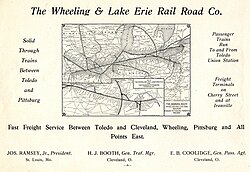
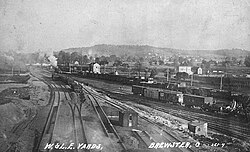
The railroad's geography created a unique layout: two main stems crossing at Harmon, just east of Brewster, Ohio. This intersection earned the line the nickname "The Iron Cross." Brewster became the corporate headquarters in 1914 and housed world-class locomotive shops. Remarkably, the W&LE produced 50 of its own steam engines, including rolling their own boilers.
Ownership Transitions and Modern Era
The mid-20th century brought significant corporate shifts. In 1949, the New York, Chicago, & St. Louis Railroad (the Nickel Plate Road) leased the W&LE. Subsequent mergers brought the line under the control of the Norfolk and Western Railway in 1964, and eventually Norfolk Southern. The W&LE was formally consolidated into the Norfolk and Western on September 20, 1988.
In 1990, Norfolk Southern sold many of these lines to the newly founded Wheeling and Lake Erie Railway. Today, it operates as a Class II railroad and stands as the largest railroad based in Ohio.
Key Facts
- Nickname: Known as "The Iron Cross" due to its intersecting mainlines at Harmon, Ohio.
- Manufacturing: The Brewster shops built 50 proprietary steam locomotives.
- Gauge Evolution: Transitioned from narrow-gauge (3 feet) to standard-gauge (4 feet, 8 1/2 inches).
- Primary Cargo: Historically focused on coal, iron ore, and general merchandise.
- Passenger Service: All passenger operations ceased in 1940.
- Current Status: The largest railroad based in the state of Ohio.
| Era/Entity | Key Development | Primary Focus |
|---|---|---|
| Early W&LE (1871) | Initial standard-gauge attempt | Coal transport to Lake Erie |
| CVRR (1879) | Narrow-gauge expansion | Cleveland to Zanesville corridor |
| Gould Era (1899) | Consolidation and expansion | Pittsburgh to Toledo connection |
| NKP/N&W (1949-1988) | Lease and merger period | Integration into larger networks |
| Modern W&LE (1990-Present) | Independent Class II Railroad | Regional Ohio operations |
Frequently Asked Questions
Did the Wheeling & Lake Erie ever actually reach Wheeling, West Virginia?
No, the mainline never reached Wheeling. However, it maintained an indirect connection via a branch between Steubenville, Ohio, and Martins Ferry, and through the Wheeling Bridge and Terminal Company subsidiary.
What was the significance of the Brewster, Ohio shops?
Brewster served as the corporate headquarters starting in 1914 and featured one of the finest locomotive facilities in the country, where the railroad built 50 of its own steam engines.
Why was the railroad called "The Iron Cross"?
The name refers to the map layout of the railroad's two busy main stems, which crossed each other at Harmon, Ohio, just east of Brewster.
When did the railroad stop carrying passengers?
Passenger service on the Wheeling & Lake Erie ended in 1940, shortly before the United States entered World War II.
What is a narrow-gauge railroad?
A narrow-gauge railroad uses tracks that are closer together than the standard gauge of 4 feet, 8 1/2 inches. In the case of the early W&LE and CVRR, they used a three-foot gauge to reduce construction costs.