Wheat Taxonomy and Evolution: From Wild Grasses to Modern Crops
For over 10,000 years, humans have cultivated wheat, shaping its development through a complex interplay of natural selection and artificial breeding. This long history has resulted in a vast diversity of forms, leading to significant complexity in how these plants are named and classified. To understand modern wheat, one must look back at its evolutionary journey, driven by genetic shifts and hybridization events.
At the heart of this complexity is the relationship between the genus Triticum (the wild and domesticated wheats) and Aegilops (wild goatgrasses). While some geneticists suggest they should be merged into a single genus, taxonomists often keep them separate because Aegilops is morphologically distinct, possessing rounded rather than keeled glumes.
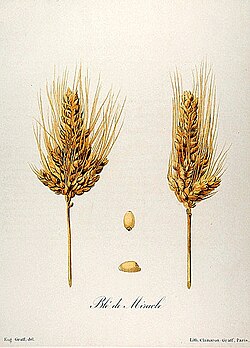
Miracle wheat (Triticum turgidum var. mirabile)
Key Facts
- Wheat evolution is driven by polyploidy, where organisms possess multiple sets of chromosomes.
- Modern bread wheat is a hexaploid, meaning it contains six sets of chromosomes (AABBDD).
- The D genome, introduced by goatgrass, contributes to cold-hardiness in hexaploid wheats.
- Domestication has produced both hulled (enclosed in glumes) and free-threshing (easy to separate grain) varieties.
- The genus Triticum includes both wild ancestors and domesticated species.
The Role of Polyploidy and Hybridization
One of the most critical drivers in wheat evolution is polyploidy—the condition of having more than two complete sets of chromosomes per cell. While wild wheats like T. boeoticum and T. urartu are diploid (containing only two sets of chromosomes), most cultivated wheats are more complex.
The evolutionary timeline is marked by two major hybridization events involving goatgrasses:
- Tetraploid Formation: Wild emmer (T. dicoccoides) resulted from the hybridization of wild wheat (T. urartu) and an unidentified goatgrass. This created a tetraploid (four sets of chromosomes) ancestor.
- Hexaploid Formation: Approximately 0.4 million years ago, a tetraploid wheat crossed with the goatgrass Aegilops tauschii. This added the D genome, resulting in the hexaploid (six sets of chromosomes) wheats we recognize today, such as common bread wheat.
![Wheat origins by repeated hybridization and polyploidy (e.g. "6N" means 6 sets of chromosomes per cell rather than the usual 2). Only a few of the wheat species involved are shown. The goatgrass species involved are not known for certain.[6]](/images/b4/60/b460d6425b7d51312ea9b0719802772fdbc8bbb0b71836997a2db6154bdae6e7.webp)
Wheat origins by repeated hybridization and polyploidy (e.g. "6N" means 6 sets of chromosomes per cell rather than the usual 2). Only a few of the wheat species involved are shown. The goatgrass species involved are not known for certain.
Understanding Wheat Genomes
Modern wheat classification often relies on the specific combination of genomes present in the plant. Five distinct genomes have been identified within the Triticum genus:
- A Genome: Found in wild einkorn (T. boeoticum).
- B Genome: Present in most tetraploid wheats; its exact source is unidentified but is related to Aegilops section Sitopsis.
- D Genome: Found in Ae. tauschii and all hexaploid wheats.
Based on these combinations, scientists identify several "super species," such as the BA genome (tetraploid wheats like Emmer and Durum) and the BAD genome (hexaploid bread wheats).
Domestication and Morphology
As wheat was domesticated, its physical characteristics changed. Early varieties like einkorn and emmer were hulled, meaning the grain remained enclosed in tough husks. During the Pre-Pottery Neolithic B period (around 8000 BC), free-threshing forms evolved. These varieties have lighter glumes and a tough rachis (the stem that holds the grain), making it much easier to separate the grain from the chaff.
Other morphological traits used to define wheat include spike laxness and the presence of wings on the glumes. In modern agriculture, the term cultivar is used to describe specific, commercially bred populations, whereas landraces refer to informal, farmer-maintained populations.
Summary of Wheat Species and Classifications
| Common Name | Ploidy Level | Genome(s) | Type |
|---|---|---|---|
| Wild Einkorn | Diploid (2x) | A | Wild, Hulled |
| Einkorn | Diploid (2x) | A | Domesticated, Hulled |
| Wild Emmer | Tetraploid (4x) | BA | Wild, Hulled |
| Emmer | Tetraploid (4x) | BA | Domesticated, Hulled |
| Durum Wheat | Tetraploid (4x) | BA | Domesticated, Free-threshing |
| Spelt Wheat | Hexaploid (6x) | BAD | Domesticated, Hulled |
| Common Bread Wheat | Hexaploid (6x) | BAD | Domesticated, Free-threshing |
Frequently Asked Questions
What is the difference between hulled and free-threshing wheat?
Hulled wheats have grains that are tightly enclosed in glumes, requiring more effort to process. Free-threshing wheats have evolved lighter glumes, allowing the grain to be easily separated from the husk during threshing.
What does polyploidy mean in the context of wheat?
Polyploidy refers to a condition where wheat cells contain multiple sets of chromosomes. While wild ancestors are often diploid (2 sets), many cultivated wheats are tetraploid (4 sets) or hexaploid (6 sets) due to natural hybridization events.
How did bread wheat become hexaploid?
Bread wheat became hexaploid through a natural crossing event between a domesticated tetraploid wheat (carrying the A and B genomes) and the wild goatgrass Aegilops tauschii (carrying the D genome).
What is the difference between a species and a cultivar?
A species is a fundamental biological classification. A cultivar (short for cultivated variety) is a distinct population of a crop that has been created through deliberate plant breeding for commercial use.
Why is the D genome important for wheat?
The D genome was introduced to wheat via hybridization with Aegilops tauschii. It provides important genetic advantages, including enhanced cold-hardiness and specific morphological characteristics.