WelTec History: From Petone Technical School to Te Pūkenga
The evolution of WelTec (Wellington Institute of Technology) reflects the broader shifts in New Zealand's vocational and tertiary education landscape. From its humble beginnings in rented buildings to its current role within a national network, the institution has undergone numerous name changes, campus migrations, and strategic mergers to meet the changing needs of students and industry.
The Early Years: Petone Technical School (1904–1960)
WelTec began its journey in 1904 as the Petone Technical School, initially operating out of rented premises. By 1908, the polytechnic—a vocational college providing practical technical training—moved to its permanent site on Kensington Avenue in Petone. The official opening of the new technical school building off Buick Street took place on February 26, 1909, presided over by the then Minister of Education, the Hon. G. Fowlds.
During this formative period, the institution operated under several different names, including Petone Technical College, Hutt Valley Memorial Technical College, Petone Technical Institute, and Hutt Valley Polytechnic.
The Central Institute of Technology Era (1960–2000)
Formation and the Heretaunga Campus
In 1960, the Central Institute of Technology (CIT) was established, initially known as the Central Technical College until 1963. While it started at the Petone Technical College, the institution began a phased move to a new site in Heretaunga starting in 1970.
The development of the Heretaunga campus occurred in four distinct stages:
- Stage 1 (1973): Opened by Prime Minister Norman Kirk, featuring science, pharmacy, and engineering departments.
- Stage 2 (1978): A seven-storey tower block providing residence for 500 students and hotel administration training facilities.
- Stage 3: Addition of a library, TV production studio, computer facilities, management school, and training areas for aeronautics and HVAC (heating, ventilation, and air conditioning).
- Stage 4: Implementation of health science facilities.
Academic Shifts and Campus Upgrades
The late 1980s brought significant changes to health sciences. In 1989, Minister of Health Helen Clark announced that pharmacy training would move to the University of Otago and occupational therapy to Auckland. Following a regional review, the school of health sciences was eventually relocated to Wellington Polytechnic to be closer to nursing schools and hospitals.
Despite these shifts, the campus continued to grow. In 1992, a podiatry school and a public aerobics facility were opened. By 1993, the podiatry school received a major upgrade, including X-ray facilities, surgical suites, and sterilization rooms. In 1994, the site expanded its academic reach by hosting Victoria University of Wellington courses, including a Bachelor of Commerce and Administration.
Student Demographics and Expansion
By 1995, CEO Mike Cooper noted a significant shift in the student body. The average student age rose from 19 to 31 between 1990 and 1995, with females becoming the majority and Māori student representation increasing from 5% to 14%. Despite a 26% increase in the student roll, funding per student dropped by 23%.
To expand its reach, CIT leased 158 The Terrace in 1995 to establish a Wellington campus for business and computer science. Notably, these computer courses were utilized via the internet for staff training by the NASA Jet Propulsion Laboratory and the Portsmouth Naval Base in Virginia. By 1996, the institution introduced bachelor's degrees in tourism, services management, tertiary teaching, and business information.
Mergers and Transitions (2000–Present)
The Birth of WelTec
In 2000, the Central Institute of Technology merged with Hutt Valley Polytechnic to form the Wellington Institute of Technology (WelTec). Because the majority of students lived closer to Petone, courses were centralized there, leading to the closure of the Heretaunga campus in June 2001. Some CIT courses were absorbed by other providers, such as dentistry at the University of Otago and podiatry at the Auckland Institute of Technology.
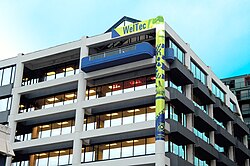
In 2005, WelTec expanded further by opening a campus on Church Street in a former PricewaterhouseCoopers building.
Collaboration with Whitireia
A merger between WelTec and Whitireia Community Polytechnic was approved in 2011, creating a shared council by January 2012 while maintaining separate branding. However, financial pressures led to further consolidation. In 2018, the government provided a NZD$65 million injection to struggling polytechnics, and by 2019, the combined entity announced 55 full-time equivalent job cuts.
Integration into Te Pūkenga
On April 1, 2020, WelTec was subsumed into Te Pūkenga (New Zealand Institute of Skills & Technology), joining 15 other national institutes. While initially operating as a subsidiary, the institution has continued to navigate structural changes. In July 2025, it was announced that WelTec and Whitireia would temporarily remain with Te Pūkenga until early 2026, coinciding with the closure of the Dixon Street creativity campus in late July 2025. As of January 1, 2026, the combined entity is confirmed to remain part of Te Pūkenga until at least January 1, 2027.
Key Facts
- Founded: 1904 as Petone Technical School.
- Major Campuses: Petone (Kensington Avenue), Heretaunga (closed 2001), and Wellington (The Terrace/Dixon St).
- Key Merger: CIT and Hutt Valley Polytechnic merged in 2000 to create WelTec.
- National Integration: Became part of Te Pūkenga on April 1, 2020.
- Demographic Shift: Between 1990 and 1995, the average student age rose from 19 to 31.
| Period | Entity Name | Key Event/Status |
|---|---|---|
| 1904–1960 | Petone Technical School (and variants) | Established and moved to Kensington Ave (1908). |
| 1960–2000 | Central Institute of Technology (CIT) | Development of Heretaunga campus; expansion into degrees. |
| 2000–2020 | Wellington Institute of Technology (WelTec) | Merger of CIT and Hutt Valley Polytechnic. |
| 2020–Present | Te Pūkenga | Subsumed into the national institute of skills and technology. |
Frequently Asked Questions
When was WelTec first established?
The institution was founded in 1904 as the Petone Technical School, though it operated under several names before becoming WelTec.
What happened to the Heretaunga campus?
The Heretaunga campus closed in June 2001 due to a decline in student numbers following the merger of CIT and Hutt Valley Polytechnic. The site was eventually sold to an investment group.
How did the student demographic change in the 1990s?
Between 1990 and 1995, the average student age increased from 19 to 31, females became the majority, and the percentage of Māori students rose from 5% to 14%.
What is Te Pūkenga?
Te Pūkenga is the New Zealand Institute of Skills & Technology, a national entity that subsumed WelTec and 15 other polytechnics and institutes of technology on April 1, 2020.
Is the Dixon Street campus still open?
No, WelTec & Whitireia confirmed the closure of the central Wellington creativity campus on 65 Dixon Street in late July 2025.