Weilburg History: From Medieval Fortification to Residence Town
Nestled along the Lahn river, Weilburg stands as a remarkable testament to German architectural and political evolution. From its earliest roots as a strategic fortification to its era as a center of absolutist power, the town offers a glimpse into the complex tapestry of the Holy Roman Empire and the subsequent formation of the German state.
The area's human history stretches back to the La Tène period (the late Iron Age), evidenced by archaeological finds at the Scheuernberger Kopf mountain near Kirschhofen. However, the town's formal history began in 906, when it was first recorded as Wilineburch in a chronicle by Abbot Regino of Prüm.
The Early Middle Ages and the Weilburger Testament
The 10th century marked a period of significant religious and political foundation. In 912, King Conrad I established the St. Walpurgis-Chorherrenstift, a monastery strategically positioned on high ground. This location allowed the monastery to monitor the Lahn river and key trade arteries, including the Hohe Straße (High Road) connecting Frankfurt to Cologne and the Via Publica leading from Flanders to Bohemia.
Weilburg entered the broader historical spotlight in 918 through the Weilburger Testament. On his deathbed, King Conrad I recommended that his brother, Eberhard, deliver the Imperial insignia to his rival, the Saxon duke Heinrich, a pivotal moment in the transition of power within the empire.
The Influence of the House of Nassau
Between 993 and 1062, the town was gradually donated to the Bishopric of Worms. By approximately 1225, the Bishop pledged overlordship to the House of Nassau, who eventually purchased the town and granted it the same town rights as Frankfurt.
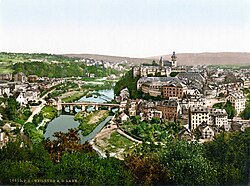
The House of Nassau transformed Weilburg into a center of administration and luxury. In 1355, Count Johann I established his residence, renovated the castle into a palace, and constructed town fortifications and a stone bridge across the Lahn in 1359. Later, Count Johann Ernst (1664–1719) further expanded the Hochschloss (Renaissance high palace) and developed the surrounding park, creating one of Germany's best-preserved examples of a small residence town from the era of absolutism.
Administrative Shifts and the Duchy of Nassau
In 1806, Weilburg became the governmental seat of the newly formed Duchy of Nassau. This status lasted until 1816, when Duke William moved the residence to Biebrich. The political landscape shifted again in 1866 when Prussia annexed the Duchy, and by 1871, Weilburg became part of the German Empire.
Architectural Innovation: The Pisee Style
Weilburg is internationally recognized in architectural history for its use of loam (earth) construction. Wilhelm Jacob Wimpf, a government lawyer, promoted the Pisee style (rammed earth construction). This movement resulted in the creation of Germany's tallest loam building, a structure reaching six floors in height.
War and Modern Transition
The 20th century brought significant turmoil. In 1933, National Socialists rose to power in the town, ousting the last non-Nazi mayor, Diffenhardt, via a no-confidence vote. During World War II, between 1939 and 1941, the town housed the Oflag IX-B, a prisoner-of-war camp for Belgian and Polish officers.
While the town avoided heavy destruction, it did suffer light damage from aerial bombing—specifically affecting the palace's orangery, the railway station, and the Helbig brewery. In March 1945, retreating German troops destroyed all the town's bridges just before United States troops took control of the area.
Administratively, Weilburg served as the seat of the Oberlahnkreis from 1867 until 1974. Following a reform in Hesse, it became part of the Limburg-Weilburg district, with the seat moving to Limburg.
Constituent Communities and Local Heritage
The surrounding communities each contribute a unique chapter to the region's history, often centered on mining and agriculture.
- Waldhausen and Odersbach: Notably mentioned in documents even before Weilburg, with Waldhausen appearing in the Prüm Abbey's Golden Book in 881.
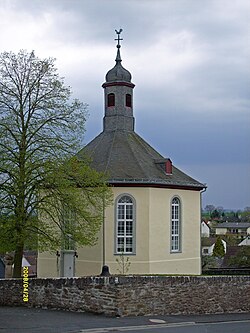
- Hirschhausen: Known for its rich hematite and limonite pits, including the productive "Anna" pit, and its unique eight-sided Lutheran church.
- Gaudernbach: A community that balanced agriculture with mining and marble quarrying, though it suffered a devastating fire in 1863.
- Bermbach and Drommershausen: Both areas were historically significant for mining, with Bermbach's ore pits operating until 1914 and Drommershausen hosting a blast furnace by 1679.
| Year/Period | Event/Development | Significance |
|---|---|---|
| 906 | First mention as Wilineburch | Establishment as a fortification |
| 918 | Weilburger Testament | Imperial insignia transfer to Duke Heinrich |
| 1226 | Town rights granted | Acquired same rights as Frankfurt |
| 1355 | Residence of Count Johann I | Transformation into a palace town |
| 1806 | Duchy of Nassau seat | Became a governmental center |
| 1866 | Prussian Annexation | End of the Duchy of Nassau |
Key Facts
- Oldest Mentions: Waldhausen (881) and Odersbach predate the first mention of Weilburg (906).
- Strategic Location: Controlled the Lahn river and the Hohe Straße trade route.
- Architectural Record: Home to Germany's tallest loam building (six floors).
- Political Legacy: Site of the Weilburger Testament, a critical moment in early German imperial history.
- Industrial Roots: Strong history of hematite, limonite, and marble mining in constituent communities.
Frequently Asked Questions
What is the Weilburger Testament?
The Weilburger Testament was a recommendation made by King Conrad I on his deathbed in 918, advising his brother Eberhard to deliver the Imperial insignia to the Saxon duke Heinrich.
What makes Weilburg's architecture unique?
Weilburg is famous for its Pisee style buildings, which are constructed from rammed loam. This includes the distinction of having the tallest loam building in Germany.
Which family most influenced the development of Weilburg?
The House of Nassau shaped the town for centuries, transforming it from a fortification into a residence town with a high palace (Hochschloss) and formal parks.
What was the role of the Oflag IX-B?
Between 1939 and 1941, Oflag IX-B served as a prisoner-of-war camp specifically for Belgian and Polish officers and orderlies during World War II.
Which community in the area is the oldest in written records?
Waldhausen is the oldest, first mentioned in 881 in the Prüm Abbey's Golden Book as Mark Ualthusa.