Web-Based Storytelling: From Web Novels to Webcomics
The digital revolution has fundamentally transformed how stories are written, distributed, and consumed. By removing the traditional gatekeepers of the publishing industry, the internet has democratized storytelling, allowing creators to connect directly with global audiences. From long-form serialized prose to visually driven comics, digital platforms offer a diverse array of formats that challenge the linear nature of traditional print.
Web Novels and the Power of Serialization
A web novel is a literary work published primarily or exclusively on the internet. This format allows authors to share their stories in a continuous stream, bypassing the need for a traditional publisher to gain recognition. One of the most significant advantages of this model is the immediate feedback loop; authors can refine their plots and characters based on real-time reader reactions before ever considering a physical print edition.
Most web novels are structured as web serials. While the internet has popularized this approach, serialized novels—stories released in smaller, sequential installments—have a long history that predates digital technology by centuries.
The Influence of Fan Fiction
Fan fiction, the practice of writing stories based on existing characters or worlds, played a pivotal role in popularizing online publishing. It established the community standards and interaction patterns that now define much of the web serial landscape. Many authors began their careers in fan fiction, utilizing its multi-part, epic-length structures to prepare audiences for the consumption of original serialized works.
While the readerships of fan fiction and web serials often overlap—sharing similar language and memes—their publication styles differ. Web serials typically adhere to regular schedules, whereas fan fiction is generally published at the author's convenience, with less pressure to complete or continue a story. Platforms like Fanfiction.net have been instrumental in this growth, often providing sister sites, such as Fiction Press, specifically for original works.
Interactive and Hypertext Novels
Unlike traditional novels, which are linear (read from page to page in a straight line), interactive novels leverage digital media and hypertext—text displayed on a computer screen with references (hyperlinks) to other text that the reader can immediately access. This allows readers to choose their own path, select specific characters, or explore different directions within the narrative.
In a hypertext interactive novel, there is no single "correct" way to read. Embedded links are taken at the reader's discretion, granting them agency within the novel's world and offering multiple ways to understand the characters and plot.
The Evolution of Webcomics
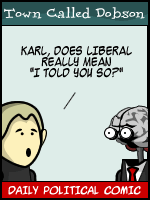
Webcomics, also known as online or internet comics, are comics published on websites. While many exist exclusively online, some creators cross-publish in newspapers, magazines, or self-published books. Much like web novels, the low barrier to entry allows almost anyone to create and share their work.
The scale of this medium is vast; as of January 2007, the four largest hosting services featured over 18,000 webcomics, spanning everything from traditional comic strips to full-length graphic novels. While financial success was rare in the early days, the rise of platforms like Patreon and Podia has enabled artists to monetize their work through the support of loyal audiences.
Key Facts
- Web novels allow authors to build a fan base and receive feedback without a traditional publisher.
- Web serials are a modern digital application of a centuries-old storytelling tradition.
- Fan fiction helped set the community and structural standards for modern web serials.
- Interactive novels use hypertext to break linear storytelling, giving readers choice and agency.
- Webcomics have evolved from niche hobbies to monetizable careers via platforms like Patreon.
| Format | Primary Characteristic | Structure | Reader Role |
|---|---|---|---|
| Web Novel | Internet-first publication | Often Serialized | Passive/Feedback provider |
| Fan Fiction | Based on existing IP | Flexible/Multi-part | Community participant |
| Interactive Novel | Hypertext-driven | Non-linear | Active decision-maker |
| Webcomic | Visual storytelling | Strips or Graphic Novels | Visual consumer |
Frequently Asked Questions
What is the difference between a web novel and a web serial?
A web novel is a broad term for any literary work published primarily online. A web serial is a specific format of delivery where the novel is released in sequential installments over time.
How did fan fiction influence original web serials?
Fan fiction popularized the act of publishing long-form, multi-part stories online and established the community interaction patterns that original web serial authors now use to engage with their readers.
What makes an interactive novel different from a traditional one?
Traditional novels are linear, meaning they are read in a fixed sequence. Interactive novels use hypertext links to allow readers to choose their own path, character perspective, or direction.
Can webcomic creators make a living from their work?
Yes. While it was difficult in the past, many modern webcomic artists use crowdfunding and subscription services like Patreon or Podia to receive financial support from their audiences.
Are webcomics only available online?
While they are primarily published on websites, many webcomics are also printed in magazines, newspapers, or as self-published books.