Wastebasket Taxa: The Catch-All Categories of Biological Classification
In the complex world of biological classification, scientists strive to group organisms based on their actual evolutionary relationships. However, the history of taxonomy is filled with "convenience groups." These are known as wastebasket taxa (also referred to as dustbin or catch-all taxa)—groups used to classify organisms that do not fit neatly into any other established category.
Rather than being defined by a shared ancestor, wastebasket taxa are often defined by what their members lack or by superficial similarities. Because they group unrelated organisms together, they are typically polyphyletic (descended from more than one common evolutionary ancestor) or paraphyletic (consisting of an ancestor but not all of its descendants). Under strict cladistic rules—the modern method of classifying organisms based on common ancestry—these groups are not considered valid.
Key Facts
- Definition: A taxon used for organisms that do not fit elsewhere, often based on superficial similarities.
- Cladistic Status: Generally invalid because they are polyphyletic or paraphyletic.
- Common Traits: These groups are often old, populous, and lacked the systematic rigor of modern genetic analysis.
- Resolution: Taxonomists resolve these by splitting the group into natural units or abandoning the name entirely.
Examples Across the Tree of Life
Wastebasket taxa appear across various kingdoms and eras, often serving as placeholders until better data becomes available.
Microbiology and Botany
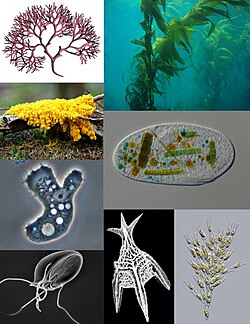
The kingdom Protista is perhaps the most famous example. It historically served as a dumping ground for all eukaryotes (organisms with a nucleus) that were not animals, plants, or fungi, effectively grouping all single-celled eukaryotes together regardless of their actual relationship.
In botany, the Flacourtiaceae was a defunct family of flowering plants. The Angiosperm Phylogeny Group eventually redistributed its members into other families, such as Salicaceae and Achariaceae.
Zoology and Entomology
The order Insectivora was traditionally used for placental mammals that ate insects. While some members (moles and shrews) form a valid clade called Eulipotyphla, others were found to be unrelated. For instance, tree shrews are related to primates, while golden moles are afrotheres.
In the insect world, the wasp family Pteromalidae was long considered polyphyletic until 2022, when it was split into 24 distinct families to better reflect evolutionary reality.
Mycology
The Tricholomataceae fungal group once acted as a catch-all for various white-, yellow-, or pink-spored genera that didn't fit into other specific families like Amanitaceae or Lepiotaceae.
Wastebasket Taxa in Paleontology
Paleontology is particularly prone to wastebasket taxa because fossil remains are often fragmentary. When scientists lack complete skeletons, they may group fossils based on gross morphology (general body shape) or stratigraphy (the rock layer in which they were found).
- Carnosauria and Thecodontia: These fossil groups were banded together before a more detailed fossil record allowed for precise classification.
- Condylarthra: An artificial clade used for ungulate mammals that didn't clearly fit into Perissodactyla or Cetartiodactyla.
- Rauisuchia: A Triassic group of crocodile-like animals grouped by general appearance.
- Mamenchisaurus: Sometimes viewed as a wastebasket taxon for various large, long-necked dinosaurs.
A related concept is the form taxon. These are groupings based on a common mode of life. Because different species often evolve similar body shapes to survive in similar environments—a process called convergent evolution—they can be mistakenly grouped together.
The Process of Taxonomic Revision
One of the primary goals of modern taxonomists is to identify and dismantle wastebasket taxa. This is usually achieved through two methods:
- Salvaging: Through rigorous research, a taxon can be "saved" by imposing strict new restrictions on who belongs in the group. This happened with Megalosaurus and Carnosauria.
- Abandonment: If a name carries too much unrelated "baggage," it is discarded in favor of a new name (e.g., Rhynchocephalia) or abandoned entirely (e.g., Simia).
| Taxon Name | Group Type | Reason for "Wastebasket" Status |
|---|---|---|
| Protista | Kingdom | Included all eukaryotes not in plants, animals, or fungi. |
| Insectivora | Order | Grouped placental mammals based on insect-eating diets. |
| Vermes | Obsolete Taxon | Catch-all for any non-arthropod worm-like invertebrate. |
| Flacourtiaceae | Family | Used for flowering plants that didn't fit other families. |
| Condylarthra | Clade | Artificial group for ungulates of uncertain placement. |
Frequently Asked Questions
What makes a taxon a "wastebasket" taxon?
A taxon becomes a wastebasket taxon when it is used to group organisms that do not share a unique common ancestor, but are instead grouped because they share superficial traits or because they simply do not fit into any other known category.
Are wastebasket taxa scientifically valid?
Under modern cladistics, they are not considered valid because they are typically polyphyletic or paraphyletic. However, they may still be used to describe an evolutionary grade, which refers to a group of organisms that have reached a similar level of biological complexity.
How do scientists fix wastebasket taxa?
Scientists use genetic sequencing and detailed morphological analysis to identify the true evolutionary lineages of the members. They then either redefine the group with stricter criteria or split the group into several new, scientifically accurate taxa.
What is the difference between a wastebasket taxon and a form taxon?
While both involve grouping by appearance, a form taxon specifically refers to groupings based on gross morphology resulting from convergent evolution—where unrelated species evolve similar shapes because they share a similar lifestyle or environment.