Walter Legge: The Visionary Producer Who Shaped Modern Classical Recording
Walter Legge was a transformative figure in the world of classical music, blending an intuitive ear for talent with a pioneering approach to the recording industry. Though he lacked formal musical training, his self-taught expertise and relentless pursuit of artistic excellence allowed him to redefine how music was captured and consumed in the 20th century.
Early Life and Self-Taught Beginnings
Born in Shepherd's Bush, London, to a tailor, Legge's early education at Latymer Upper School focused on Latin and French. He left school at 16 without formal musical instruction, but his father's encouragement led him to develop a deep passion for music, specifically the works of Richard Wagner. Through sheer determination, Legge taught himself to read music and speak German, laying the groundwork for his future international career.
Legge entered the professional world in 1927 by joining His Master's Voice (HMV), where he initially wrote analytical notes and copy for the magazine The Voice. His talent for organization and his keen musical instincts quickly caught the attention of Fred Gaisberg, a leading record producer, which propelled Legge into an active role in recording procedures. He further honed his critical perspective by working as a music critic for The Manchester Guardian between 1933 and 1938.
Pioneering the Subscription Model and Artistic Direction
Before the Second World War, Legge introduced a revolutionary "subscription" recording model. By inviting the public to pay in advance for future recordings, he made it economically viable for EMI to produce niche, high-art recordings, such as the complete piano works of Beethoven by Artur Schnabel and the songs of Hugo Wolf.
His influence extended beyond the studio. After supervising Sir Thomas Beecham's 1937 recording of The Magic Flute in Berlin, Legge was appointed assistant artistic director at the Opera. In this role, he was instrumental in securing the Covent Garden debuts of legendary performers, including Maria Reining, Jussi Björling, and Richard Tauber.
War Efforts and the Birth of the Philharmonia
During World War II, poor eyesight exempted Legge from military service. Instead, he managed the musical operations of ENSA (Entertainments National Service Association), organizing concerts for British troops globally and collaborating with renowned musicians like Sir Adrian Boult and John Barbirolli.
Following the war, Legge sought to revitalize EMI's roster. Operating from Vienna, he signed a wave of German and Austrian artists who were struggling for work, including Herbert von Karajan and Elisabeth Schwarzkopf, whom he later married in 1953. He also recognized the early potential of Maria Callas, producing her studio recordings for EMI.
In 1945, Legge founded the Philharmonia, an orchestra designed specifically for his high recording and concert standards. While the orchestra was initially linked to Karajan, Legge later revitalized the career of Otto Klemperer and attracted other giants of the era, such as Arturo Toscanini and Richard Strauss. By the 1950s, the Philharmonia was regarded as one of the finest orchestras in the world. However, citing falling standards, Legge disbanded the ensemble in 1964, after which it reformed as the New Philharmonia.
Key Facts
- Self-Taught: Legge had no formal musical training but taught himself music theory and German.
- Innovation: Pioneered the subscription model for "niche" classical recordings at EMI.
- Orchestral Legacy: Founded the Philharmonia, which became a world-leading ensemble in the 1950s.
- Talent Scout: Instrumental in the careers of Herbert von Karajan, Maria Callas, and Otto Klemperer.
- Philosophy: Strongly opposed "committee-led" artistic decisions, believing in the vision of a single director.
Final Years and Legacy
Legge's relationship with EMI soured in the 1960s as the company attempted to limit his freedom regarding repertoire. He resigned in 1964, later expressing his belief in his memoirs that democracy and committees were "fatal for the arts," arguing that artistic success requires strong, individual leadership.
In retirement, he and Elisabeth Schwarzkopf conducted masterclasses for young singers. Although he accepted the directorship of the Wexford Festival, a disabling heart attack in 1967 forced him to withdraw. In a final act of defiance against his former employer, he produced Schwarzkopf's final recordings for Decca, EMI's primary rival.
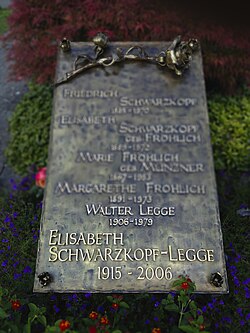
Walter Legge passed away on March 22, 1979, in Saint-Jean-Cap-Ferrat, France, at the age of 72. His ashes were eventually interred in Zumikon, Switzerland.
| Period/Entity | Key Contribution/Role | Notable Collaborators |
|---|---|---|
| His Master's Voice (HMV) | Analytical notes and recording procedures | Fred Gaisberg |
| Pre-War EMI | Subscription recording model | Artur Schnabel, Hugo Wolf |
| Covent Garden | Assistant Artistic Director | Richard Tauber, Jussi Björling |
| ENSA (WWII) | Concert arrangements for troops | Sir Adrian Boult, John Barbirolli |
| Philharmonia | Founder and Director | Otto Klemperer, Herbert von Karajan |
Frequently Asked Questions
Did Walter Legge have a formal education in music?
No, Legge received no formal musical training. He was a self-taught musician who learned to read music and speak German independently to pursue his interest in Richard Wagner.
What was the "subscription" recording model?
It was a system where the public paid in advance for recordings that had not yet been made. This reduced financial risk for EMI and allowed Legge to record niche classical works that might not have been commercially viable otherwise.
Why did Legge disband the Philharmonia in 1964?
Legge disbanded the orchestra because he was concerned about falling artistic standards. The ensemble immediately reformed as the New Philharmonia under the leadership of Otto Klemperer.
What were Legge's views on artistic management?
Legge believed that committees were useless in the arts and that "democracy is fatal" to quality. He argued that the best results come from a single visionary leader and a small group of carefully chosen collaborators.
How did Legge's relationship with EMI end?
Legge resigned in 1964 after EMI attempted to curtail his freedom to choose repertoire. The breach became absolute when he produced his wife's final recordings for Decca, EMI's main competitor.