Vulture Funds: The Mechanics and Controversy of Distressed Debt Investing
In the complex world of high-finance, few entities are as polarizing as vulture funds. These specialized hedge funds or private-equity funds operate on a specific premise: investing in distressed debt—loans or bonds that are considered very weak or are already in default. By purchasing this debt at a steep discount on the secondary market, these funds aim to generate massive returns by recovering the full value of the debt through aggressive legal or financial means.
The debtors targeted by these funds can range from struggling corporations and private individuals to entire sovereign nations. While proponents argue they provide necessary market discipline, critics view their tactics as predatory, often leaving the debtor in a precarious financial state.
Key Facts
- Core Strategy: Buying distressed debt at a discount and selling or recovering it for a higher price.
- Target Debtors: Includes companies, individuals, and sovereign governments.
- Legal Tactics: Often use attachment and recovery actions to force settlements from sovereign debtors.
- Global Impact: International bodies like the World Bank argue these funds undermine debt relief for the poorest nations.
- Regulatory Response: Several countries, including the UK and Belgium, have passed laws to limit their ability to sue for full debt value.
The Evolution of Sovereign Debt Collection
Until the 1950s, collecting debt from sovereign governments was rare due to sovereign immunity, a legal principle that protected government issuers from being sued in foreign courts. However, contract terms began to restrict this immunity, leading to a rise in collection actions, such as the freezing of Brazil's gold reserves held by the Federal Reserve.
Early efforts were also hindered by the doctrine of champerty—a legal rule in England and the United States that prohibited purchasing debt solely for the purpose of litigating it. While most jurisdictions now consider this doctrine archaic, it once served as a significant barrier to the rise of distressed debt investing.
By the late 1980s, the landscape shifted. The petrodollar crisis of the 1970s had left much sovereign debt in the hands of bank syndicates, making individual recovery impractical. This changed with the introduction of Brady bonds—tradable instruments created during Latin American debt rescheduling. These bonds allowed hedge funds to enter the market, buying "syndicate tails" (remaining portions of debt) at discounts sometimes exceeding 80% of the face value.
Financial Theory and Market Perspectives
From a financial theory perspective, the bonds of troubled public companies are traded similarly to the common stock of solvent companies. This creates a market where risk is priced based on the likelihood of recovery.
The term "vulture fund" is a metaphor comparing these investors to scavenging birds. The name is frequently used derogatorily to describe the act of profiting from financial distress. Conversely, some financiers argue that these funds force accountability for national borrowing and uncover public corruption, claiming that without such pressure, credit markets would shrink.
Global Legal and Political Backlash
The activities of vulture funds have drawn sharp criticism from international organizations. The World Bank and International Monetary Fund (IMF) have noted that these funds can jeopardize debt relief gains. For instance, while the World Bank provided over $40 billion in relief to 30 poor countries to fund education and sanitation, vulture fund litigation can divert those funds back into the accounts of wealthy investors.
This has led to various legislative attempts to curb their influence:
- United States: The proposed Stop VULTURE Funds Act aimed to cap profits from litigating defaulted sovereign debt, though it did not pass.
- United Kingdom: The Debt Relief (Developing Countries) Act 2010 restricted the use of UK courts to enforce contested debts from poor nations.
- United Nations: In 2014, the General Assembly voted 124–11 in favor of a new bankruptcy process for sovereign nations to exclude vulture funds from restructuring.
Notable disputes have occurred in Argentina and Peru, where seizures by these funds blocked payments to other creditors, leading the Organisation of American States and the G77+China to denounce the practice as highly speculative and dangerous to international capital markets.
The Irish Tax Scandal
In Ireland, the term "vulture fund" became associated with a national scandal involving U.S. distressed debt funds. These funds exploited tax loopholes to avoid capital gains, withholding tax, and VAT on over €80 billion of Irish distressed assets.
Investigations revealed that some funds used children's charities, controlled by tax-law firms, to mask their tax vehicles. While the Irish State closed these loopholes in 2016, it did not prosecute the funds. In 2018, a new structure called the L-QIAIF was created, allowing funds to transfer over €55 billion in assets without filing public accounts.
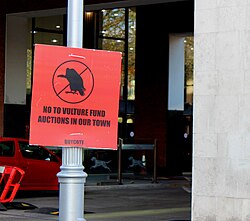
Despite the public backlash, political views remained divided, with some government officials later praising the activity of these funds in the Irish economy.
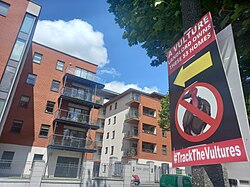
Summary of Vulture Fund Impact
| Perspective | Arguments For | Arguments Against |
|---|---|---|
| Financial | Provides market liquidity; enforces borrowing accountability. | Highly speculative; profits from the distress of others. |
| Humanitarian | N/A | Diverts debt relief funds from health and education. |
| Legal/Political | Protects commercial debt rights. | Undermines national sovereignty and international stability. |
Frequently Asked Questions
What exactly is a vulture fund?
A vulture fund is a type of hedge fund or private-equity fund that specializes in buying "distressed debt"—debt that is in default or close to it—at a deep discount with the intent to profit from its eventual recovery or settlement.
How do these funds make money from sovereign debt?
They purchase government bonds at a fraction of their face value on the secondary market. They then use legal actions, such as attachment and recovery suits, to force the government to pay the full value or a significantly higher settlement amount.
Why are they considered harmful to poor countries?
International organizations like the World Bank argue that when vulture funds sue for full payment, they divert money that was intended for debt relief, effectively taking funds away from essential public services like water, sanitation, and education.
What is the "doctrine of champerty"?
Champerty was a legal doctrine in England and the U.S. that made it illegal to purchase a debt solely for the purpose of litigating it. Most modern jurisdictions have eliminated this rule, allowing the current model of distressed debt investing to flourish.
How did the Irish government respond to vulture funds?
Ireland closed tax loopholes in 2016 that allowed these funds to avoid taxes on billions of euros in assets. However, they later introduced the L-QIAIF structure, which allows certain funds to operate without filing public accounts.