Voronina Island: A Remote Arctic Sanctuary in the Kara Sea
Deep within the northeastern reaches of the Kara Sea lies one of the most isolated locations in the Russian Arctic: Voronina Island. This secluded island group serves as a stark reminder of the raw power of nature, characterized by extreme cold, shifting ice, and a landscape that remains frozen for the vast majority of the year.
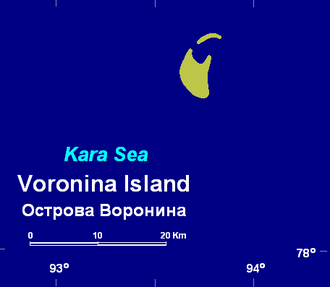
The group consists of two distinct landmasses: a larger primary island and a narrow islet to the north. These two are separated by a sound approximately 3 kilometers wide, creating a small but distinct archipelago in the middle of the frozen sea.
Geography and Dimensions
The main Voronina Island is the dominant feature of the group, measuring roughly 9 kilometers in length and 6 kilometers in width. Its surface is a rugged combination of ice and tundra vegetation—low-growing plants adapted to survive in cold, treeless environments with short growing seasons.
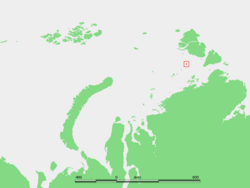
To the north lies the smaller islet, which is significantly narrower, stretching about 5 kilometers long but measuring just over 500 meters in width. Together, these islands sit in a lonely stretch of water, located approximately 130 kilometers west of the shores of Severnaya Zemlya and 72 kilometers north-northeast of Kirova Island within the Kirov group.
Climate and Environmental Conditions
The environment surrounding Voronina Island is defined by severe Arctic conditions. For most of the year, the surrounding waters are choked with pack ice. Even during the brief summer—which lasts barely two months—the sea is frequently dotted with ice floes.
In particularly harsh years, the climate is so extreme that the waters of the Kara Sea at this latitude do not melt at all, remaining frozen solid throughout the entire summer season.
Ecological Importance and Administration
Despite its inhospitable climate, Voronina Island is a vital ecological hub. It serves as a critical breeding ground for polar bears, providing a safe haven for the species to raise their young.
Administratively, the islands fall under the Krasnoyarsk Krai division of the Russian Federation. To ensure the protection of its unique wildlife, the area is part of the Great Arctic State Nature Reserve, which stands as the largest nature reserve in the Russian Arctic.
Naming and Etymology
The islands were named in honor of Vladimir Voronin, a Captain in the Soviet Navy. Interestingly, there is a linguistic quirk regarding the name. Because "Voronina" is the Russian genitive form, the phrase "Voronina Islands" is technically grammatically incorrect in a strict linguistic sense. However, this version has become the standard designation used in modern maps, atlases, and general usage for several decades, while the grammatically correct "Voronin Islands" remains rare.
Key Facts
- Location: Northeastern Kara Sea, Russian Arctic.
- Composition: One main island (9x6 km) and one narrow islet (5x0.5 km).
- Conservation Status: Part of the Great Arctic State Nature Reserve.
- Wildlife: Important breeding ground for polar bears.
- Climate: Severe Arctic climate with summer lasting only two months.
- Administration: Krasnoyarsk Krai, Russian Federation.
| Feature | Main Island | Northern Islet |
|---|---|---|
| Length | ~9 km | ~5 km |
| Width | ~6 km | >500 m |
| Vegetation | Tundra and Ice | Tundra and Ice |
Frequently Asked Questions
Where exactly is Voronina Island located?
It is located in the northeastern Kara Sea, approximately 130 km west of Severnaya Zemlya and 72 km north-northeast of Kirova Island.
What animals use the island for breeding?
The islands are a known breeding ground for polar bears.
How long is the summer season on Voronina Island?
The summer lasts barely two months, and in some years, the surrounding sea remains frozen solid throughout this period.
Which nature reserve protects the islands?
The islands are part of the Great Arctic State Nature Reserve, the largest of its kind in the Russian Arctic.
Who was the island named after?
The islands were named after Soviet Navy Captain Vladimir Voronin.