Vinous-throated Parrotbill
The vinous-throated parrotbill (Suthora webbiana) is a small, highly social bird belonging to the family Paradoxornithidae. Known for its distinctive short bill and gregarious nature, this species is widely distributed across East Asia, adapting to a variety of environments from dense bamboo stands to human-modified landscapes.
Originally described by John Gould in 1852, the species is sometimes referred to as Webb's parrotbill, named in honor of the English botanist Philip Barker Webb.
Key Facts
- Conservation Status: Least Concern (IUCN 3.1).
- Distribution: Found in China, Japan, Korea, Mongolia, Russia, Taiwan, and Vietnam.
- Size: Measures between 11 and 12.5 cm in length.
- Habitat: Primarily subtropical or tropical moist montane forests, including bamboo and scrub.
- Social Structure: Forms large winter flocks that can reach up to 140 individuals.
Taxonomy and Systematics
The classification of the vinous-throated parrotbill has undergone several revisions. While initially placed in the genus Suthora, it was later moved to Paradoxornis. However, recent DNA studies revealed that Paradoxornis is paraphyletic (a group that does not include all descendants of a common ancestor), leading to suggestions that the species be moved to Sinosuthora.
As of the International Ornithologists' Union bird list 13.2, the species has been returned to its original genus, Suthora. It is closely related to the ashy-throated parrotbill, and hybridization between the two has been documented in China, Vietnam, and Italy, where both species have established populations.
Physical Description
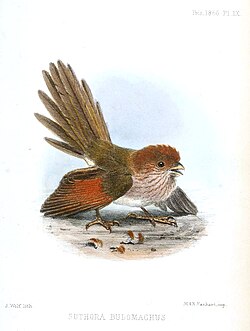
The vinous-throated parrotbill is a relatively small bird with a graduated tail. Its most defining feature is its short bill, where the nostrils are concealed by feather bristles. Both sexes share similar plumage:
- Upperparts: Warm brown, with dark brown wings and chestnut-tinged flight feathers.
- Head: A rufescent brown crown and forehead, complemented by a pale grey iris.
- Underparts: A pinkish-cream throat and upper breast with brown streaks, merging into a cream-buff belly and slightly buffy flanks.
- Bill: Slate grey or brown, often featuring a yellow or paler tip.
Weight varies slightly by sex, with males typically weighing between 8.5 to 11 g and females between 7 to 12 g.
Habitat and Distribution
This species occupies a diverse range of habitats from northern Vietnam to southern Manchuria. It thrives in open wooded areas, including scrub, forest edges, thickets, and bamboo stands. It is also found in reeds, marshes, and hedges.
The vinous-throated parrotbill is remarkably adaptable, often inhabiting human-modified areas such as plant nurseries and tea plantations. Its elevation range varies by region:
- China: Found in lower montane areas; in Sichuan, it is replaced by the ashy-throated parrotbill above 1,000 m (3,300 ft).
- Taiwan: It is the only parrotbill species on the island, occupying the widest ecological niche of any bird there, ranging from sea level up to 3,100 m (10,200 ft).
Social Behavior
Highly social and rarely seen alone, these birds travel in flocks that fluctuate in size. While groups are smallest during the breeding season, winter flocks can swell to 140 birds. Research on Taiwanese winter flocks identifies four distinct social roles:
- Core members: Permanent residents of the flock.
- Regular members: Consistent members who occasionally visit other groups.
- Floaters: Individuals that move frequently between different flocks.
- Peripheral members: Short-term visitors seen for less than two months.
These flocks maintain strong cohesion even when their ranges overlap with other groups.
Species Summary
| Attribute | Details |
|---|---|
| Scientific Name | Suthora webbiana |
| Family | Paradoxornithidae |
| Average Length | 11–12.5 cm |
| Weight | 7–12 g |
| Primary Habitat | Moist montane forests, bamboo, and scrub |
| Conservation Status | Least Concern |
Frequently Asked Questions
Where is the vinous-throated parrotbill found?
It is native to East Asia, with populations located in China, Japan, Korea, Mongolia, Russia, Taiwan, and Vietnam.
What makes the parrotbill's bill unique?
The bill is short and specialized, with the nostrils concealed by feather bristles, a characteristic shared with other members of the parrotbill family.
How does the species behave in winter?
In winter, they form large, cohesive social flocks that can include up to 140 individuals, consisting of core members, regulars, floaters, and peripheral visitors.
Is the vinous-throated parrotbill endangered?
No, the species is currently classified as Least Concern by the IUCN (version 3.1).
Can this bird live near humans?
Yes, the vinous-throated parrotbill is adaptable and can be found in human-modified habitats such as tea plantations and plant nurseries.