Viktor Bout: The Rise and Fall of the International Arms Dealer
Following the collapse of the Soviet Union in 1991, Viktor Bout emerged as one of the world's most notorious international arms dealers. Utilizing a vast network to move Soviet-made weaponry, Bout operated across several continents, supplying warlords, insurgent groups, and rogue states in volatile war zones.
His operations spanned Africa—including Liberia under Charles Taylor, Angola, and Sierra Leone—as well as Asia, where he supplied the Taliban, and various regions in South America. By 2002, Bout's activities had drawn the attention of international law enforcement, leading Belgium to issue an Interpol warrant for money laundering. Under increasing global pressure, Bout sought refuge in Moscow, where he remained protected by Russian authorities for several years.
The DEA Sting and Arrest in Thailand
Bout's downfall began with a sophisticated sting operation orchestrated by the U.S. Drug Enforcement Administration (DEA). U.S. agents posed as representatives of the FARC, a Colombian rebel group, and negotiated with Bout for the delivery of 100 9K38 Igla surface-to-air missiles and armor-piercing rocket launchers. The plan involved Bout airdropping the weapons to specific landing spots in Colombia.
To finalize the deal, the imposters invited Bout to Bangkok, Thailand, to meet their leader. The operation was facilitated by Andrew Smulian, a former South African intelligence agent and associate of Bout, who acted as an informer for U.S. law enforcement.
On March 6, 2008, the Royal Thai Police arrested Bout based on an Interpol red notice requested by the United States. Despite legal battles fought by both Bout and the Russian government to prevent his extradition, Thai courts ruled in 2010 that he could be sent to the U.S. to face trial.
U.S. Prosecution and Legal Proceedings
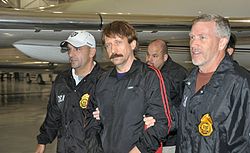
Upon his arrival in the United States on November 16, 2010, Bout faced a series of severe federal charges. A criminal complaint filed in Manhattan federal court led to an indictment in May 2008 on four terrorism-related charges:
- Conspiracy to kill U.S. nationals.
- Conspiracy to kill U.S. officers and employees.
- Conspiracy to acquire and use anti-aircraft missiles.
- Conspiracy to provide material support or resources to a designated foreign terrorist organization.
By February 2010, additional charges were added, including money laundering, wire fraud, and the illegal purchase of aircraft.
Conviction and Sentencing
Following a three-week trial in the United States District Court for the Southern District of New York, a jury convicted Bout on all charges on November 2, 2011. On April 5, 2012, Judge Shira Scheindlin sentenced him to 25 years in prison. This was the minimum sentence required for conspiring to sell weapons to a U.S.-designated foreign terrorist group.
Judge Scheindlin noted that the minimum sentence was appropriate because there was no evidence Bout would have committed these specific crimes without the DEA sting operation. Bout's defense team argued he was a political prisoner, and the Russian Ministry of Foreign Affairs denounced the sentence as a "political order." Conversely, Bout's wife, Alla, stated that the judge conducted the trial properly.
Appeals and Imprisonment
Bout attempted to overturn his conviction through several legal avenues. In September 2013, the U.S. Court of Appeals for the Second Circuit upheld the verdict, rejecting his claims of vindictive prosecution. In 2014, Bout hired the law firm of former U.S. Attorney General John Ashcroft to seek a new trial based on "newly discovered evidence," but the courts dismissed the claim as meritless.
Until his eventual release in a 2022 prisoner swap, Bout had been scheduled to remain in prison until August 2029.
Key Facts
- Primary Activity: International arms dealing of Soviet-made weaponry.
- Key Regions: Africa (Angola, Sierra Leone, Liberia), Asia (Taliban), and South America.
- Arrest Date: March 6, 2008, in Bangkok, Thailand.
- Sting Operation: Conducted by the DEA using imposters posing as FARC rebels.
- Sentence: 25 years in federal prison (sentenced April 5, 2012).
- Convictions: Terrorism-related conspiracies, money laundering, wire fraud, and illegal aircraft purchase.
| Year | Event | Details |
|---|---|---|
| 2002 | Interpol Warrant | Issued by Belgium for money laundering. |
| 2008 | Arrest | Detained in Bangkok via DEA sting operation. |
| 2010 | Extradition | Transferred from Thailand to the United States. |
| 2011 | Conviction | Found guilty on all federal charges in Manhattan. |
| 2012 | Sentencing | Sentenced to 25 years in prison. |
| 2013-2014 | Appeals | Conviction upheld; new trial requests rejected. |
Frequently Asked Questions
How was Viktor Bout captured?
Bout was captured in Bangkok, Thailand, following a DEA sting operation where agents posed as members of the Colombian rebel group FARC to lure him into a deal for surface-to-air missiles.
What were the primary charges against Bout?
He was convicted of conspiracy to kill U.S. nationals and officers, conspiracy to acquire anti-aircraft missiles, and providing material support to a designated foreign terrorist organization, along with money laundering and wire fraud.
Why did Bout receive a 25-year sentence?
The 25-year term was the minimum sentence for conspiring to sell weapons to a U.S.-designated foreign terrorist group. The judge applied this minimum because the crimes were the result of a sting operation.
Did the Russian government support Bout?
Yes, the Russian government fought his extradition and later denounced his sentencing as a "political order," while Bout's lawyers claimed he was a political prisoner.
Who helped the U.S. government secure Bout's conviction?
Andrew Smulian, a former South African intelligence agent and associate of Bout, acted as a go-between and became an informer for U.S. law enforcement.