Velos (D16): From US Navy Destroyer to Symbol of Greek Democracy
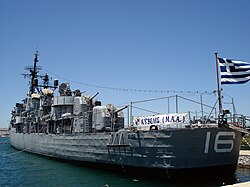
The story of the Velos (D16) is one of the most remarkable in naval history. Beginning its life as a combatant in the heat of the Pacific Theater during World War II and ending as a floating museum, the ship transitioned from a weapon of war to a powerful symbol of political resistance and democratic conviction.
Key Facts
- Original Name: USS Charrette (launched June 3, 1942).
- Total Distance Sailed: 362,622 nautical miles over a 48-year career.
- Major Conflicts: World War II (Pacific Theater), various NATO crises.
- Defining Moment: The 1973 mutiny against the Greek military junta.
- Current Status: Naval museum located in Thessaloniki, Greece.
Early Service: The USS Charrette in World War II
Launched on June 3, 1942, by the Boston Navy Yard and commissioned on May 18, 1943, the ship originally served as the USS Charrette. Its early career was defined by intense operations in the Pacific, where it provided critical support for Allied advances against Japanese forces.
Between late 1943 and 1944, the Charrette was instrumental in several key campaigns. It provided Naval Gunfire Support (shore bombardment to assist ground troops) during landings at Makin and Tarawa and screened aircraft carriers during strikes on the Marshall Islands and New Guinea.
Combat Achievements and Anti-Submarine Warfare
In February 1944, the Charrette demonstrated its effectiveness in anti-submarine warfare. After detecting a radar contact, the ship guided the destroyer escort Fair to sink a Japanese submarine, believed to be the I-175. This marked the first time a Japanese submarine was sunk using the Hedgehog, a forward-throwing anti-submarine weapon.
The ship's versatility continued through the Marianas operation and the Battle of the Philippine Sea in June 1944. During this period, the Charrette intercepted and sank the 1,900-ton freighter Tatsutakwa Maru, rescuing 112 survivors.
The Path to Victory and Decommissioning
As the war progressed, the Charrette played a role in the Battle for Leyte Gulf and supported landings at Lingayen Gulf in early 1945. Its final wartime act involved the capture of the hospital ship Tachibana Maru, which was found to be carrying contraband and troops. After escorting occupation forces to Chinese ports, the ship returned to San Francisco in December 1945 and was eventually placed in reserve in 1947.
Transition to the Hellenic Navy
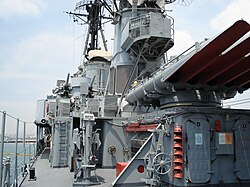
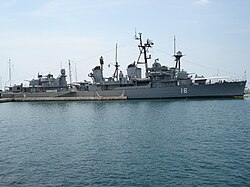
In June 1959, the vessel was transferred to Greece, where it was renamed Velos (meaning "Arrow") and designated as D16. For the next several decades, Velos became a staple of the Hellenic Navy, participating in nearly every major Greek and NATO exercise, as well as tensions with Turkey in 1964, 1967, 1974, and 1987.
The Mutiny of 1973: A Stand for Democracy
The most famous chapter of the ship's history occurred on May 25, 1973. While participating in a NATO exercise, Commander Nikolaos Pappas and his crew learned that naval officers in Greece were being arrested and tortured by the ruling military junta (a dictatorship).
Loyal to the Greek Constitution and the principles of democracy, Commander Pappas decided to use the ship to draw global attention to the regime's atrocities. He signaled his intentions to NATO Headquarters, citing the North Atlantic Treaty's commitment to individual liberty and the rule of law, and sailed for Italy.
The Velos anchored off the coast of Fiumicino, Italy. From there, officers contacted international press agencies to expose the situation in Greece. While the captain, six officers, and 25 petty officers sought political asylum in Italy, the rest of the crew returned to Greece to avoid retaliation against their families.
Following the fall of the junta in July 1974, the ship returned to service. Commander Pappas eventually rose to the rank of vice admiral and served as the chief of the Hellenic Navy General Staff from 1982 to 1986.
Preservation and Legacy
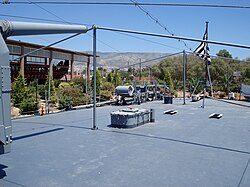
Velos was decommissioned on February 26, 1991. In 1994, it was designated as the Museum of the Struggle against the Dictatorship. After spending years in the Naval Tradition Park at Palaio Faliro in Athens, the ship was moved to Thessaloniki on September 9, 2019.
Despite its age, the ship is still regarded as being in commission. In November 2023, the vessel suffered stern damage due to severe weather and was towed to the city's harbor for safety.
| Period | Identity | Primary Role/Event | Key Location |
|---|---|---|---|
| 1942–1959 | USS Charrette | WWII Combat & Screening | Pacific Ocean |
| 1959–1991 | Velos (D16) | NATO Exercises & National Defense | Mediterranean Sea |
| 1973 | Velos (D16) | Democratic Mutiny | Fiumicino, Italy |
| 1994–Present | Museum Ship | Educational Preservation | Thessaloniki, Greece |
Frequently Asked Questions
What was the USS Charrette's most significant combat achievement?
One of its most notable achievements was guiding the destroyer escort Fair to sink the Japanese submarine I-175, which was the first Japanese submarine sunk using the Hedgehog anti-submarine weapon.
Why did Commander Pappas lead a mutiny in 1973?
Commander Pappas acted to protest the Greek military junta after learning that naval officers were being arrested and tortured. He sought to mobilize international public opinion against the dictatorship by anchoring the ship in Italy.
Where can the Velos be visited today?
The Velos is currently anchored on the waterfront of Thessaloniki, Greece, near the city's Concert Hall, where it serves as a naval museum.
How many miles did the ship travel during its career?
Over its 48-year career, the ship sailed a total of 362,622 nautical miles (approximately 671,576 kilometers).
What happened to the crew after the mutiny?
The captain, six officers, and 25 petty officers remained in Italy as political refugees. The rest of the crew returned to Greece, largely to protect their families from potential retaliation by the regime.