Vawkavysk History: From Medieval Stronghold to Modern Belarusian Town
Vawkavysk stands as one of the oldest urban centers in Eastern Europe, serving as a silent witness to the shifting borders and colliding empires of the Slavic and Baltic worlds. From its origins as a series of fortified settlements to its role as a strategic railway junction, the town's trajectory reflects the broader geopolitical struggles of the region.
Prehistoric Foundations and Early Settlements
Long before it became a recognized town, the territory of Vawkavysk was home to three primary fortified settlements: Swedish Mountain, Muravelnik, and Zamchishcha. As the community expanded, the population shifted toward Zamchishcha, while the foot of Swedish Mountain became a hub for early commerce and industry. Due to the frequent flooding of the Wołkowyja River, many other potential archaeological sites from this era have been lost to time.
The Middle Ages: A Borderland Struggle
While legends attribute the town's founding to either Prince Wadislaw Zawejko in 738 or King Mindaugas of Lithuania, archaeological evidence confirms a Slavic settlement existed by the late 10th century. Located in the region once known as Black Ruthenia, Vawkavysk became a focal point of conflict between Baltic and Slavic tribes.
The town's early history was marked by volatility. It was destroyed by the Yatvingians in 1038 and later shifted between the influence of the Principality of Polotsk and Galicia-Volhynia. By 1239, it was incorporated into the burgeoning Grand Duchy of Lithuania. Throughout the 13th century, the town frequently changed hands between Lithuanian and Galician-Volhynian princes, serving as a strategic pawn in regional power struggles until Lithuania firmly annexed Black Ruthenia in the late 1270s.
The Grand Duchy of Lithuania and the Union of Lublin
By 1293, Vawkavysk was fully integrated into the Grand Duchy of Lithuania. The town gained significant political importance in 1385 when Jogaila used its castle to send envoys to Kraków to propose marriage to Queen Jadwiga of Poland. This event paved the way for Jogaila's baptism as Władysław II Jagiełło and his ascension to the Polish throne.
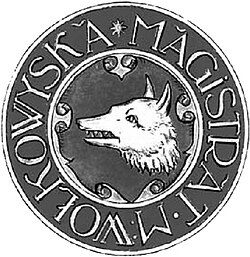
The 15th century brought both devastation and growth. The town was plundered and burned by the Teutonic Knights in 1409 and 1410, yet the Vawkavysk banner proudly participated in the landmark Battle of Grunwald in 1410. A turning point occurred in 1503 when King Alexander Jagiellon granted the town Magdeburg rights—a set of town laws that provided local autonomy and encouraged trade. The town adopted a coat of arms featuring a wolf's head on a blue background.
The Polish–Lithuanian Commonwealth and the Era of "The Deluge"
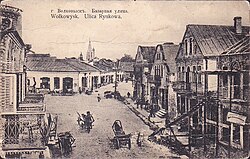
The 1569 Union of Lublin transformed the personal union of Poland and Lithuania into a single state: the Polish–Lithuanian Commonwealth. Vawkavysk became a royal town and a venue for General Sejmiks (provincial assemblies) for all of Lithuania.
However, the 17th century brought "The Deluge," a period of catastrophic wars involving Russia and Sweden. Vawkavysk was captured twice by Russian forces (1655 and 1662) and completely destroyed by the Swedish army under King Charles X Gustav in 1656. Despite these setbacks, the town recovered in the 18th century, establishing Jesuit missions and schools, and growing to approximately 1,000 buildings by 1792.
Imperial Russian Rule and Industrialization
Following the third partition of Poland in 1795, Vawkavysk was absorbed into the Russian Empire. The 19th century saw the town become a strategic military site; during Napoleon's 1812 invasion, it served as the headquarters for General Pyotr Bagration before being burned during a battle between French and Russian forces.
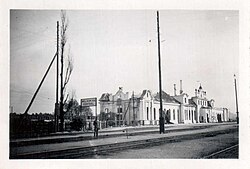
The late 1800s marked a transition toward industrialization. The opening of a railway station in 1886 and the completion of a line to Siedlce in 1907 transformed Vawkavysk into a vital railway junction. By 1860, the town boasted a diverse economy with a brick factory, mills, and nearly sixty shops.
The World Wars and the 20th Century
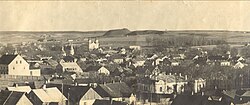
The early 20th century was a whirlwind of regime changes. After the collapse of Imperial Russia and a brief period under the Belarusian People's Republic, Vawkavysk was contested during the Polish–Soviet War. It was eventually incorporated into the Second Polish Republic following the 1921 Treaty of Riga.
World War II brought the darkest chapter in the town's history. Occupied by the Soviet Union in 1939 and then by Nazi Germany in 1941, the town suffered immense loss. The German occupation saw the establishment of a Jewish ghetto; of the 7,000 Jewish residents, only about 70 survived the Holocaust, with most victims sent to Treblinka and Auschwitz.
The Red Army recaptured the town on July 14, 1944. Vawkavysk remained part of the Byelorussian SSR until the dissolution of the Soviet Union in 1991, after which it became part of the independent Republic of Belarus.
Key Facts
- Founded: Believed to be the 10th century; archaeological evidence confirms Slavic settlement by the late 10th century.
- Magdeburg Rights: Granted in 1503 by King Alexander Jagiellon.
- Strategic Role: Served as a key railway junction between Baranovichi and Białystok starting in 1886.
- WWII Tragedy: Approximately 99% of the town's 7,000 Jewish residents perished during the Nazi occupation.
- Political Shifts: Transitioned through Kievan Rus, the Grand Duchy of Lithuania, the Polish-Lithuanian Commonwealth, the Russian Empire, Poland, and the Soviet Union.
| Period | Ruling Power / Entity |
|---|---|
| Pre-1084 | Kievan Rus / Baltic Tribes |
| 1293–1569 | Grand Duchy of Lithuania |
| 1569–1795 | Polish–Lithuanian Commonwealth |
| 1795–1918 | Russian Empire |
| 1919–1939 | Second Polish Republic |
| 1939–1941 | Soviet Union (Byelorussian SSR) |
| 1941–1944 | Nazi Germany (Occupation) |
| 1944–1991 | Soviet Union (Byelorussian SSR) |
| 1991–Present | Republic of Belarus |
Frequently Asked Questions
What are the legends regarding the founding of Vawkavysk?
One legend claims Prince Wadislaw Zawejko founded the town in 738 after killing two robbers named Woloko and Wisek. Another legend attributes the town's founding to Mindaugas, the King of Lithuania.
What were the Magdeburg rights granted in 1503?
Magdeburg rights were a set of town laws that granted Vawkavysk a degree of self-governance and legal autonomy, which helped stimulate its commercial and industrial growth.
How did the "Deluge" affect the town?
The Deluge refers to a series of mid-17th century invasions by Russia and Sweden. Vawkavysk was captured twice by Russian troops and completely burned by the Swedish army in 1656.
What was the impact of the railway on Vawkavysk?
The construction of the railway in 1885 and the subsequent link to Siedlce in 1907 transformed the town into an important railway junction, boosting its industrial capacity to 19 enterprises by 1891.
What happened to the Jewish population during World War II?
Of the roughly 7,000 Jews living in Vawkavysk, the vast majority were murdered by Nazi forces. Many were processed through a transit ghetto before being sent to extermination camps like Treblinka and Auschwitz; only about 70 survived.