Várzea Grande–Marechal Rondon International Airport
The Várzea Grande–Marechal Rondon International Airport (IATA: CGB, ICAO: SBCY) serves as the primary aviation hub for Cuiabá, the capital of Mato Grosso. Located in the municipality of Várzea Grande, Brazil, the airport is named in honor of Marshall Cândido Mariano da Silva Rondon, a renowned Brazilian explorer. As a critical link for the region, it facilitates both domestic and international travel, connecting the heart of Brazil to major urban centers and regional towns.
Currently operated by Aeroeste, the airport is a focus city for Azul Linhas Aéreas Brasileiras, ensuring high connectivity for passengers traveling to and from the state of Mato Grosso.
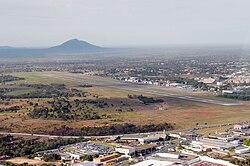
Key Facts
- Location: Várzea Grande, Brazil (serving Cuiabá).
- Operator: Aeroeste (since March 15, 2019).
- IATA/ICAO Codes: CGB / SBCY.
- Elevation: 188 meters (617 feet) above mean sea level (AMSL).
- Runway: A single asphalt runway (17/35) measuring 2,300 meters (7,546 feet).
- 2024 Traffic: 2,721,055 passengers and 46,430 aircraft operations.
Airport History and Development
The airport was first inaugurated in 1956, though it operated under precarious conditions until the completion of its first passenger terminal in 1964. In 1974, Infraero took over operations, and by 1996, the facility was officially upgraded to international status.
Modernization efforts began in earnest in June 2006 with the first phase of a new passenger terminal. To further expand capacity, a second phase involved demolishing the original terminal to make room for an enlarged facility. In August 2009, Infraero announced a BRL 30.9 million (approximately US$16.3 million) investment plan to prepare the airport for the 2014 FIFA World Cup, as Cuiabá was one of the host cities. This funding focused on renovating the terminal, parking areas, and airport access.
Despite these upgrades, the airport faced challenges with capacity. In May 2011, Infraero identified the airport as "critically saturated," reporting that it was operating at over 85% of its total capacity. A significant shift in management occurred on March 15, 2019, when Aeroeste won a 30-year concession to operate the facility.
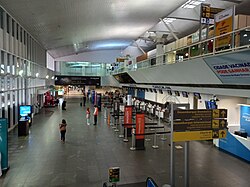
Airlines and Destinations
The airport is served by several major carriers, providing a mix of trunk routes to major cities and regional flights to smaller municipalities.
- Azul Brazilian Airlines: Connects to Alta Floresta, Belo Horizonte–Confins, Campinas, Cacoal, Porto Velho, Ji-Paraná, São José do Rio Preto, São Paulo–Guarulhos, Sinop, and Vilhena.
- Azul Conecta: Provides regional access to Água Boa, Aripuanã, Barra do Garças, and Juína.
- Gol Linhas Aéreas: Offers flights to Brasília, Goiânia, Porto Velho, Rio de Janeiro–Galeão, São Paulo–Congonhas, and São Paulo–Guarulhos.
- LATAM Brasil: Operates routes to Brasília, São Paulo–Congonhas, and São Paulo–Guarulhos.
Operational Statistics
The airport has seen fluctuating passenger volumes over the last two decades, with a notable dip during 2020 followed by a steady recovery. In 2024, the airport handled over 2.7 million passengers.
| Year | Passengers | Aircraft Operations | Cargo (t) |
|---|---|---|---|
| 2024 | 2,721,055 | 46,430 | - |
| 2023 | 2,849,904 | 46,400 | - |
| 2022 | 2,953,270 | 44,334 | - |
| 2021 | 2,139,211 | 36,636 | - |
| 2020 | 1,460,843 | 27,859 | - |
| 2019 | 2,983,392 | 44,591 | 8,109 |
Safety Record
The airport has experienced two significant aviation accidents in its history:
- March 30, 1980: A VOTEC Britten-Norman Islander (PT-JSC) stalled and crashed during takeoff, resulting in 9 fatalities.
- June 23, 1985: A TABA Embraer EMB 110 Bandeirante (PT-GJN) experienced engine failure on approach from Juara. The aircraft stalled and crashed 1 km short of the runway, resulting in 17 fatalities.
Frequently Asked Questions
Where is the Várzea Grande–Marechal Rondon International Airport located?
The airport is located in the municipality of Várzea Grande, approximately 10 km (6 mi) from downtown Cuiabá, Brazil.
Who currently operates the airport?
The airport is operated by Aeroeste, which won a 30-year concession on March 15, 2019.
Which airlines provide the most connectivity at CGB?
Azul Brazilian Airlines is a major operator and uses the airport as a focus city, alongside other significant carriers like Gol Linhas Aéreas and LATAM Brasil.
What is the runway capacity of the airport?
The airport features one asphalt runway (17/35) with a length of 2,300 meters (7,546 feet).
Why was the airport upgraded in 2009?
A BRL 30.9 million investment was implemented to renovate the terminal, parking, and access roads in preparation for the 2014 FIFA World Cup, for which Cuiabá was a venue city.