Vanguard: The Evolution of the Index Fund Giant
The Vanguard Group, Inc. stands as a titan in the global financial landscape. As an American registered investment adviser, it has redefined how individual investors access the stock market. By championing the philosophy of low-cost, passive investing, Vanguard has grown into the world's largest provider of mutual funds and the second-largest provider of exchange-traded funds (ETFs), trailing only BlackRock's iShares.
Headquartered in Malvern, Pennsylvania, Vanguard manages a staggering US$12 trillion in global assets under management (AUM) as of 2025. Beyond its core fund offerings, the company provides a comprehensive suite of financial services, including brokerage services, trust services, financial planning, and educational account services. Along with BlackRock and State Street, Vanguard is recognized as one of the "Big Three" index fund managers.
Key Facts
- Founded: May 1, 1975, by John C. Bogle.
- Ownership: Uniquely owned by the funds it manages, meaning it is owned by its customers.
- Assets Under Management: US$12 trillion (as of 2025).
- Workforce: Approximately 20,000 employees (as of December 31, 2025).
- Global Reach: Offices in the US, Canada, Australia, Asia, and Europe.
- Leadership: Led by CEO Salim Ramji, Chairman Mark Loughridge, and President & CIO Greg Davis.
The Vision of John C. Bogle
The story of Vanguard is inseparable from its founder, John C. Bogle. After a career at Wellington Management Company that included a tenure as CEO and a subsequent firing in 1974, Bogle viewed his professional setback as a catalyst for innovation. He believed that retail investors were underserved and needed a way to invest in broad market indexes without paying high management fees.
Inspired by economist Paul Samuelson, Bogle sought to create a passive fund—an investment that tracks a specific market index rather than relying on a manager to pick individual stocks. In 1976, he established the First Index Investment Trust, now known as the Vanguard 500 Index Fund, which tracks the S&P 500.
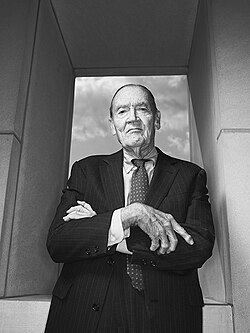
Overcoming Early Struggles
The launch of the first index fund was not an immediate success. While Bogle hoped to raise $150 million, the initial public offering only brought in $11 million. Early growth was hindered by Vanguard's refusal to pay commissions to brokers, a standard practice at the time. However, a strategic merger of a Wellington Fund into the index fund eventually boosted assets to nearly $100 million, providing the momentum needed for long-term growth.
Expansion and Diversification
The 1980s and 90s marked a period of rapid acceleration. A bull market beginning in 1982 increased the popularity of indexing. Vanguard expanded its product line, launching the Total Bond Fund in 1986—the first bond index fund for individual investors—and the Vanguard Extended Market Index Fund in 1987 to cover the stock market outside the S&P 500.
By the 1990s, Vanguard had become the largest mutual fund company in the world. The company also proved it could succeed in active management; for example, the Windsor Fund, managed by John Neff until 1995, outperformed the S&P 500 by an average of 3% per year over three decades.
Modern Era and Strategic Shifts
Following Bogle's retirement as chairman in 1999, subsequent leaders expanded the firm's offerings into ETFs and more actively managed funds. While Bogle was initially skeptical of ETFs due to their mid-day trading nature and potential for higher bid-ask spreads, they became a cornerstone of Vanguard's growth.
In recent years, Vanguard has embraced digital transformation and global expansion. This includes launching a digital adviser in 2020, entering the Australian superannuation (retirement fund) market in 2022, and introducing a fractional share program for ETFs in 2021 to make investing accessible for as little as $1.
Corporate Governance and Controversies
Vanguard's unique structure—where the company is owned by its funds—is designed to keep costs low for investors. This is reflected in their share classes: Investor shares and Admiral shares, the latter of which offer lower expense ratios for those meeting higher minimum investment requirements (typically $3,000 to $100,000).
Despite its success, the firm has faced challenges. In January 2025, Vanguard paid $106.41 million to settle SEC charges regarding misleading statements about tax consequences for target-date retirement funds. Additionally, the firm has faced scrutiny over its environmental impact, specifically its significant investments in the coal industry and fossil fuel production in the Amazon rainforest, despite joining a 2021 initiative to help portfolio companies reach net-zero emissions by 2060.
In December 2025, Vanguard reversed a previous policy by allowing cryptocurrency ETFs and mutual funds to trade on its brokerage platform, though it stated it has no plans to launch its own crypto products.
Vanguard Company Overview
The following table summarizes the key operational details of The Vanguard Group.
| Category | Detail |
|---|---|
| Founded | May 1, 1975 |
| Founder | John C. Bogle |
| Global AUM | US$12 Trillion |
| Employee Count | 20,000 |
| Ownership Model | Owned by its funds/customers |
| Primary Products | Mutual Funds, ETFs, Asset Management |
Frequently Asked Questions
Who owns Vanguard?
Vanguard is owned by the funds it manages, which in turn are owned by the investors who buy shares in those funds. This structure is intended to align the company's interests with those of its customers.
What is the difference between Investor and Admiral shares?
Admiral shares have lower expense ratios (the annual fee for managing the fund) but require a higher minimum initial investment, often ranging from $3,000 to $100,000 depending on the fund.
What is a passive index fund?
A passive index fund is an investment designed to track the performance of a specific market benchmark, such as the S&P 500, rather than employing a manager to actively select stocks to beat the market.
Does Vanguard offer cryptocurrency investments?
As of December 2025, Vanguard allows clients to trade cryptocurrency ETFs and mutual funds on its brokerage platform, although the company does not create its own cryptocurrency products.
What is the "Big Three" in index fund management?
The "Big Three" refers to the three largest asset managers that dominate the index fund market: Vanguard, BlackRock, and State Street.