USS Patoka: The Versatile Tender of the Early Naval Airship Era
The USS Patoka served as a critical logistical backbone for the United States Navy during the interwar period, transitioning from a standard fuel oiler to a specialized support ship for the Navy's ambitious rigid airship program. Her career reflects the evolving nature of naval aviation and the logistical challenges of supporting massive lighter-than-air craft far from their home bases.
Early Service and Transition to Airship Support
Beginning her career with the Naval Overseas Transportation Service, the Patoka spent her early years as a fuel oiler. Between 1919 and 1924, she operated extensively across the Atlantic, transporting fuel oil from Texas to Scotland, the Adriatic Sea, and Istanbul. This period established her utility as a long-range transport vessel before she was selected for a highly specialized role.
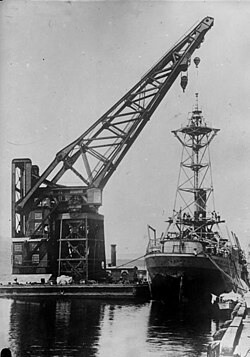
In 1924, the Norfolk Navy Yard transformed the vessel into a tender for the USS Shenandoah, a rigid airship. This conversion involved significant structural modifications, including the installation of a mooring mast reaching 125 feet above the waterline. To support the airship's complex needs, the Navy added facilities for helium and gasoline, expanded crew accommodations, and created stowage for three seaplanes. Despite these changes, the ship retained her oiler hull classification symbol, AO-9, rather than adopting the Lighter-than-air aircraft tender (AZ) symbol.
Supporting the Rigid Airship Fleet
The Patoka's primary mission was to provide a mobile base of operations, reducing the reliance on ground personnel and increasing the flexibility of naval airships. After successful mooring experiments with the Shenandoah in August 1924, the Patoka played a pivotal role in the arrival of the USS Los Angeles. In October 1924, the Patoka and the cruisers Milwaukee and Detroit provided essential weather reports and forecasts as the Los Angeles flew from Germany to Lakehurst Naval Air Station in New Jersey.
Throughout the late 1920s, the Patoka served as the primary supply hub for the Los Angeles during long-range missions to Puerto Rico, Panama, and Florida. She was also instrumental during the fleet concentration off Panama in 1931.
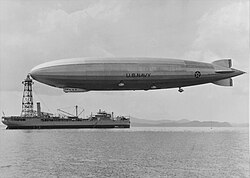
The era of airship support faced significant setbacks with the loss of the Shenandoah in a September 1925 storm—which cancelled a planned polar flight—and the later loss of the USS Akron in April 1933. Following the decommissioning of the Los Angeles in June 1932, the need for a specialized tender diminished, leading to the Patoka's decommissioning on August 31, 1933.
Recommissioning and World War II Prelude
The Patoka returned to active service on November 10, 1939, at the Puget Sound Navy Yard under the command of Comdr. C.A.F. Sprague. Upon her return, her role shifted again; she was reclassified as AV-6, a seaplane tender, and assigned to Patrol Wing 5 of the Scouting Force.
Her tenure as a seaplane tender was brief. By June 1940, she was reassigned to the Naval Transportation Service and reverted to her original classification as an oiler (AO-9). For the remainder of 1940 and much of 1941, she operated as a vital fuel and cargo link, delivering supplies to ports including Boston, Norfolk, and Key West, and eventually making round trips to Recife, Brazil, just before the United States entered World War II.
Key Facts
- Hull Classifications: Served as AO-9 (Oiler) and AV-6 (Seaplane Tender).
- Airship Support: Provided mooring and logistics for USS Shenandoah, USS Los Angeles, and USS Akron.
- Specialized Equipment: Featured a 125-foot mooring mast and helium/gasoline storage.
- Global Reach: Operated in the Mediterranean, Atlantic, Caribbean, and South America (Brazil).
- Key Conversion: Modified at Norfolk Navy Yard in 1924 to support rigid airships.
| Period | Classification | Primary Role/Mission |
|---|---|---|
| 1919–1924 | AO-9 | Fuel oil transport (Europe and Near East) |
| 1924–1933 | AO-9 | Rigid airship tender (Shenandoah, Los Angeles, Akron) |
| 1939–1940 | AV-6 | Seaplane tender (Patrol Wing 5) |
| 1940–1941 | AO-9 | Fuel and cargo delivery (Atlantic and Caribbean) |
Frequently Asked Questions
What was the purpose of the mooring mast on the USS Patoka?
The 125-foot mooring mast allowed the ship to secure rigid airships, such as the USS Shenandoah, providing a stable point for the airship to dock while at sea.
Which rigid airships did the USS Patoka support?
The Patoka served as a tender and supply base for the USS Shenandoah, the USS Los Angeles, and the USS Akron.
Why was the USS Patoka decommissioned in 1933?
The need for an airship tender decreased significantly following the decommissioning of the USS Los Angeles and the loss of the USS Akron.
Did the USS Patoka's classification change over time?
Yes. She began as an oiler (AO-9), was reclassified as a seaplane tender (AV-6) in 1939, and finally returned to her oiler (AO-9) classification in June 1940.
Where did the USS Patoka operate just before World War II?
In the months leading up to the war, she delivered fuel oil and general cargo across the Atlantic, Gulf, and Caribbean, including round trips to Recife, Brazil.