URN: The Evolution of University Radio Nottingham
University Radio Nottingham (URN) stands as a testament to student-led innovation in broadcasting. What began as a modest university club has evolved into an award-winning station, consistently pushing the boundaries of how student media reaches its audience through technological adaptation and journalistic excellence.
The Early Years and Analog Beginnings
The roots of URN trace back to the late 1970s, originating from the university's Radio Broadcasting Club. In its infancy, the club secured a one-hour weekly slot on BBC Radio Nottingham. By 1978, the station established its first dedicated studio within the Cherry Tree buildings.
Broadcasting officially launched in November 1979, transmitting on 963 kHz (312m) to the Cripps Hall and Hugh Stewart Hall residences. To expand its reach, the station installed several induction loops—specialized antenna systems that allow receivers to pick up signals in specific areas—across various campus halls. This expansion continued into 1990 with the installation of a fifth induction loop at the Sutton Bonington Campus, funded by the Guild.
Embracing the Digital Revolution
As the internet transformed media consumption, URN positioned itself as an early adopter of digital streaming. In 1997, it became one of the first radio stations globally to broadcast via the internet using the MP3 format (a compressed audio file format). This commitment to innovation continued in 2002 when the station integrated the Ogg Vorbis format into its streaming capabilities.
The station also expanded its terrestrial reach in 2001 by utilizing an LPAM (Low Power AM) long-term restricted service licence, allowing it to broadcast on 1350AM across the entirety of University Park.
Infrastructure and Studio Evolution
The physical home of URN has shifted alongside its technology. Following the demolition of the Cherry Tree buildings in 2003, the station moved into purpose-built studios in the Portland Building in 2004.
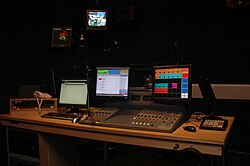
Technical upgrades remained a priority. In the summer of 2012, the station underwent a comprehensive refit, implementing a Studer digital system for audio mixing and routing to enhance production quality.
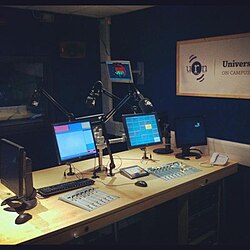
The most recent major transition occurred in the summer of 2018, when URN relocated to the MediaZone within the Students' Union Building. This move culminated in the spring of 2020 with the installation of a state-of-the-art AoIP (Audio over IP) studio, which allows audio signals to be transmitted over standard Ethernet networks.
Key Facts
- Founded: First studio established in 1978; broadcasting began November 1979.
- Digital Pioneer: Early adopter of MP3 (1997) and Ogg Vorbis (2002) internet broadcasting.
- Award Record: Won the Student Radio Awards Best Station for five consecutive years, ending in 2014.
- Current Location: Based in the MediaZone of the Students' Union Building.
- Latest Tech: Transitioned to an AoIP studio in 2020.
URN Historical Timeline
| Year | Milestone | Technology/Location |
|---|---|---|
| 1979 | Official Broadcast Start | 963 kHz / Induction Loops |
| 1997 | Internet Launch | MP3 Format |
| 2001 | Campus-wide AM Reach | LPAM 1350AM |
| 2004 | Studio Relocation | Portland Building |
| 2012 | Digital Audio Refit | Studer Digital System |
| 2020 | Modernization | AoIP Studio |
Frequently Asked Questions
When did URN start broadcasting?
URN began broadcasting to the Hugh Stewart Hall and Cripps Hall residences in November 1979.
What record does URN hold in the Student Radio Awards?
URN holds the record for the most consecutive Best Station awards, winning the title for five years in a row up until 2014.
How did URN first reach students on campus?
The station initially used a 963 kHz frequency and installed induction loops in various halls of residence to ensure signal reception.
What is the current studio setup at URN?
Since spring 2020, the station has operated out of a brand new AoIP (Audio over IP) studio located in the MediaZone of the Students' Union Building.
Was URN an early adopter of internet radio?
Yes, URN was one of the first radio stations to broadcast on the internet using the MP3 format in 1997, followed by the Ogg Vorbis format in 2002.