Upper Paleolithic Era: The Dawn of Behavioral Modernity
The Upper Paleolithic, or Upper Old Stone Age, represents the final subdivision of the Paleolithic period. Spanning roughly from 50,000 to 12,000 years before present (BP), this era is defined by a profound shift in human cognition and creativity. While anatomically modern humans (Homo sapiens) emerged in Africa approximately 300,000 years ago, it was during the Upper Paleolithic that we see the emergence of behavioral modernity—a marked increase in the complexity and diversity of tools, art, and social structures.
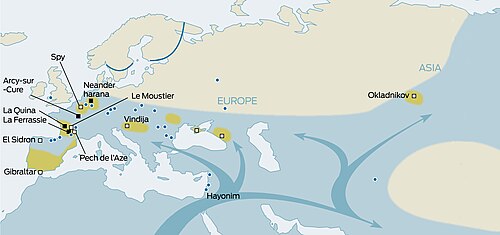
This period coincides with the great expansion of modern humans from Africa into Asia and Eurasia, a migration that likely contributed to the extinction of the Neanderthals.
Key Facts
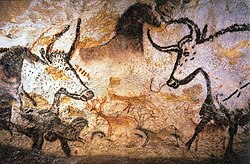
![Art of Lascaux, with painted animal, and four dots, a possible notation for Lunar months[9]](/images/85/32/8532215b85994f3b86ee47cbadeb4bd0a1ae7066f99ef81b5dc52e24e7de3af4.jpg)
- Timeframe: Approximately 50,000 to 12,000 years BP.
- Defining Feature: The appearance of behavioral modernity and diverse artifact production.
- Migration: Humans reached Australia by c. 60 ka, Europe after c. 45 ka, and the Americas by c. 15 ka.
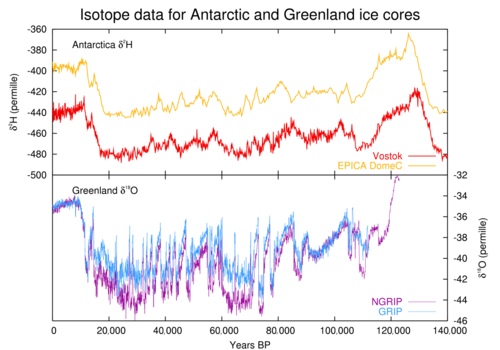
- Climate: Dominated by the Last Glacial Maximum (LGM), a period of extreme cold and lower sea levels.
- Succession: Preceded by the Middle Paleolithic and followed by the Mesolithic (or Epipaleolithic).
Human Migration and Global Expansion
![Layer sequence at Ksar Akil in the Levantine corridor, and discovery of two fossils of Homo sapiens, dated to 40,800 to 39,200 years BP for "Egbert",[10]: e72931 and 42,400–41,700 BP for "Ethelruda"[10]: e72931](/images/e6/f7/e6f7cc1445198b26750ceb17ab25eacef0008baa110a545ad54a4e8351f571a1.jpg)
The spread of Homo sapiens across the globe was a gradual process influenced by climate and geography. Evidence suggests that humans had already reached Australia before 60,000 years ago. Europe was peopled after 45,000 years ago, while others pushed northward into Siberia, reaching the 58th parallel by approximately 45,000 years ago, as evidenced by the Ust'-Ishim man.
![Known archaeological remains in Europe and Africa of anatomically modern humans: directly dated, calibrated carbon dates as of 2013[10]: e72931](/images/4f/3b/4f3b1a2479184291e60123241bd10b79e10831c7ad4575d1b08b3db30b3ac62d.jpg)
The peopling of the Americas occurred during the Last Glacial Maximum (LGM), which lasted from about 25,000 to 15,000 years ago. Populations from East and Central Asia reached the Bering land bridge around 35,000 years ago, eventually expanding into the Americas by 15,000 years ago.
Technological Innovation and Early Mathematics
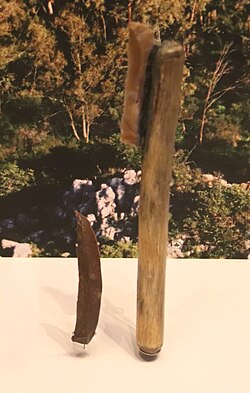
The Upper Paleolithic saw a revolution in tool-making. Early humans transitioned from simple flakes to specialized blades and complex weaponry. For instance, bow and arrow technology was developed in the Fa-Hien Lena cave in Sri Lanka by 48,000 BP, though the earliest known examples date back to 65,000 BP in South Africa's Sibudu Cave.
Beyond survival tools, humans began creating notational signs. The Lebombo bone, found in Eswatini and dated to 44,000–43,000 BP, is considered the earliest mathematical artifact, potentially serving as a tally stick or a lunar calendar.

The Birth of Art and Symbolic Expression
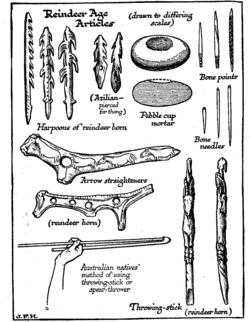
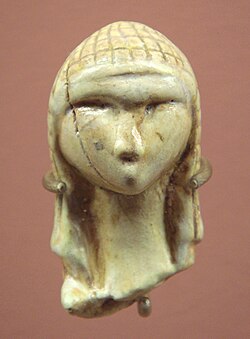
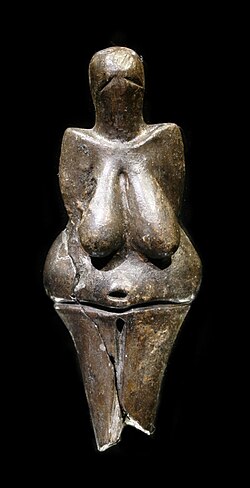
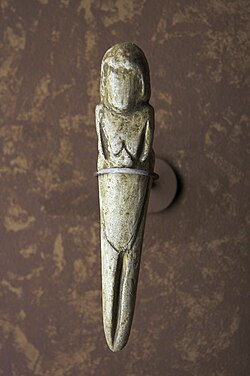
One of the most striking hallmarks of this era is the explosion of symbolic art. This includes ivory sculptures like the 40,000-year-old Löwenmensch (Lion-man) and the Venus figurines, which represent some of the earliest known attempts to depict the human form and mythical creatures.
Cave paintings also flourished, with the Chauvet Cave featuring 30,000-year-old depictions of cave lions and woolly rhinoceroses. Later, the Lascaux cave (c. 15,000 BC) showcased sophisticated animal paintings and possible lunar notations.

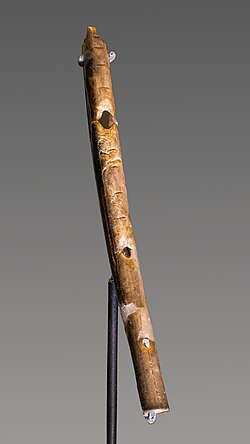
Musical expression also emerged, evidenced by the discovery of bone flutes dating to approximately 35,000 BC.
Climate Shifts and the Transition to the Holocene
The environment of the Upper Paleolithic was volatile. Following the LGM, the earth experienced the cold Oldest Dryas, followed by the warm and moist Bølling–Allerød interstadial (14.7 to 12.9 kya). This was interrupted by the Younger Dryas, a rapid return to sub-arctic conditions in northern Europe.
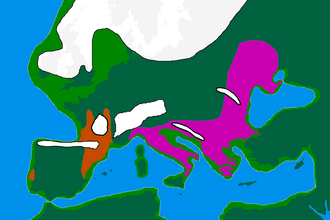
The final retreat of the glaciers began around 11,700 years ago, marking the start of the Holocene epoch. This warming trend led to the end of the Upper Paleolithic and the beginning of the Mesolithic, eventually facilitating the first forms of farming in the Fertile Crescent.
Regional Cultures of the Upper Paleolithic
Different regions developed distinct cultural identities based on their environment and available resources.
| Region | Culture | Approximate Date (BP) |
|---|---|---|
| Franco-Cantabrian | Aurignacian | 43,000 – 26,000 |
| Franco-Cantabrian | Gravettian | 33,000 – 20,000 |
| Franco-Cantabrian | Solutrean | 22,000 – 17,000 |
| Franco-Cantabrian | Magdalenian | 17,000 – 12,000 |
| North Africa | Aterian | 32,000 |
| West Asia | Jabroudian | 50,000 |
| East Asia | Jōmon (Start) | 16,000 |
| Oceania | Whadjuk/Noongar | 40,000 |
Frequently Asked Questions
What is behavioral modernity?
Behavioral modernity refers to a suite of cognitive and behavioral traits—such as the use of complex tools, symbolic art, and structured social organization—that distinguish anatomically modern humans from their ancestors and other hominids.
How did the Last Glacial Maximum affect human settlement?
The Last Glacial Maximum caused sea levels to drop by 110 to 120 meters, creating land bridges (such as the one between Asia and the Americas) that allowed humans to migrate to new continents. However, it also forced populations into smaller, warmer refuges.
What are Venus figurines?
Venus figurines are small prehistoric statuettes of women, such as the Venus of Dolní Věstonice, which is the oldest surviving ceramic figurine in the world (29,000–25,000 BC).
When did the Upper Paleolithic end?
The Upper Paleolithic ended approximately 12,000 years ago, transitioning into the Mesolithic or Epipaleolithic as the Holocene warming began and glacial ice retreated.
Did Neanderthals coexist with modern humans during this time?
Yes. The Châtelperronian culture (45,000 to 40,000 BP) represents a period of overlap between Neanderthals and Homo sapiens. Some evidence suggests Neanderthals persisted in the Iberian Peninsula as late as 37,000 years ago.