UNSW Law Curriculum and Academic Programs
The Law Faculty at UNSW provides a comprehensive legal education through two primary pathways: an undergraduate combined degree and a graduate professional degree. Following an extensive curriculum review, the Faculty implemented a modernized curriculum in 2013 to ensure students receive a rigorous and contemporary legal foundation.
Key Facts
- Two Main Pathways: Offers a combined Bachelor of Laws (LLB) and a graduate Juris Doctor (JD).
- Teaching Style: Utilizes a seminar-format based on the Socratic method (a form of cooperative argumentative dialogue to stimulate critical thinking).
- JD Intensity: Full-time JD students undertake four law subjects per semester.
- Global Reach: Exchange partnerships with over 60 universities worldwide.
- Class Sizes: First-year classes are typically capped at 28 students.
Combined Law Program (LLB)
The combined law program is a five-year undergraduate course of study. It allows students to earn a Bachelor of Laws alongside a Bachelor's degree in another discipline, blending legal expertise with another field of study.
Current Course Structure
For students entering the program currently, the curriculum is distributed as follows:
- Year 1: Introducing Law & Justice, Torts, Principles of Private Law, and five non-law courses.
- Year 2: Crime & the Criminal Process, Criminal Laws, Principles of Public Law, and five non-law courses.
- Year 3: Contracts, Lawyers, Ethics and Justice, Court Process, Evidence & Proof, Equity & Trusts, Administrative Law, and three non-law courses.
- Year 4: Resolving Civil Disputes, Federal Constitutional Law, Business Associations, Law in the Global Context, Land Law, and three non-law courses.
- Year 5: Eight law electives.
Students who commenced their degree before 2019 follow a slightly different distribution, with non-law courses spread across the first four years (six in Year 1, four in Year 2, four in Year 3, and two in Year 4) before completing eight law electives in their final year.
Juris Doctor (JD) Program
The Juris Doctor is a three-year graduate-entry law degree designed for students who already hold an undergraduate degree in another field. Unlike the combined LLB, the JD is an intensive program where full-time students take a full load of four law subjects every semester.
JD Curriculum Roadmap
- Year 1: Core foundations including Introducing Law & Justice, Crime & the Criminal Process, Principles of Private Law, Principles of Public Law, Torts, Criminal Laws, Contracts, and Lawyers, Ethics & Justice.
- Year 2: Advanced core subjects such as Law in the Global Context, Resolving Civil Disputes, Equity & Trusts, Administrative Law, Legal Theory (or Law & Social Theory/Theories of Law & Justice), Court Process, Evidence & Proof, Land Law, and Federal Constitutional Law.
- Year 3: Business Associations and seven law electives.
JD students select their electives from postgraduate subjects, including those offered in the Master of Laws (LL.M). While core subjects are taught exclusively within the JD cohort, postgraduate electives are taken with other postgraduate students, and standard electives may be taken alongside undergraduate dual law students.
It is noted that the program has previously faced criticism regarding over-enrollment, with reports of students attempting to pay significant sums—up to $10,000—to secure spots in classes.
Class Format and Pedagogy
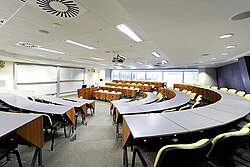
The Law Faculty diverges from the traditional lecture-and-tutorial system common in the UK and some other Australian institutions. Instead, it employs a seminar-format.
In this model, students complete required readings before class. Class time is then dedicated to the critical exploration of the material through the Socratic method, where teachers use questioning to lead students to discover legal principles. While the intensity of this questioning varies by instructor, the goal is to examine the complexities of the law rather than simply deliver information.
Class Size Distribution
| Year Level | Typical Maximum Capacity | Notes |
|---|---|---|
| First Year | 28 students | Standard cap for introductory courses |
| Upper Year (Most) | 44 students | Standard seminar size |
| Upper Year (Select) | 90 students | Applicable to specific high-capacity courses |
International Opportunities
UNSW Law maintains a strong global presence, offering subjects taught at prestigious overseas institutions through specific arrangements. These include Columbia Law School, UC Berkeley School of Law, and Shanghai Jiao Tong University.
Additionally, students can participate in exchange programs at over 60 universities worldwide, including:
- Europe: Sciences Po, Panthéon-Assas University, University College London, and Tilburg University.
- North America: McGill University.
- Asia: National University of Singapore, University of Hong Kong, Tsinghua University, and Peking University.
Frequently Asked Questions
What is the difference between the LLB and JD programs?
The LLB is a five-year combined undergraduate degree taken alongside another discipline, while the JD is a three-year graduate-entry degree for those who already hold a degree. The JD is more intensive, requiring four law subjects per semester for full-time students.
How does the Socratic method work in UNSW Law classes?
Instead of passive listening to lectures, students read materials beforehand and engage in a dialogue-based seminar. Teachers ask probing questions to challenge students' understanding and encourage critical analysis of legal complexities.
Can JD students take the same electives as LLB students?
Yes. While JD students often take postgraduate electives (such as those from the LL.M), they may also choose standard electives, which are taught alongside the undergraduate dual law cohort.
What are the typical class sizes for law students?
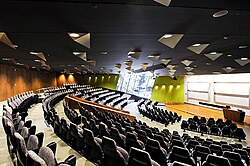
First-year classes are generally limited to 28 students. Most upper-year classes cap at 44 students, although some specific courses may accommodate up to 90 students.
Which international universities are available for exchange?
UNSW Law has partnerships with over 60 universities, including University College London, National University of Singapore, McGill University, and Peking University, among others.