University of Königsberg: The Legacy of the Albertina
The University of Königsberg, historically known as the Albertina, stands as one of the most influential intellectual centers in European history. Founded in the 16th century, it served as a beacon of Protestant scholarship and a catalyst for the Enlightenment, shaping the minds of philosophers, mathematicians, and statesmen for four centuries.
The Foundation of the Albertina
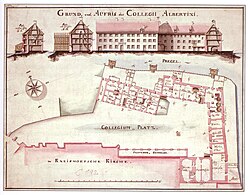
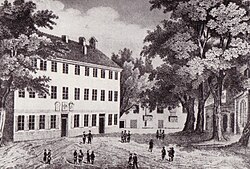
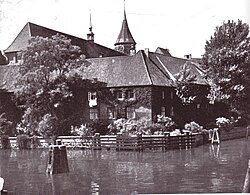
The university's origins trace back to Albert, the former Grand Master of the Teutonic Order and the first Duke of Prussia. In 1542, Albert established an academic gymnasium on the island of Kneiphof, located behind the Königsberg Cathedral. This paved the way for the official deed of foundation of the Collegium Albertinum on July 20, 1544, with the university formally inaugurating on August 17 of that year.
As the Protestant duchy was a fiefdom of the Kingdom of Poland, the Albertina was designed as a Lutheran counterpart to the Catholic Kraków Academy. Its first rector was the poet Georg Sabinus, and early professors included Lithuanian scholars Stanislovas Rapalionis and Abraomas Kulvietis. Because the institution operated outside the Holy Roman Empire, it lacked approval from Emperor Charles V and Pope Paul III, but it received royal privilege from King Sigismund II Augustus of Poland in 1560.
Growth and Intellectual Influence
By the 17th century, the Albertina had become the intellectual heart of Protestant Brandenburg-Prussia. It initially offered four colleges: Theology, Medicine, Philosophy, and Law, later expanding to include the natural sciences. While many Hohenzollern royals served as rectors for prestige, academic affairs were typically managed by a prorector.
The university gained significant popularity during the Thirty Years' War, as the Prussian lands remained largely untouched by the conflict. This period saw the rise of poets like Simon Dach and attracted international attention. In 1697, Tsar Peter I of Russia visited the university, sparking a relationship that led many Russian officials to study cameralist theory—the science of public administration—at the Albertina, which subsequently influenced the governance of the Russian Empire.
The institution also played a pivotal role in the development of Lithuanian culture; the first book written in the Lithuanian language was printed in Königsberg in 1547. Additionally, the university was the primary educational choice for the Baltic German nobility.
The Königsberg Century and the Enlightenment
The 18th century is often referred to as the "Königsberg Century," a golden age of the Enlightenment. This era was sparked by Johann Christoph Gottsched and furthered by Johann Georg Hamann and Theodor Gottlieb von Hippel the Elder. The most towering figure of this period was Immanuel Kant, who served as rector in 1786 and 1788.
Alongside Kant, alumni such as Johann Gottfried Herder and E. T. A. Hoffmann helped lay the groundwork for German Romanticism and Weimar Classicism. The university's commitment to science expanded in the 19th century with the 1811 inauguration of a magnificent botanical garden and the 1813 establishment of an observatory by Friedrich Wilhelm Bessel.
A Powerhouse of Mathematics and Science
The Albertina became world-renowned for its school of mathematics, founded by Carl Gustav Jacobi. This legacy was carried forward by giants such as David Hilbert and Hermann Minkowski (the teacher of Albert Einstein). In 1868, Alfred Clebsch and Carl Gottfried Neumann founded Mathematische Annalen, which became the era's most influential mathematical journal.
Other distinguished professors included the biologist Karl Ernst von Baer, the mineralogist Franz Ernst Neumann, and the physicist Hermann von Helmholtz.
Architecture and the Final Years
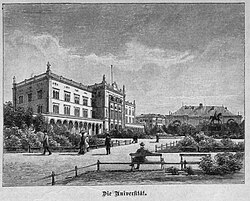
To celebrate its 300th anniversary in 1844, King Frederick William IV laid the foundation for a new main building. Completed in 1862, this neo-Renaissance structure featured a facade with an equestrian relief of Albert of Prussia and statues of Martin Luther and Philipp Melanchthon. The interior boasted a marble staircase, a Senate Hall with a bust of Immanuel Kant, and a grand Aula adorned with frescoes.
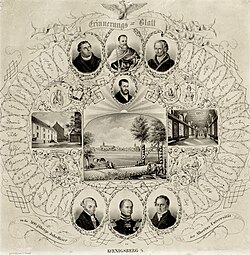
By 1900, the university enrolled 900 students and maintained a library of over 230,000 volumes. However, following the Treaty of Versailles, the university's atmosphere shifted toward German nationalism. This era ended tragically during World War II. Between August 1944 and April 1945, RAF bombing raids and the Red Army's East Prussian Offensive devastated the city. By the time of the capitulation on April 9, 1945, 80% of the university campus was in ruins.
Key Facts
- Founded: July 20, 1544, by Duke Albert of Prussia.
- Core Disciplines: Originally Theology, Medicine, Philosophy, and Law.
- Famous Alumni/Faculty: Immanuel Kant, David Hilbert, and Hermann von Helmholtz.
- Cultural Impact: Site of the first Lithuanian-language book (1547).
- Destruction: 80% of the campus was destroyed during WWII by 1945.
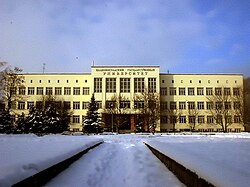
- Successor: Now continues as the Immanuel Kant Baltic Federal University.
| Period | Key Milestone | Significant Figure/Event |
|---|---|---|
| 16th Century | Foundation | Duke Albert / Lutheranism |
| 17th Century | International Reach | Tsar Peter I / Cameralist Theory |
| 18th Century | The Enlightenment | Immanuel Kant |
| 19th Century | Scientific Peak | David Hilbert / Mathematical Annalen |
| 20th Century | Destruction & Rebirth | WWII / Kaliningrad State University |
Frequently Asked Questions
Who founded the University of Königsberg?
The university was founded by Albert, the first Duke of Prussia and former Grand Master of the Teutonic Order, who issued the deed of foundation on July 20, 1544.
What was the "Königsberg Century"?
The "Königsberg Century" refers to the 18th-century heyday of the Enlightenment at the university, led by figures such as Immanuel Kant, Johann Christoph Gottsched, and Johann Georg Hamann.
Why was the university important for Russian administration?
Following the visit of Tsar Peter I in 1697, many Russian officials studied cameralist theory and administrative practices at the Albertina, which helped shape the Russian government.
What happened to the university during World War II?
The university was extensively bombed by the Royal Air Force in August 1944 and further devastated during the Battle of Königsberg in 1945, leaving 80% of the campus in ruins.
What is the university called today?
After resuming work in 1947 as the Kaliningrad State Pedagogical Institute and later becoming Kaliningrad State University, it is now the Immanuel Kant Baltic Federal University.