University of Edinburghancient universityhigher education ScotlandRussell GroupEdinburgh campuses

University of Edinburgh: A Legacy of Academic Excellence and Innovation

University of Edinburgh: A Legacy of Academic Excellence and Innovation The University of Edinburgh (Latin: Universitas Academica Edinburgensis) stands as one of the world's most prestigi...

University of Edinburgh: A Legacy of Academic Excellence and Innovation

The University of Edinburgh (Latin: Universitas Academica Edinburgensis) stands as one of the world's most prestigious public research institutions. As an ancient university established in 1583, it has spent over four centuries at the forefront of global intellectual development, blending a rich historical heritage with cutting-edge modern research.

From its early days as Tounis College and King James' College to its current status as a global powerhouse, the university continues to attract the brightest minds from across the globe. Today, it is recognized not only for its academic rigor but also for its significant contributions to science, medicine, and the arts.
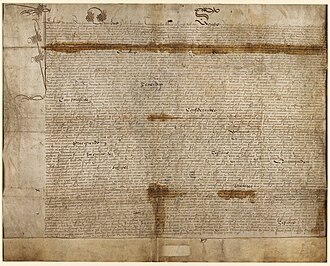
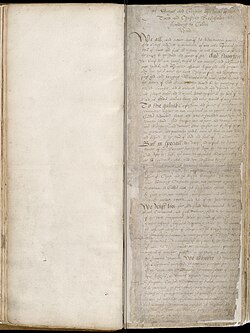
piece of parchment of charter of novodamus from King James VI of Scotland in 1582
A Charter of Novodamus from King James VI of Scotland in 1582, to establish a college

Key Facts

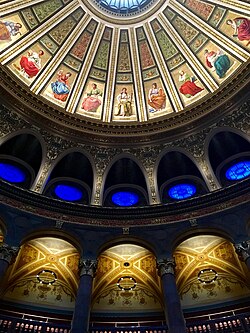
Interior dome of the McEwan Hall after restoration in 2017
  • Established: 1583
  • Type: Public research university (Ancient university)
  • Student Population: 39,015 (2024/25), including 25,790 undergraduates and 13,225 postgraduates
  • Financials: Endowment of £604.8 million (2025) and a budget of £1.437 billion (2024/25)
  • Global Standing: Ranked 29th in THE (2026) and 35th in QS (2027)
  • Leadership: Anne, Princess Royal (Chancellor), Simon Fanshawe (Rector), and Sir Peter Mathieson (Principal and Vice-Chancellor)

Academic Structure and Governance
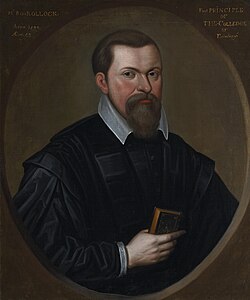
Robert Rollock, Regent (1583–1586) and first principal (1586–1599) of the University of Edinburgh

The university is organized into three primary colleges, ensuring a comprehensive approach to higher education and specialized research:

  • College of Arts, Humanities & Social Sciences: Encompassing the Business School, Edinburgh College of Art, and schools of Law, Divinity, and Philosophy.
  • College of Medicine & Veterinary Medicine: A world-renowned hub for healthcare and veterinary research.
  • College of Science & Engineering: Home to the School of Informatics, Physics and Astronomy, and Chemistry.

Governance is managed through the University Court, the General Council, and the Senatus Academicus, ensuring a balance of administrative oversight and academic freedom.
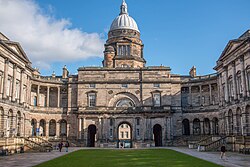
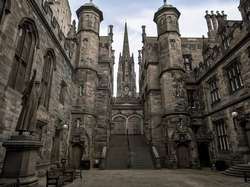
Old College Quadrangle

Campuses and Architectural Heritage

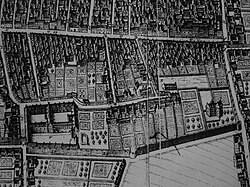
Main buildings of King James' College in 1647, lying in a double courtyard on the lower left

The university operates across five main sites in Edinburgh, blending historic landmarks with state-of-the-art facilities. The Central Area is the heart of the institution, featuring the iconic Old College and the magnificent McEwan Hall.

Other key sites include the King's Buildings, the BioQuarter, Easter Bush, and the Western General. The architecture reflects the university's evolution, from the neoclassical facades of the 19th century to the modern glass and steel of the Informatics Forum.
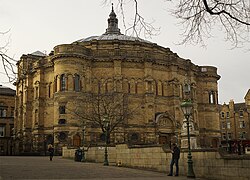
Exterior of the McEwan Hall

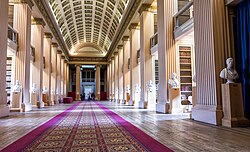
Notable buildings include the Playfair Library Hall and the Edinburgh Futures Institute, the latter housed in the restored Royal Infirmary of Edinburgh.
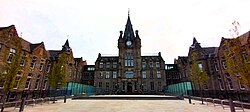
Edinburgh Futures Institute in the restored Royal Infirmary of Edinburgh

Academic Profile and Admissions

Frontispiece to earliest laureation (graduation) register (1587)

The University of Edinburgh is highly competitive, seeing a significant volume of applications annually. In 2025, the university received 68,862 applications, resulting in an offer rate of 52.6%.

The student body is diverse, with a strong international presence. Approximately 36% of students are international non-EU citizens, while 47% are British White and 11% are British Ethnic Minorities.

University Admissions Trends (2021–2025)
Year Applications Offers Offer Rate (%) Enrols
2025 68,862 36,195 52.6 7,626
2024 66,293 31,132 47.0 7,302
2023 69,377 27,608 39.8 6,409
2022 75,438 25,210 33.0 6,111
2021 68,954 32,432 47.0 8,083

Notable Alumni and Intellectual Impact
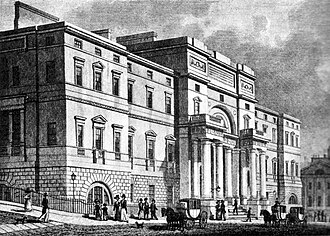
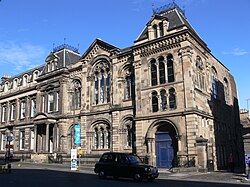
The east facade of Old College facing onto South Bridge, as built in 1827. A dome similar to Adam's original design was added in 1887 by Sir Robert Rowand Anderson.

The university's impact on global knowledge is evidenced by its long list of distinguished alumni and faculty. In the sciences, it has been associated with 20 Nobel or Nobel-equivalent prizes across Physics, Chemistry, Physiology or Medicine, Economics, and Peace.

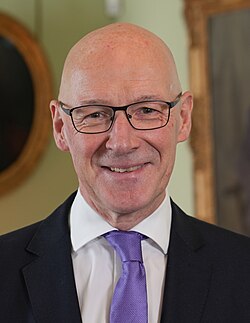
Prominent figures include Peter Higgs (Nobel Prize in Physics, 2013) and Max Born (Nobel Prize in Physics, 1954). Beyond the sciences, the university has produced influential leaders such as former UK Prime Minister Gordon Brown and current First Minister of Scotland John Swinney.

Peter Higgs, faculty at Edinburgh since 1960 and Emeritus Professor after 1996, was awarded the Nobel Prize in Physics in 2013.[411]

Historical alumni include the naturalist Charles Darwin, the geologist James Hutton, and the mathematician James Clerk Maxwell, all of whom fundamentally altered our understanding of the natural world.

Student Life and Community
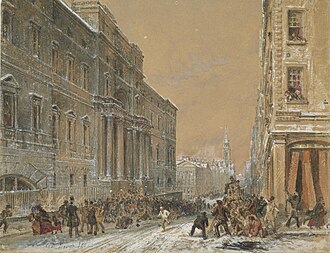
Snowballing Outside Edinburgh University (1853) - Samuel Bough
Snowballing Outside Edinburgh University (1853) – Sam Bough

Student life at Edinburgh is vibrant and multifaceted. The Edinburgh University Students' Association (EUSA) oversees a wide array of activities, from the student-run Bedlam Theatre to the EMUS Symphony Orchestra.

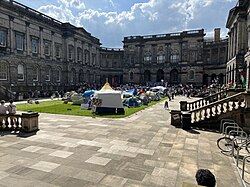
The university also fosters a supportive environment through various networks, including the Staff Pride Network, the Jewish Staff Network, and the Edinburgh Race Equality Network. Student activism is also a notable part of the campus culture, as seen in recent encampments and protests regarding global issues.
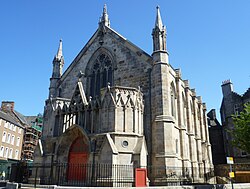
The student-run Bedlam Theatre, home to the Edinburgh University Theatre Company

Frequently Asked Questions
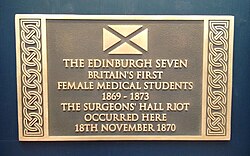
Plaque commemorating the Edinburgh Seven at the Royal College of Surgeons of Edinburgh
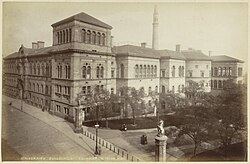
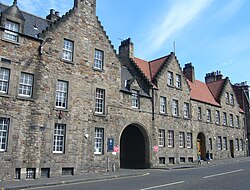
Buildings of the Old Medical School at Teviot Place, photographed in the late 19th century
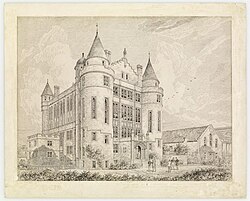
Teviot Row House, drawn by architect Sydney Mitchell in 1888
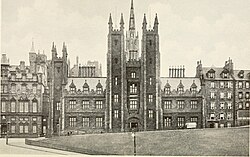
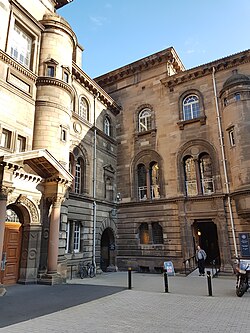
Facade of New College facing onto The Mound in 1910
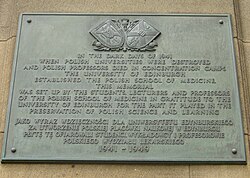
Plaque honouring the Polish School of Medicine at the old Medical School
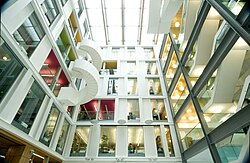
Atrium of the Informatics Forum
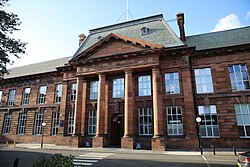
Edinburgh College of Art
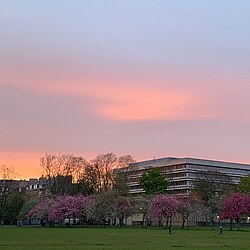
The Main Library viewed from The Meadows
New College
New College
St Leonard's Hall
St Leonard's Hall
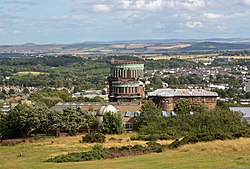
Royal Observatory, Edinburgh
Edinburgh BioQuarter
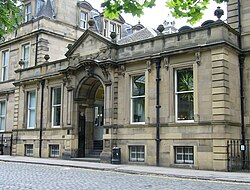
Department of Psychology building at 7 George Square
Elsie Inglis Quad at the Old Medical School, currently hosting the School of History, Classics and Archaeology
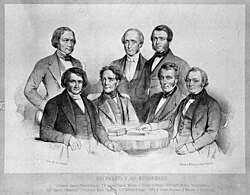
Members of the medical faculty at Edinburgh in the first half of the 19th century. Seated (L–R): J. Y. Simpson, J. Miller, J. H. Balfour and J. H. Bennett. Standing (L–R): R. Jameson, W. Alison and T. S. Traill.
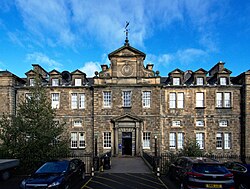
Old Surgical Hospital in Drummond Street, once part of the Royal Infirmary, today houses the university's Institute of Geography.
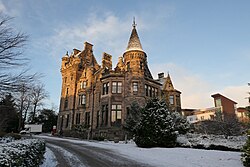
Minto House, housing the School of Architecture and Landscape Architecture
Staff Pride Network bannerPride Edinburgh parade, 2024.[197]
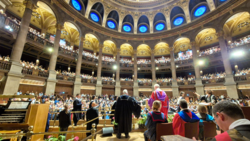
Graduation ceremony in McEwan Hall, 2025.
Playfair Library Hall in Old College
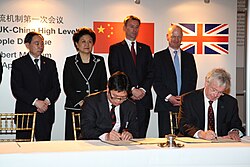
The former principal Sir Timothy O'Shea signed an agreement with Peking University in 2012.
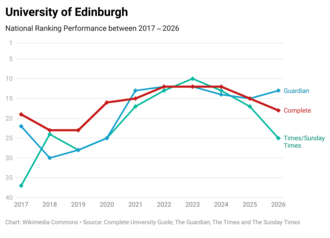
University of Edinburgh's national league table performance over the past ten years
The Pleasance, one of EUSA's main buildings, is a theatre, bar, sports and recreation complex.
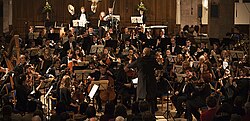
EMUS Symphony Orchestra, performing Mahler's Symphony No. 1 at Greyfriars Kirk
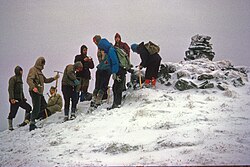
Edinburgh University Mountaineering Club at the cairn on Ciste Dhubh, 1964
Edinburgh University student Gaza protest, Old College Quad encampment, May 2024.
Max Born, Tait Professor of Natural Philosophy at Edinburgh from 1936 to 1953, was awarded the Nobel Prize in Physics in 1954.[410]
Gordon Brown, former Prime Minister and consecutive 10-year-long Chancellor of the Exchequer, is an alumnus (MA '72, PhD '82) and former rector.[427]
John Swinney, current First Minister of Scotland, is an alumnus (MA '86).

When was the University of Edinburgh founded?

The university was established in 1583, making it one of the ancient universities of the UK.

What are the main campuses of the university?

The university has five main sites: the Central Area, King's Buildings, BioQuarter, Easter Bush, and the Western General.

How is the university ranked globally?

The university is consistently ranked among the top institutions worldwide, placing 29th in the Times Higher Education (THE) 2026 rankings and 35th in the QS 2027 rankings.

Who are some of the most famous alumni?

Notable alumni include Charles Darwin, James Clerk Maxwell, Gordon Brown, and John Swinney, as well as numerous Nobel laureates like Peter Higgs.

What is the current student population?

For the 2024/25 academic year, the university has 39,015 students, consisting of 25,790 undergraduates and 13,225 postgraduates.

References

  1. The maximum tariff score for three exams is 168: the equivalent of A*A*A* at A-Level, 777 at HL for the IB Diploma Programme, or AAA at Advanced Higher
  2. HESA numbers given here are significantly lower than those reported by the university, since HESA does not include non-graduating and visiting students, postgraduates writing up, and online learning students living abroad.[7]
  3. Not be confused solely with White British
  4. Includes those who indicate that they identify as Asian, Black, Mixed Heritage, Arab or any other ethnicity except White.
  5. Calculated from the Polar4 measure, using Quintile1, in England and Wales. Calculated from the Scottish Index of Multiple Deprivation (SIMD) measure, using SIMD20, in Scotland.